New Arrivals — Browse our catalog for the latest authentic Japanese sword arrivals. Browse →
1467–1477 (Ōnin 1 – Bunmei 9)
Kyoto
Forces
Eastern Army
Western Army
About 8 min read
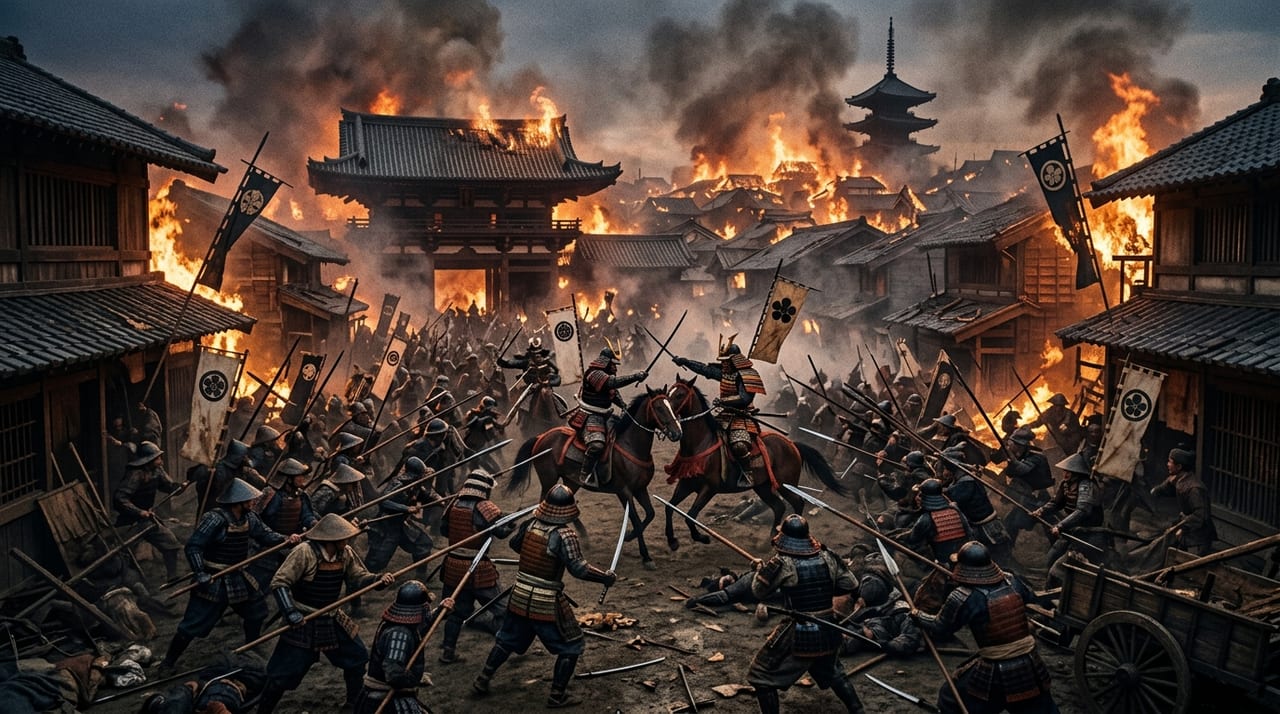
The Ōnin War (1467–1477) was a great upheaval that hollowed out the Muromachi shogunate and pulled Japan into roughly a century of the Sengoku (Warring States) period. Its origins lay in the succession question within the shogunal house and in power struggles among the shugo daimyō. The influence this eleven-year conflict had on sword culture, however, was immeasurably great.
The eighth shogun, Ashikaga Yoshimasa, had long had no heir and had named his younger brother Yoshimi as his successor. However, when Yoshimasa's wife, Hino Tomiko, bore a son (later Yoshihisa), the succession question of the shogunal house became complicated. Power struggles among the shugo daimyō became entangled with it. Kanrei (shogunal deputy) Hosokawa Katsumoto and the powerful western leader Yamana Sōzen (Mochitoyo) became the axis of the conflict, and they clashed in Kyoto in Ōnin 1 (1467).
The urban fighting centered on Kyoto brought unprecedented demand for swords to Japan's sword culture. In this war, large numbers of lower-ranking foot soldiers called ashigaru were mobilized, and the main weapon shifted from the naginata, suited to individual combat, to the yari (spear), suited to group fighting. The move from one-on-one combat to group tactics advanced rapidly.
Meeting this demand was the sword-producing region clustered around Osafune in Bizen Province (present-day southeastern Okayama Prefecture). Known as "Bizen Osafune," this region shifted to a mass-production system after the Ōnin War. Smiths of the Osafune school produced large quantities of practical mass-produced blades called kazu-uchi-mono and supplied them to military commanders, ashigaru, and rural warriors across the country. Blades of this period, generally called Sue-Bizen, fell short of the masterpieces of the Kamakura and Nanbokuchō periods in refinement. In practical usability and volume of circulation, however, they were unmatched by any other producer.
The ruin of Kyoto also dealt a heavy blow to the Yamashiro-school smiths, who were tied to court culture.
Meanwhile, smiths of Mino Province (present-day Gifu Prefecture) rose rapidly in the wake of the Ōnin War. The Mino tradition (Mino-den) is characterized by practical construction that resists breaking, which suited the battlefields of an age of disorder. Seki in Mino (present-day Seki, Gifu Prefecture) flourished as a sword-producing center. Together with Bizen Osafune, it became one of the two great centers of Japanese swordmaking in the Sengoku period after the Ōnin War. This rise of the Mino smiths was precisely the structural change in the sword industry that the Ōnin War gave birth to.
The sharp rise in demand inevitably brought a decline in quality. Swords mass-produced after the Ōnin War varied in workmanship, and later connoisseurs graded them as sue-kotō and kazu-uchi-mono. Between the works of the celebrated Kamakura-period smiths Masamune and Yukimitsu and the mass-produced blades of the Sengoku period, there was a large gap in both technique and aesthetics.
But this era holds a notable paradox. Because demand for swords soared explosively, skilled smiths also gained more opportunities to hone their craft. A market principle began to take hold: "good work sells." This created a competitive environment in which capable smiths could win more orders. It can be said that this competition supported the later development of sword technology in the Sengoku period.
After the war ended, Ashikaga Yoshimasa built a villa in Higashiyama (present-day Sakyō Ward, Kyoto), later Ginkaku-ji (the Silver Pavilion), and nurtured a refined culture known as Higashiyama culture. Ironically, the Ōnin War, which reduced the capital to ruins, also became the occasion for the ultimate form of beauty: the Higashiyama culture that blossomed on those ruins. Noh, the tea ceremony, flower arranging, and shoin-zukuri architecture were all refined in this period.
The Ōnin War is remembered as the event that "opened the door" to the Sengoku period. In sword history, however, it was a turning point that brought about a transformation: the formation of production centers and the establishment of a mass-production system.
応仁の乱後、備前長船から台頭した「祐定」を名乗る刀工集団は、戦国期の膨大な刀剣需要を支える量産体制「数打ち物」を築いた。その実態と鑑定上の難しさを解説する。
2026-09-23
応仁の乱(1467〜77年)を境に、戦国時代の主役となった「足軽」の武装実態を解明する。足軽が実際に携行した刀の種類・品質・入手経路と、数打ち刀(大量生産刀)の普及が刀剣業界にもたらした構造変化を時代史とともに論じる。
2026-05-12
応仁の乱を経た文明・延徳期、京都の刀工が各地に散り、備前長船に優秀な職人が集中した歴史的経緯と技術的変容を解説する。
2026-05-11
日本刀の「五箇伝」——備前・相州・大和・美濃・山城——は室町時代に体系化された地域的鍛刀流派の集大成である。それぞれの技法的特徴・代表刀工・歴史的背景を解説し、五箇伝が現代の刀剣鑑定に与える影響を考察する。
2026-04-30