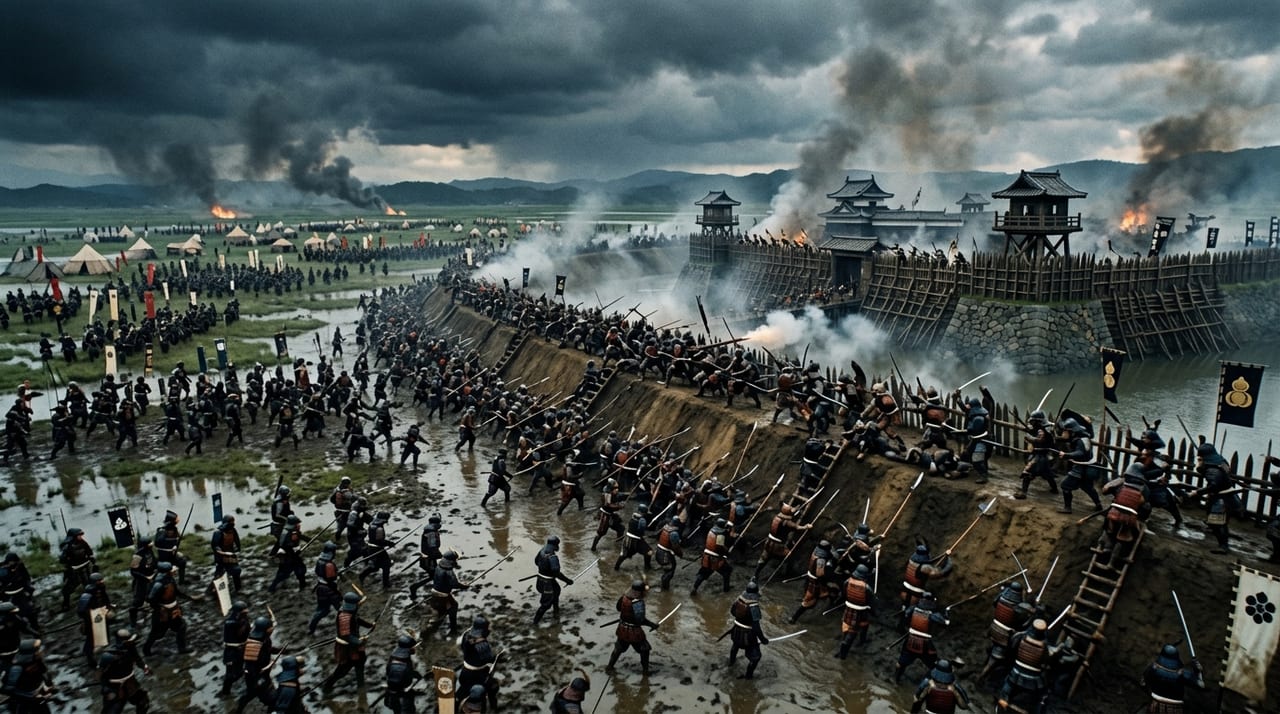
Ashikaga Takauji Appointed Seii Taishogun: The Muromachi Shogunate
1338 (Ryakuo 1 / Engen 3)
Kyoto
- Date
- 1338 (Ryakuo 1 / Engen 3)
- Location
- Kyoto
- Result
- Takauji became shogun and the Kyoto-based Muromachi shogunate was formally established; it lasted roughly 240 years.
About 8 min read
Overview
In 1338 (Ryakuo 1 / Engen 3), Ashikaga Takauji was appointed seii taishogun and became the founder of the Ashikaga shogunal house. The Muromachi shogunate was a warrior government seated in Kyoto, named after the Hana no Gosho (Muromachi-dono) palace built by the third shogun, Ashikaga Yoshimitsu. Its effective establishment is dated to 1336 (Kenmu 3), when the Kenmu Shikimoku setting out its political policy was issued, and Takauji's appointment as shogun in 1338 made that regime official. The shogunate lasted until 1573, when Ashikaga Yoshiaki was driven out of Kyoto by Oda Nobunaga (some take Yoshiaki's formal resignation in 1588 as the end).
Background
After the fall of the Kamakura shogunate, Emperor Go-Daigo began the Kenmu Restoration, but the expectations of the warriors diverged from the realities of the regime, and Takauji came into conflict with the emperor. In 1336 Takauji drove Go-Daigo out of Kyoto and installed Emperor Komyo. Go-Daigo later based himself at Yoshino, and the Nanbokucho period began, with the Northern Court in Kyoto and the Southern Court at Yoshino standing side by side.
In that year Takauji issued the Kenmu Shikimoku, which set out the basic direction of the new government in articles and has the character of the Muromachi shogunate's political program. At the time of the Shikimoku, however, Takauji had not yet been appointed seii taishogun.
Course of Events
In 1338 (Ryakuo 1 / Engen 3; some sources write Kenmu 5) Takauji was appointed seii taishogun. The office was the position by which the court recognized the head of the warriors, and it brought his regime into form as a shogunate in both name and substance. Because era names differ between the Northern and Southern Courts, citing the Western year 1338 avoids confusion.
Even after the shogunate's founding, conflict with the Southern Court continued. The shogunate's structure was not one in which the shogun directly commanded all retainers; instead, provincial warriors called shugo governed the regions, their legitimacy supported by appointment from the shogun, giving it the character of a coalition. This arrangement later encouraged the growth of the shugo daimyo.
Connection to the Sword
The founding of the Muromachi shogunate falls in the Nanbokucho period of Japanese sword history. Exceptionally long tachi are known from this era, reflecting the demands of a society at war. In a warrior society headed by the shogun, swords were both the emblem of the samurai and important gifts expressing bonds of lord and vassal.
The Ashikaga house is also spoken of in connection with famous swords in later periods. For example, the thirteenth shogun, Ashikaga Yoshiteru, is said to have fought with swords in his possession when he was killed in 1565 (Eiroku 8). That, however, occurred more than two centuries after Takauji's appointment, and the provenance of individual swords must be checked with the holding museums and scholarly works. Because no reliable source linking Takauji's appointment to a specific sword was confirmed, no such claim is made here.
Impact
Takauji's appointment fixed a new political form: a warrior government seated in Kyoto. Whereas the Kamakura shogunate was based in the east, the Muromachi shogunate was based in Kyoto, where the imperial court stood. The deepening exchange between court nobles and warriors is commonly explained as a background to the later Muromachi culture.
Under the third shogun, Yoshimitsu, the Northern and Southern Courts were reunited (the Meitoku Accord) and the shogunate reached its height. When the sixth shogun, Yoshinori, was killed in the Kakitsu Incident of 1441, however, shogunal authority declined and real power passed to the Hosokawa and Miyoshi clans.
Assessment and Legacy
The Muromachi shogunate was a warrior government lasting some 240 years, and its starting point is Takauji's appointment in 1338. Views differ on whether its founding should be dated to the promulgation of the Kenmu Shikimoku in 1336 or to the appointment as shogun in 1338. Both carry historical weight, so this entry treats them as two stages: the presentation of policy, and its formalization through office.
Assessments of Takauji's character and of his conflict with Go-Daigo vary among scholars. This entry restricts itself to facts whose dates can be confirmed and avoids definitive judgments in the evaluative portions.