Ashigaru and Swords in the Mid-Muromachi Period — The Real Armament of Ashigaru after the Ōnin War and the Spread of Kazuuchi-tō
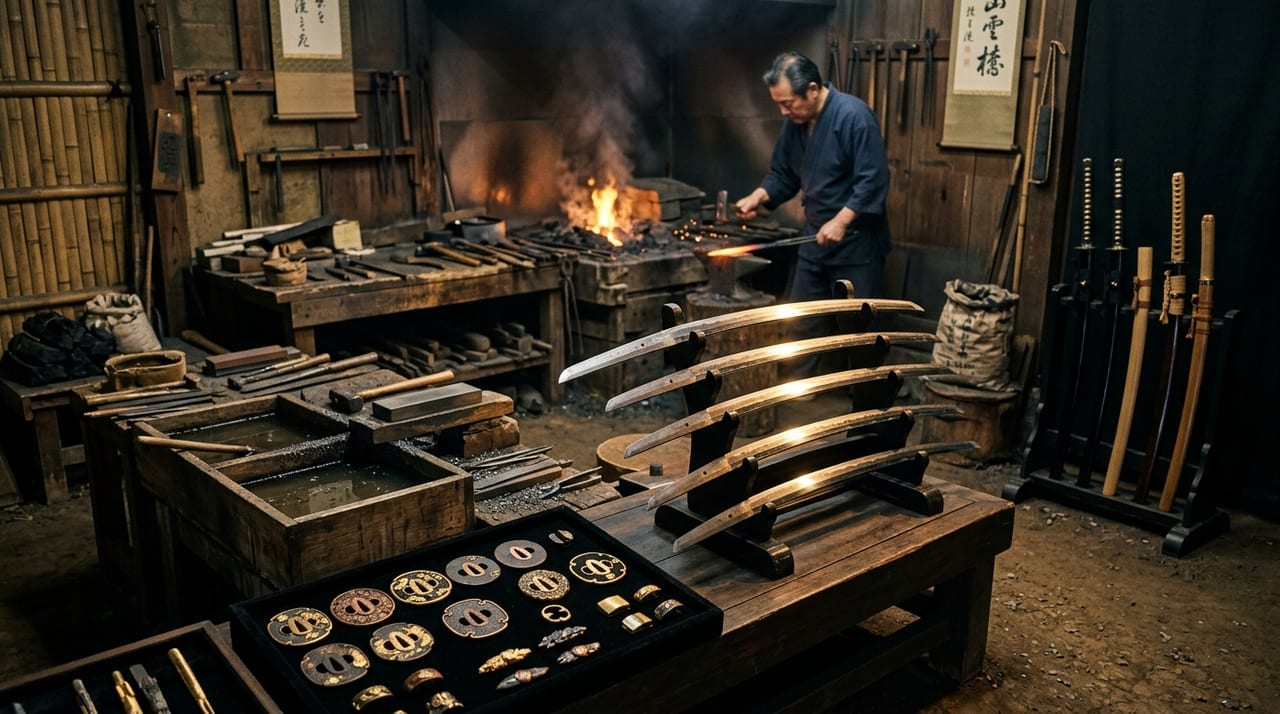 * Image is for illustrative purposes only.
Table of Contents
The Ōnin War and the Change of the "Main Actors of War"
The Ōnin War, which broke out in Ōnin 1 (1467), was an unprecedented civil conflict that turned Kyoto into a battlefield for eleven years. One of the greatest changes this upheaval brought to Japanese military history was the rise of the ashigaru (foot soldiers).
Battles in the Heian, Kamakura, and early Muromachi periods centered on mounted combat led by bushi (warriors). Mounted archers held the initiative, and infantry soldiers often played only a supporting role. However, the prolonged, urban street fighting of the Ōnin War demonstrated the effectiveness of the agile ashigaru. Moving about in light armor, the ashigaru grew increasingly prominent as forces responsible for arson, pillaging, and small-scale surprise attacks.
This change fundamentally altered the structure of demand for swords. Until then, swords made for bushi were primarily chumon-uchi (custom-made swords), in which a single tōkō carefully took his time to forge a single blade. However, in order to arm ashigaru with swords, large-scale, low-cost, and rapid production became indispensable. This is considered the full-scale beginning of the kazuuchi-tō (mass-produced sword) production system (see also What are kazuuchi-tō?).
The Armament of Ashigaru — What They Actually Carried
The armament of ashigaru has been partially reconstructed from war chronicles, illustrated scrolls, and excavated materials. The typical equipment of an ashigaru was roughly as follows.
- Primary weapon: Yari (spears) were most common. After the Ōnin War, the primary weapon of ashigaru units is said to have shifted from the bow to the yari. Yari were inexpensive to produce and could be handled with relatively simple training, making them suitable for supplying to large ashigaru forces.
- Sword as a secondary weapon: The swords worn by ashigaru carried a different meaning from those worn by bushi. Their uses are said to have primarily been as "a last resort when a yari was broken or lost" and "for taking the heads of defeated enemies." For this reason, it is thought that practicality — durability, ease of handling, and sharpness — was prioritized over artistic quality.
- Quality of swords: Kazuuchi-tō were central to the swords used by ashigaru. In the sword-producing regions of Bizen (Okayama Prefecture) and Mino (Gifu Prefecture), mass-production systems for kazuuchi-tō are said to have become established after the Ōnin War. Unlike chumon-uchi, which required months per blade from a single master tōkō, kazuuchi-tō were produced in a short time at low cost through division of labor and simplification of processes.
The Production System for Kazuuchi-tō — Changes in the Workshops of Bizen and Mino
The most important major production centers for kazuuchi-tō were Bizen (the Seto Inland Sea region of Okayama Prefecture) and Mino (the Seki and Mino region of Gifu Prefecture).
The Bizen mass-production system: The group of tōkō centered on Osafune in Bizen had been known for its high volume of sword production even before the Ōnin War. After the Ōnin War, a shift is said to have progressed from a system in which a small number of craftsmen produced fine pieces to one in which multiple craftsmen produced quantities through division of labor (discussed in detail in The Ōnin-Bunmei War and the Sword Industry).
Bizen kazuuchi-tō were known as "Bizen-mono (Bizen pieces)," and although quality varied, it is thought that basic cutting ability and durability were ensured. Because they could be supplied in large quantities, Bizen became one of the major suppliers when Sengoku daimyo procured full sets of armaments for their ashigaru forces.
The Mino mass-production system: The tōkō of Mino Province (present-day Seki City, Gifu Prefecture and surroundings) are known as Seki kaji (Seki smiths). Mino-den tōkō were known for superior cutting ability and a distinctive style of hamon (in particular the sanbonsugi hamon), but are said to have maintained high output even under the mass-production system (Kanemoto (Magoroku Kanemoto) is a representative example of the sanbonsugi hamon: Kanemoto (Magoroku Kanemoto)). It is said that Mino swords also circulated among warriors of the eastern provinces.
Ashigaru Sword Acquisition Routes — Battlefield Plunder and Market Purchase
Ashigaru are said to have had multiple routes for obtaining swords.
- Supply from daimyo: Cases have been confirmed in which daimyo placed large orders for kazuuchi-tō with sword-producing regions and distributed them to ashigaru. This "arms supply" served the dual purpose of securing ashigaru loyalty and equipping the forces. It is also said that in some cases the daimyo's family crest was engraved on the supplied swords, or a specific mei was cut, to "identify the owner."
- Bundori (battlefield seizure): Taking weapons from defeated enemies on the battlefield — bundori — was one of the important sources of income for ashigaru. It is said that defeating a notable bushi allowed one to obtain a high-quality sword, which could then be sold for cash income.
- Market purchase: During the Sengoku period, merchants and markets dealing in swords developed throughout the country. For ashigaru of farming village origin, it was also common to use supplemental income from the farming off-season to purchase swords. Most swords circulating in the market are thought to have been kazuuchi-tō or used swords in poor condition.
Ashigaru Armament and Structural Changes in the Sword Industry
The rise of the ashigaru and the spread of kazuuchi-tō brought major structural change to the Japanese sword industry.
- The beginning of polarization: After the Ōnin War, the sword market clearly divided into a two-tier structure: "fine pieces for daimyo and bushi (chumon-uchi)" and "kazuuchi-tō for ashigaru and peasant soldiers." This polarization can also be seen as the prototype of the distinction between "art swords" and "practical items" in the modern sword market.
- Division of labor among tōkō: Under the mass-production system, a tendency emerged for processes — forging the blade from tamahagane, the yaki-ire (quenching) process, and the polishing process — to be divided among workers. This was also a period in which the traditional system of a single tōkō handling all processes coexisted with a mass-production system based on division of labor.
- Broader distribution of swords: Mass-produced kazuuchi-tō circulated widely through wholesale merchants and sword markets in various regions. The "sword logistics" system, in which Sengoku daimyo placed large orders with distant sword-producing regions and transported the swords by sea and land routes, also gradually became fully developed. This distribution system is considered the forerunner of the Edo-period sword dealer and sword wholesaler system.
The ashigaru transformed swords from "something belonging to a small elite of bushi" into "something that the many people participating in war needed." While this change promoted the mass production of the Japanese sword industry, it also had a somewhat paradoxical effect of making the traditional tōkō culture that produced fine pieces and masterworks stand out as "something special. Those with an interest are welcome to browse the product listings.