What Are Kazuuchi-tō? — The Reality Created by Mass Production and Warfare in the Muromachi Period
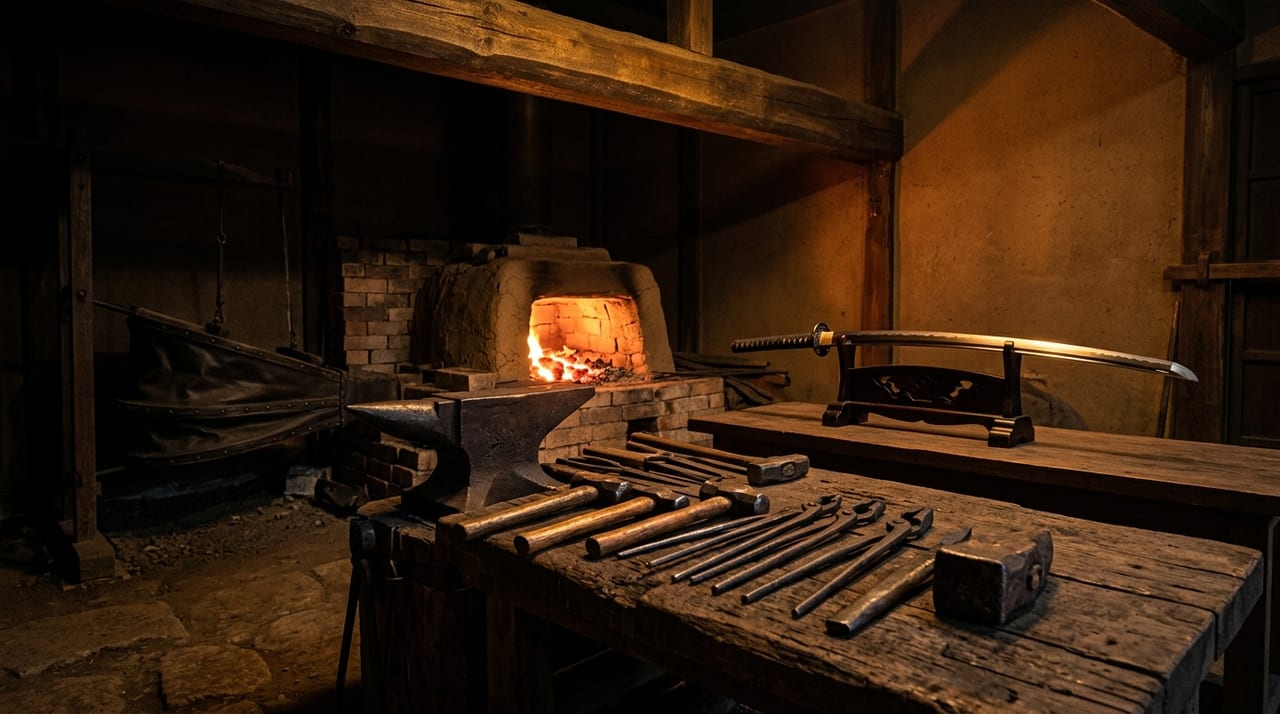 * Image is for illustrative purposes only.
Table of Contents
Kazuuchi is a collective term for practical swords mass-produced using simplified processes to meet the massive wartime demand from the late Muromachi period through the Sengoku period. The word stands in contrast to "chūmon-uchi," swords forged one at a time with care, and these swords were produced in large quantities at centers such as Bizen Osafune and Mino Seki. This article draws on historical sources to examine the background and reality of how kazuuchi-tō came to be, and their impact on sword history.
The Ōnin War and the Explosion in Sword Demand — From Muromachi to Sengoku
The Ōnin War, which broke out in 1467 (the 1st year of Ōnin), was a great conflict that reduced Kyoto to scorched earth for eleven years and simultaneously marked a turning point that profoundly changed the history of the Japanese sword. Until then, sword demand had centered on the production of fine swords for formal wearing by warriors and for dedication to shrines and temples, and tōshō prided themselves on careful, small-scale work. However, the more than a century of warfare that followed the Ōnin War and continued into the Sengoku period required practical swords on an unprecedented scale.
When large numbers of soldiers drawn from the lower warrior and peasant classes — ashigaru (foot soldiers) and ji-zamurai (local warriors) who had traditionally been unable to carry swords — appeared on the battlefield, demand for inexpensive and practical uchigatana surged. Powerful daimyo placed large orders with various production centers to equip armies of tens of thousands of men, and tōshō were forced to shift to a production system that prioritized quantity over quality.
The Reality of Kazuuchi-tō — The Merits and Demerits of Mass Production
Kazuuchi refers to swords produced in large quantities with an emphasis on efficiency, in contrast to the style of a master craftsman who spares neither time nor skill on a single sword. The characteristics of kazuuchi-tō mass-produced after the Ōnin War are as follows.
- Simplified tanren (forging) process: There was an increase in cases where the number of rounds of orikaeshi tanren (folding) was reduced and relatively uniform low-carbon steel was fashioned directly into the blade. Even in modern metallurgical analysis, the coarse steel grain structure indicating fewer rounds of tanren has been confirmed in Sengoku-period kazuuchi-tō.
- Uniform shape: The uchigatana form with a nagasa (blade length) of around 2 shaku 3 sun (approximately 70 cm) became standardized, and a system for assembly-line production of swords to the same specifications within workshops was established.
- Omitted or forged mei (signature): The market was flooded with "counterfeits" that used the names of famous tōkō without permission, as well as mumei (unsigned) mass-produced items. Kazuuchi-tō bearing the mei of the Bizen Osafune school were problematic even at the time, known as "kazuuchi Osafune," and became a major challenge in later sword appraisal.
Symbolic of the mei problem at Bizen Osafune is the "collective mei system." The mei of Sukesada, the most popular tōshō, is said to have been shared by more than 50 tōshō belonging to the same workshop, and swords bearing that mei circulated in the tens of thousands during the Sengoku period alone. The estimated total production of the Osafune center as a whole during the Sengoku period is said to have exceeded one million blades, demonstrating the industrial scale of the Japanese sword industry at the time.
However, it would be wrong to dismiss all kazuuchi-tō as inferior goods. Workshops of skilled tōshō produced swords that maintained a minimum level of quality even while rationalizing the process, and even today there are many Sengoku-period kazuuchi-tō that can obtain a kanteisho (appraisal certificate) at the hozon or tokubetsu hozon level.
The Rise of Regional Tōshō — The Spread of the Five Traditions
Another major change in the Muromachi and Sengoku periods was the dispersal of tōshō, who had been concentrated in the Kinai region and Bizen, to all parts of the country. Sengoku daimyo in each region independently recruited or trained tōshō and sought to establish self-sufficient production systems within their domains.
Mino Province (around present-day Seki City, Gifu Prefecture) is a prime example. Tōshō who had migrated from the end of the Kamakura period through the Nanbokuchō period settled centered on Seki, and after the Ōnin War rapidly expanded their influence as the tōkō group of the Mino-den. Swords produced by Kanemoto, also known by the alias "Seki no Magoroku," and Kanesada were favored by Sengoku warriors for their toughness and practicality, and circulated throughout the country as "Mino-mono."
In Satsuma (Kagoshima Prefecture), the Naminohira school maintained its lineage for a long time under the patronage of the Shimazu clan, and in the Tōhoku region, the Date clan retained tōshō and the tradition of "Sendai-tō" was formed.
Bizen and Yamashiro — The Fierce Competition Between the Two Major Production Centers
The two pillars of sword production throughout the Muromachi period were the Osafune school of Bizen Province (around present-day Setouchi City, Okayama Prefecture) and the tōshō who carried on the lineage of the Awataguchi and Rai schools of Yamashiro Province (Kyoto Prefecture).
Bizen Osafune was the largest sword-producing center since the Kamakura period, and during the Muromachi period a single school is said to have had dozens to over a hundred tōshō concentrated there. A highly organized production system was established, encompassing the procurement of raw materials, the sharing of kaji tools, and the development of sales networks; "Bizen-mono" enjoyed the highest reputation and was actively exported both domestically and abroad.
The going price for kazuuchi-tō ranged from a few hundred mon to a few kanmon, equivalent in modern terms to roughly 80,000–300,000 yen. This affordability — a fraction of the cost of a chūmon-uchi by a master craftsman — was the economic background that enabled their widespread adoption across a broad range of classes, from ashigaru to ji-zamurai. It should be noted that in the Mino production center, demand was also strong for long-handled weapons such as spears and naginata in addition to uchigatana, and the tōshō of Seki established a firm position in the production of long-handled weapons as well.
The tōshō of Yamashiro, on the other hand, served as official tōkō to the Muromachi shogunate and supplied high-quality made-to-order swords known as "jōsaku" to the shogunal house and powerful daimyo. Though fewer in number, each sword was finished to a high standard, and even today "Yamashiro-mono" receives high praise from sword collectors.
However, after the Ōnin War, when Kyoto became a battlefield and the Yamashiro workshops suffered devastating blows, Bizen's overwhelming mass-production capacity came to dominate the Sengoku market. The sword industry of the Sengoku period was an era of tension between quality and quantity.
What Sengoku Warriors Demanded of Swords — Between Utility and Art
What Sengoku warriors demanded of swords was not uniform. For warriors who prioritized actual combat above all, the absolute requirements for a sword were that it "not break, not bend, and cut well." Even sword collectors like Oda Nobunaga and Tokugawa Ieyasu are said to have clearly distinguished between swords for actual combat and meibutsu (named treasure swords) for appreciation.
What was valued in assessing the worth of a sword was the sharpness rating of "wazamono," "ōwazamono," and "saijō ōwazamono." The Kaihō Kenjaku written by Yamada Asaemon (published in the 9th year of Kansei, 1797) systematized this, but the culture of sharpness evaluation that served as its precursor was formed during the Sengoku period.
Artistic value came to be emphasized again from the Azuchi-Momoyama period (the latter half of the 16th century) onward, after the unification of the country. When Toyotomi Hideyoshi launched the campaign known as meibutsu-gari (a movement to collect celebrated swords) and the exchange of meibutsu as gifts among daimyo became popular, swords once again came to foreground their aspect as prestige goods and works of art.
The kazuuchi-tō born from the warfare of the Muromachi period can be said to represent the "shadow history" of the Japanese sword, yet without them, the brilliance of the famous swords held by the rulers who unified the realm would not have existed.