Nanako Punching: The Fish-Roe Background Texture That Defines Japanese Sword Fitting Surfaces
 * Image is for illustrative purposes only.
Table of Contents
What is Nanako-Uchi—The Art of Scattered Light on the Ground
Nanako-uchi (魚子打ち, also called nanako, 魚子) is a technique of striking fine, round indentations at equal intervals into a metal surface, creating a uniform ground pattern that resembles fish eggs (nanako). Among the ground-finishing techniques in metalwork for tsuba and small fittings, it has long been prized as the most widely used and technically demanding technique.
A specialized nanako chisel (ななこたがね)—a thin steel rod with a hemispheric tip—is held perpendicular to the metal surface and struck with even force using a small hammer. With each strike, the chisel is precisely shifted to the next position, and striking continues at exact intervals, covering the entire surface with small hemispherical indentations. Though it appears simple work, a uniform surface cannot be achieved unless the chisel's angle, striking force, and spacing are all constant. Even skilled craftsmen require several days to completely cover a large area with fine nanako, demanding both mental concentration and physical stamina. Because of this monotonous yet intensely demanding work, larger workshops are said to have sometimes employed specialized craftsmen called "nanako-shi" (魚子師) who dedicated themselves solely to nanako-uchi, separate from the senior metalworkers who handled preliminary designs and high relief carving. This division of labor between ground finishing and motif carving was a deliberate strategy to maintain high quality in both aspects.
The visual effect of nanako-uchi lies in "uniform light diffusion." While a polished flat metal surface reflects light mirror-like in one direction, a nanako-uchi surface diffuses light in all directions through countless minute hemispheres. This unique luster that glows softly with depth creates a powerful effect as the "ground (background)" that enhances carved and inlaid motifs. It is the essential role of nanako-uchi to serve as the stage that makes the main subject truly the focus.
Types of Nanako—Variations in Technique and Appearance
Nanako-uchi encompasses several varieties; the chisel's tip shape, spacing, and depth create different visual qualities.
| Type | Characteristics |
|---|---|
| Fine nanako (こまかいなこ) | Extremely fine indentations of 0.5–1 mm diameter or less are struck densely. Particularly common in Goto family red copper ground pieces, with a surface that possesses a uniform, refined luster resembling silk fabric. Technically the most challenging, serving as a benchmark of a craftsman's skill level. |
| Coarse nanako (あらいなこ) | Relatively larger indentations are struck at slightly wider intervals. Frequently seen in Shoami-school works from the mid-Edo period onward; compared to fine nanako, the visual texture is more prominent, possessing a rustic strength. |
| Hishi-uchi (diamond-striking) (ひしうち) | A variant technique using a chisel with a diamond-shaped tip instead of round indentations. Creates sharp, geometric texture, employed in decorative contexts. |
| Ichimatsu-uchi (checkerboard-striking) (いちまつうち) | Nanako arranged in a grid pattern with rows aligned into a perfect square grid without offset. Creates an orderly, serene impression and is readily accessible to modern viewers. |
All these derivative techniques are based on fundamental nanako-uchi, evidence that craftsmen deliberately chose and manipulated the ground's appearance. Even with the same "fine nanako," the rhythm of indentation arrangement and how light interacts vary subtly depending on the craftsman, era, and school; comparing these differences is itself one of the pleasures of appreciation.
How to Appreciate Nanako-Uchi—Points for Viewing
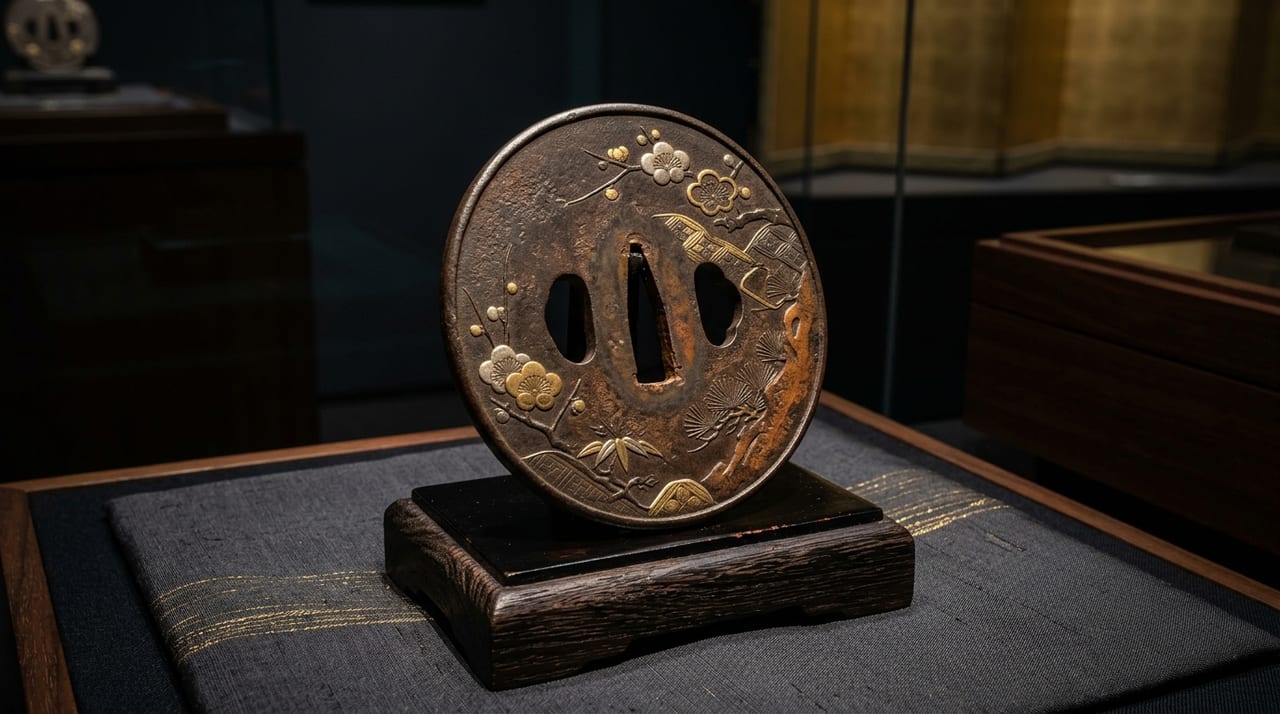
When handling tsuba or fittings featuring nanako-uchi for the first time, observing them while varying the angle of light makes their appeal more apparent. Under overhead light, the entire ground appears uniformly dim, but when the light source is tilted obliquely, each of the countless indentations takes on shadow and depth, and a granular texture emerges clearly. This quality of "changing appearance depending on viewing angle" is unique to nanako-uchi and absent from flat polished surfaces.
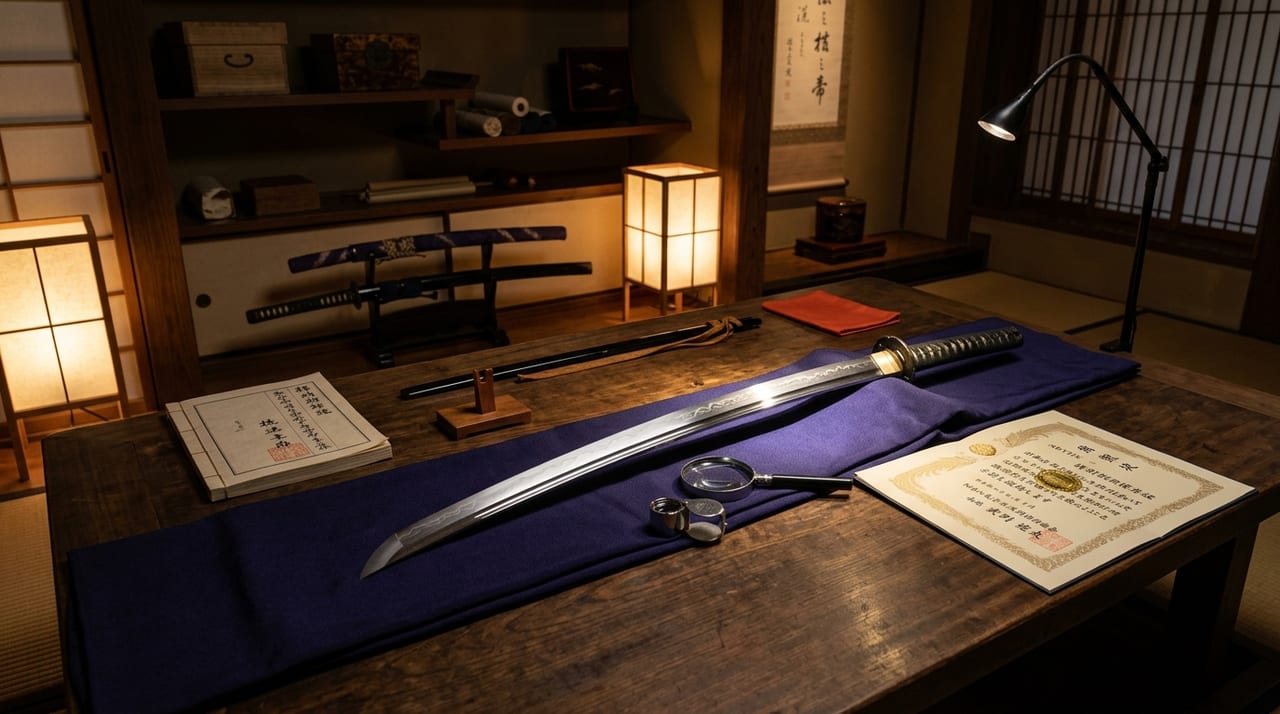
To assess quality, one method involves using a magnifying lens to examine the variation in the indentations' diameter, depth, and spacing. The less variation, and the more uniformly struck throughout, the more it indicates work by a skilled craftsman. Conversely, areas where spacing becomes irregular or indentation size is uneven may indicate traces of reworking or later repairs. By attending not only to the subject matter of carving and inlay but also to the uniformity of the ground background, one can more fully appreciate the overall refinement of the work.
Condition and Preservation—Changes Over Time
Because nanako-uchi involves striking countless shallow indentations into a metal surface, extended handling and repeated cleaning can cause the indentations to wear slightly, resulting in gentler shadows compared to their original state. This is a common aging process in metalwork generally and does not necessarily indicate a defect, but how clearly the ground's texture remains is noted during authentication as an indicator of preservation condition.
When considering purchase, selecting pieces authenticated by the NBTHK (Society for Preservation of Japanese Art Swords) that certify authenticity, period, and maker—including assessment of the ground's condition—provides a practical foundation for confidently enjoying the beauty of nanako-uchi. While authentication certificates do not record every indentation's condition in detail, they provide third-party assurance of the work's authenticity, period, and provenance, supporting the foundation for comprehensive appreciation including the ground's character.
Goto Family Nanako-Uchi—The Peak of the Art
Goto family red copper ground pieces occupy a special position as exemplars of the technical pinnacle of nanako-uchi.
The Goto family, a prestigious metalworking clan founded by Goto Yūjō in the late Muromachi period and continuing through the Edo period, represents the apex of the craft. Serving as the official metalworkers for the Tokugawa shogunate, they were intimately connected to the bakufu and primarily worked on small sword fittings (menuki, kogai, and kōgai). The red copper (shakudō) favored by the Goto family is a copper-gold alloy that, through heat-coloring treatment, takes on a deep black-purple hue, and pairs exceptionally well with nanako-uchi.
The Goto family's nanako consists of extremely fine indentations roughly 0.3–0.7 mm in diameter arranged with flawless precision, conveying overwhelming refinement even to the naked eye. Viewed through a magnifying lens, all indentations are remarkably uniform in depth, diameter, and spacing. The Edo craftsmen achieved this uniformity—difficult even with modern industrial machining—entirely by hand.
Goto family metalwork pieces, with high relief carving and inlay laid over this refined nanako ground, are internationally recognized as "works of art that integrate the beauty of the ground with the beauty of the subject" and are held in numerous major Western museums. The fact that the Goto family's traditional techniques were passed down from successive masters to disciples and affiliated craftsmen, with skill refined across generations, is one reason their works are regarded as exceptional.
Nara Metalwork Nanako-Uchi—The Aesthetics of Subtraction
Nara metalwork (including artists such as Sugiura Jōi, Nara Toshinaga, and Tsuchiya Yasuchika), regarded as comparable to the Goto family, also produced many fine pieces employing nanako-uchi for ground finishing.
Nara metalwork nanako is often somewhat coarser than that of the Goto family. However, its uniformity remains high, with the contrast between ground and high relief carving being more visually striking than the ground itself. The composition in which realistically carved animal, plant, and human motifs emerge from the uniform nanako ground embodies the East Asian aesthetic principle of "negative space (the ground) enhancing the primary subject." Nara metalwork is positioned as the school that perfected this "aesthetics of subtraction" through nanako-uchi.
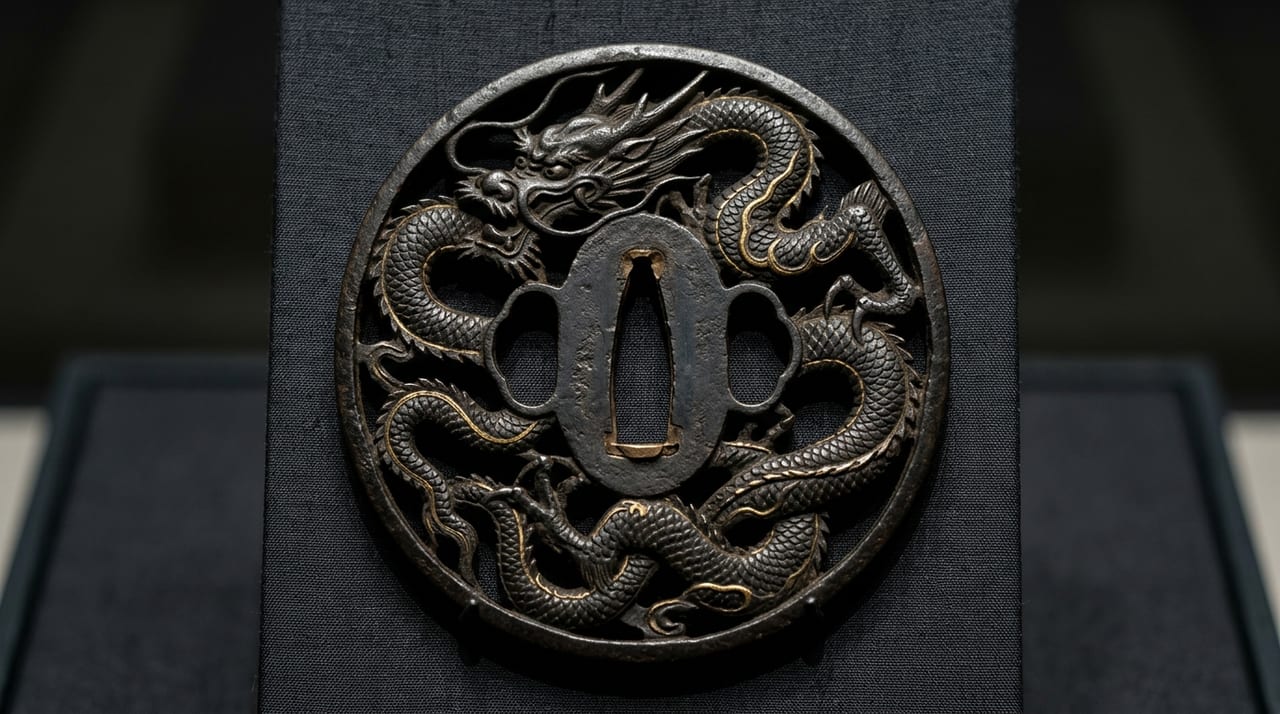
The combination of uniform nanako-uchi ground and high relief that makes motifs stand out naturally guides the viewer's eye to the subject while simultaneously creating an added depth of appreciation when one notices the meticulous work in the background. This reveals that nanako-uchi was understood not merely as surface preparation but as an integral part of the overall design that shapes how the entire work is perceived.