Nanban Tsuba — The Strange Beauty of Japanese Tōsōgu Born from Exotic Taste
 * Image is for illustrative purposes only.
Table of Contents
The Nanban Trade and Japanese Tōsōgu
"Nanban" was a Japanese term of the time referring primarily to people who came from Southern Europe, such as Portugal and Spain. Beginning with the introduction of firearms (matchlock guns) to Tanegashima by the Portuguese in 1543, exchanges between Japan and Southern European nations spread rapidly. This was the beginning of the "nanban trade."
Not only firearms but also Western armor, swords, craft objects, glassware, and paintings flowed into Japan, and some daimyo and military commanders actively collected them. "Nanban taste" permeated the upper strata of warrior society, and among the commanders known as Kirishitan daimyo, some adopted rosaries and crosses as motifs in their tōsōgu (sword fittings).
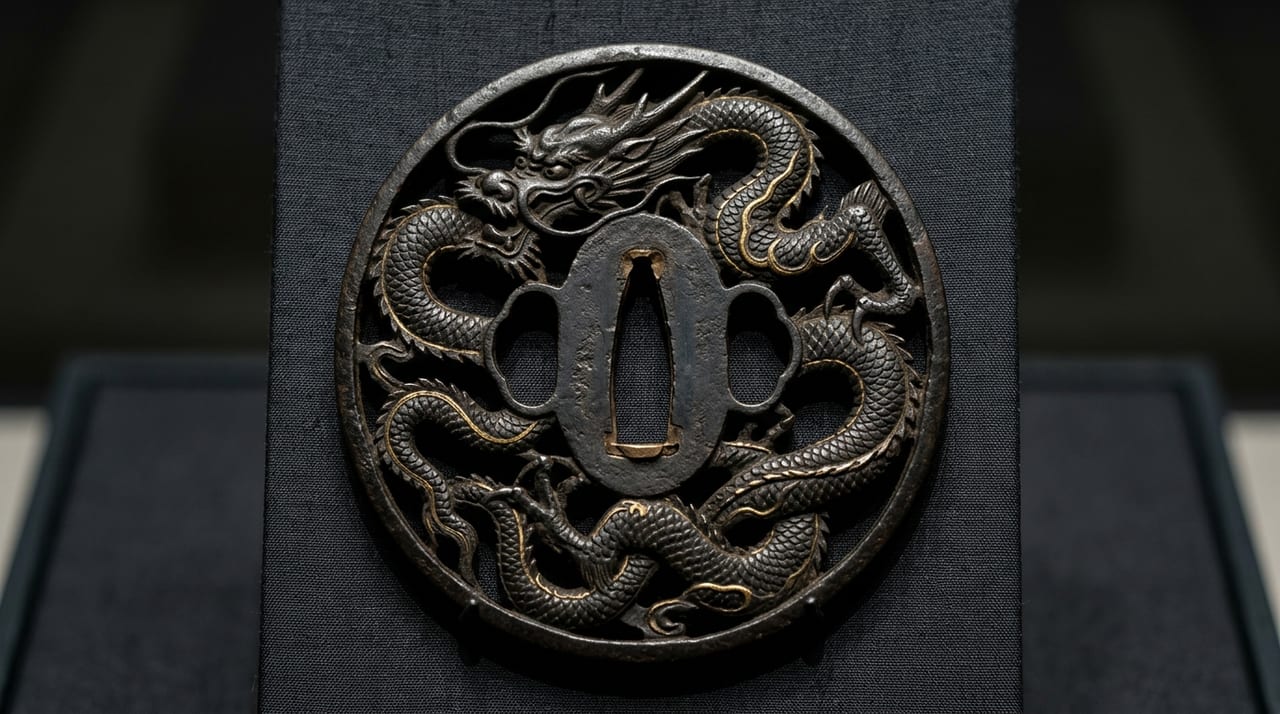
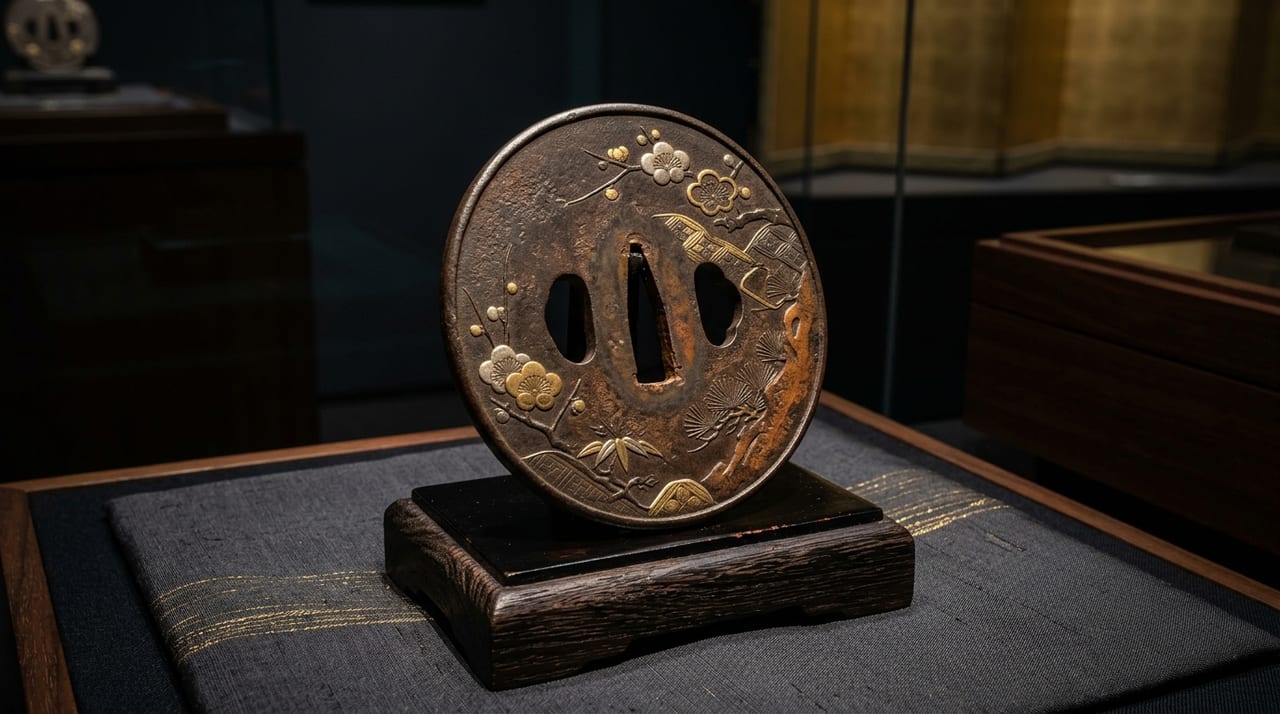
This contact with nanban culture gave birth to an entirely new genre in the world of tōsōgu: the "nanban tsuba."
Major Types of Nanban Tsuba
Nanban tsuba are classified mainly into three types according to their production background, materials, and design.
Yōmono Tsuba — Tsuba of Imported Materials
The most typical nanban tsuba is the yōmono tsuba, which repurposes European-made iron materials. Its most distinctive feature lies in the metal structure of the iron ground. It often has a fine mesh-like structure (a layered structure resembling Damascus steel) or a homogeneous structure fundamentally different from the hada produced by Japanese orikaeshi tanren (folding). There are cases where specialist metal analysis has confirmed the iron to be of European origin.
Among yōmono tsuba, there are also examples in which metal sheets originally used as components of European swords or armor were repurposed and fashioned into the form of Japanese tōsōgu. The fact that the material itself is "nanban" is the major difference from the other types.
Ikoku Shumi Tsuba — Tsuba with Nanban Motif Carvings
This type features nanban-derived motifs carved into the tsuba by Japanese craftsmen. While the material is domestic iron, the following "exotic taste" motifs were adopted as designs:
- Western armor (cuirasses, helmets, shields)
- Sailing ships (nanban vessels)
- Crosses and rosaries
- Figures of nanban people (foreigners)
- Western plants and flowers (Dutch chrysanthemums, carnations, etc.)
- Exotic animals such as lions and elephants
These motifs struck craftsmen as "rare curiosities from foreign lands" and also met the demand of the commanding warriors and daimyo — their patrons — for nanban taste.
Kongō Yōshiki Tsuba — The Beauty of Eclecticism
This is an eclectic style of tsuba that maintains traditional Japanese tsuba shapes and sukashi (openwork) techniques while partly adding nanban-style decoration. Such examples may also be considered works that have absorbed and Japanized foreign influence. Pieces combining the standard round or mokko-shaped tsuba with openwork of Western armor fall into this category. Their appeal lies in a distinctive tension that is neither purely "nanban" nor purely "Japanese."
Historical Background of Nanban Tsuba
Nanban tsuba were produced most actively from the late 16th to the early 17th century. This period was also the height of Christianity in Japan, when the estimated number of believers nationwide is said to have reached several hundred thousand. Openness toward foreign culture was high, and exotic taste was valued as a kind of "iki" in warrior society.
Oda Nobunaga, Ōmura Sumitada, and Takayama Ukon were representative figures among the Kirishitan daimyo and commanders who actively received nanban culture. Their cultural influence is thought to have extended even to the designs of tōsōgu.
However, the times shifted rapidly. The persecution of Christians by Toyotomi Hideyoshi in 1597 (the Great Martyrdom of Keichō), the subsequent edicts banning Christianity issued by the Tokugawa shogunate, and the completion of the sakoku policy in 1641 (restricting the Dutch to Dejima in Nagasaki) caused the influence of nanban culture to shrink rapidly. The period during which nanban tsuba were actively produced was limited to a mere half century, and excellent surviving examples are extremely rare.
Craft Characteristics and Artisanship of Nanban Tsuba
Both the materials and techniques used in the production of nanban tsuba merit special attention.
Regarding the tetsuji (iron ground): in the case of yōmono tsuba, the distinctive metal structure of European iron appears as it is. In ikoku shumi tsuba and kongō yōshiki tsuba using domestic iron, traces can be seen of craftsmen employing the techniques of usuniku-bori (shallow relief carving) and sukashi-bori (openwork carving) to reproduce Western motifs.
Particularly impressive are the many fine depictions of sailing ships (nanban vessels), with surviving works in which the set of the sails, the movement of the waves, and the texture of the hull are all carved in minute detail. The high level of expressive skill reflects the fact that craftsmen referenced nanban prints, picture scrolls, and actual craft objects when producing these works.
There are also lavish examples combining kin zōgan (gold inlay) and silver inlay, with gold highlighting applied to the details of crosses and figures. This combination of techniques demonstrates that nanban tsuba were produced not merely as curiosities but as craft objects of high technical artistry.
Authenticity Questions and Appraisal of Nanban Tsuba
Because nanban tsuba are rare, they are highly sought after, and imitations produced in later periods as well as deliberate forgeries exist.
For the appraisal of yōmono tsuba, specialized scientific investigation such as X-ray fluorescence analysis (XRF) and microscopic observation of the metal structure is effective. However, since such analysis is not readily available to general collectors, the fundamentals remain traditional connoisseurship: first confirming the provenance (origin), then examining the state of the patina and rust, and observing the surface texture of the iron ground.
Works with nanban motifs carved by later hands have been produced in every period — the Edo period, the Meiji period, and modern times alike. Judging authenticity requires a comprehensive assessment of the depth and sharpness of the carvings, the naturalness of the patina on the iron ground, and the degree to which the rust has penetrated. Works accompanied by a kanteisho (appraisal certificate) from the NBTHK (Society for the Preservation of Japanese Art Swords) rated Tokubetsu Hozon Tōsōgu or above serve as an important criterion of reliability.
Collecting and Appreciating Nanban Tsuba, and Major Holding Institutions
Collectors of nanban tsuba form a specialized group even among tōsōgu enthusiasts. This genre, which contains the historical narrative of "contact between Japan and foreign lands," is particularly supported by enthusiasts with an interest in Japanese history, the history of the Kirishitan, and the history of the nanban trade.
Major holding and exhibition institutions include the following:
- Nagasaki Museum of History and Culture (Nagasaki Prefecture) — a rich collection related to the nanban trade and the Kirishitan
- Arima Kirishitan Heritage Museum (Minamishimabara City, Nagasaki Prefecture) — materials on Kirishitan daimyo culture
- Tokugawa Art Museum (Nagoya City, Aichi Prefecture) — holds excellent works spanning the full range of warrior culture
- Tokyo National Museum — occasionally exhibited in special displays of tōsōgu
Abroad, nanban tsuba from Japan are held in the Rijksmuseum in Amsterdam and the British Museum, where they are valued as "a heritage of Japanese–European exchange" seen from the European perspective.
Conclusion — A Rare Genre of Tōsōgu in Which Cross-Cultural Contact Was Crystallized
Nanban tsuba are a rare category of craft object that imprinted onto iron the historical moment when Japan came into intense contact with foreign culture. Their beauty is not merely "exotic taste": it is also testimony to the creativity with which Japanese craftsmen absorbed and sublimated foreign designs.
The fact that the production period was short and surviving examples are few also adds to the value of nanban tsuba. When one contemplates the history dormant beneath the tsuba — the era when nanban ships dropped anchor in Osaka Bay and firearms and crosses shook the culture of this island nation — tōsōgu cease to be mere metalwork and shine as a crystallization of history. For those who love Japanese swords, nanban tsuba are a genre without equal in their historical depth.