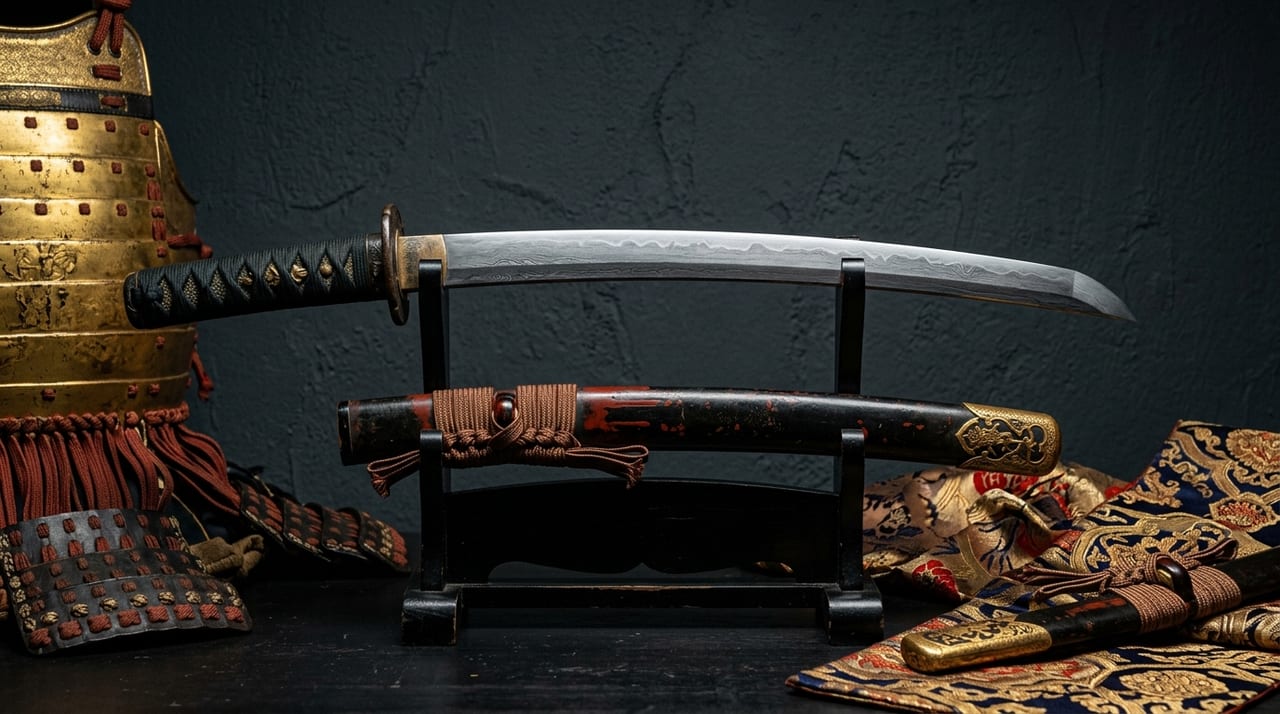
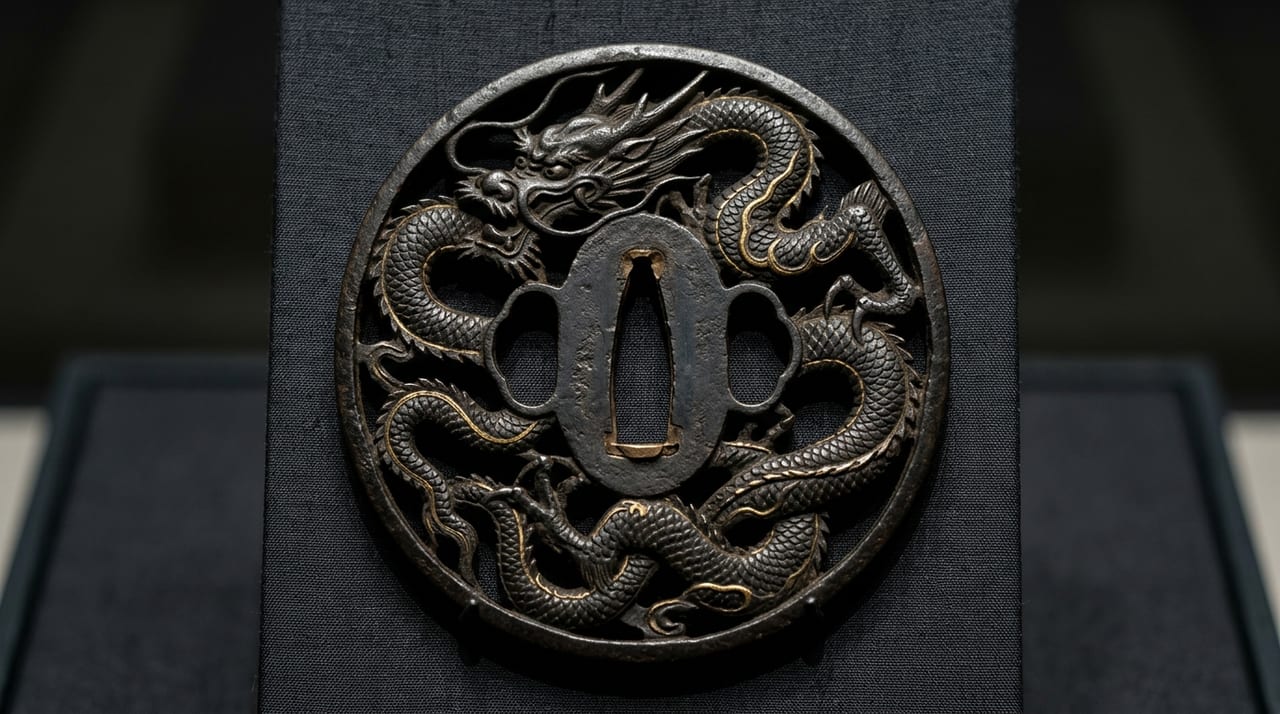
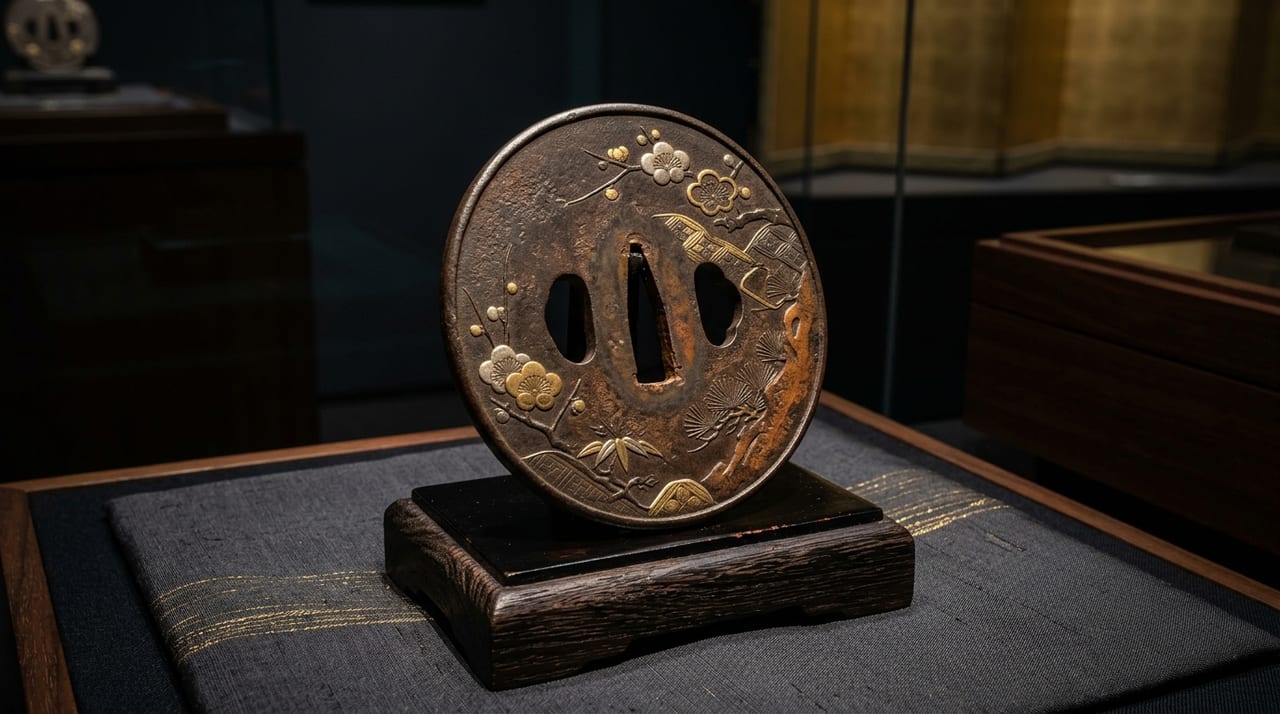
Tsuba of the Nanbokuchō and Muromachi Periods — The Flowering of Sukashi Techniques Born from War and the Rise of the Shōami School
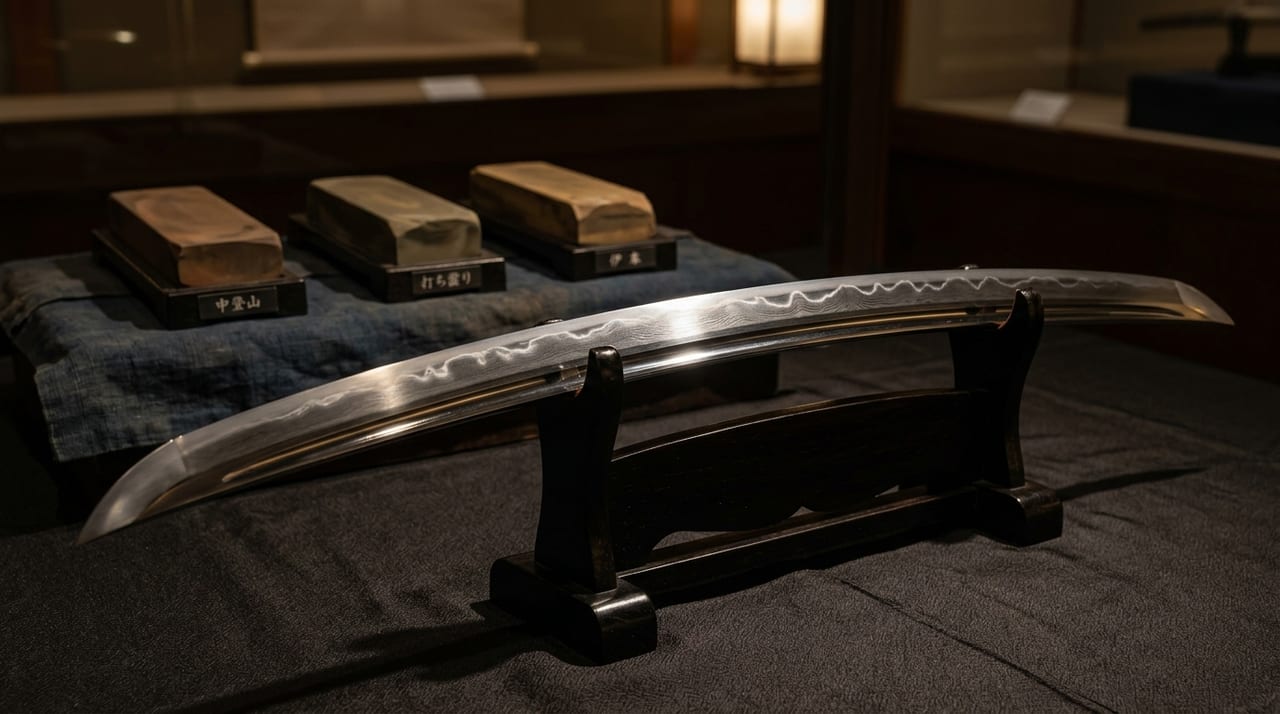 * Image is for illustrative purposes only.
Table of Contents
War and Tsuba — The Explosive Growth in Demand
The Nanbokuchō period (1336–1392) was one of the most turbulent eras in Japanese history, during which the Northern Court led by Ashikaga Takauji and the Southern Court of Emperor Go-Daigo fought across the entire country for more than half a century. The demand for swords among warriors constantly prepared for battle reached unprecedented levels, and the artisan groups supporting arms production — tōkō (swordsmiths), armorers, and tōsōgu (sword fittings) makers — rapidly became more specialized. It is thought that within this trend, the tsuba-maker (tsubashi) profession separated from the tōkō, and groups of craftsmen specializing exclusively in tsuba arose throughout the country.
Before the Nanbokuchō period, tsuba were predominantly simple disc-shaped pieces punched from thick iron plates. As warfare intensified, however, tsuba began to transcend their role as mere hand guards, evolving into symbols of the warrior class, displays of authority, and even expressions of faith and aesthetic sensibility. Their shapes also diversified from circular to mokko-gata (four-lobed), square, diamond, and modified oval forms, with lightening and refinement advancing simultaneously.
The Flowering of Sukashi Techniques — From "Showing" Iron to "Piercing" It
The most noteworthy technical innovation spanning the Nanbokuchō through Muromachi periods was the full-scale development of sukashi (pierced openwork) techniques. Sukashi refers to the cutting of decorative openings into the body of the tsuba, going beyond mere lightening by removing material to use iron itself as a medium of sculptural expression.
The main sukashi forms are as follows.
| Sukashi form | Characteristics |
|---|---|
| Maru-sukashi (round piercing) | One of the oldest forms, in which multiple circular openings are arranged regularly or irregularly. Though simple, the precision of hole diameter and placement reveals the craftsman's skill at a glance. |
| Mokko-sukashi (mokko piercing) | A four-lobed pierced form derived from the mokko-mon, the four-lobed arabesque pattern of Heian court robes. As a courtly motif inherited by warrior culture, it symbolizes the cultural fusion born of the Nanbokuchō upheaval. |
| Kuruma-sukashi (wheel piercing) | Pierced openwork inspired by the dharma wheel and the wheels of an ox-cart. Though a Buddhist symbol of the cycle of rebirth and salvation, it was versatile enough to fit the cultures of both the court and the warrior class. |
| Katana-kata sukashi (blade-form piercing) | Pierced openwork using the outline of weapons themselves — swords, blades, or cross forms. A design that straightforwardly expresses the direct martial spirit of the warring-period warrior. |
Sukashi served not only an aesthetic purpose but also a functional rationale. If a tsuba were too heavy, the center of gravity of the entire sword would shift toward the hilt, reducing its handling performance. Lightening through sukashi was a legitimate technical decision that directly contributed to adjusting the balance of the sword.
Forging and Iron Texture — The Material Character of "Nanbokuchō Tsuba"
When discussing tsuba of this era, the handling of iron as a material cannot be overlooked. Tsuba-makers of the Nanbokuchō through Muromachi periods created distinctive forged surfaces on their tsuba by repeatedly subjecting domestic iron similar to tamahagane to orikaeshi tanren (folding).
Particularly noteworthy is the rough forged surface known in later ages as oni-ita-tetsu. This surface, which intentionally retains iron's naturally rough appearance without over-refinement, resonates with the aesthetic of wabi and sabi pursued in the tea ceremony — the beauty of depth that dwells within imperfection. This is a wholly different direction from the intricate polychrome metalwork tsuba of the Edo period, and collectors drawn to this "beauty of rough texture" remain a devoted community to this day.
The treatment of the rim (mimi) of the tsuba also changed over time. In the Nanbokuchō period, the kado-mi (square-edged rim) with an angular cross-section was common, but by the late Muromachi period the maru-mi (rounded rim) became more prevalent, adding softness both to the touch and to the visual impression. Reading these subtle changes in detail is an important reference point for dating mumei (unsigned) tsuba.
The Establishment of the Shōami School — A Guild of Tsuba-Makers That Spread Nationwide
The group that left the greatest mark in the history of Japanese tsuba-making from the late Muromachi period into the early Edo period was the Shōami school (Shōami-ha). "Shōami" is not the surname of a single family but a craftsman's title (natori) passed down as an inherited name, and branch schools were established throughout the country, starting from Kyoto and extending to Edo, Nagoya, Kaga (Kanazawa), Sendai, Hakata, and beyond.
The Shōami school's greatest achievement was establishing a system capable of supplying high-quality tsuba across a wide range of price points and volumes. Their finest works were art objects featuring delicate sukashi and sophisticated iron surface treatment, while their mass-produced pieces spread as inexpensive, purely functional arms all the way down to lower-ranking warriors. The reason why Shōami-lineage works account for an overwhelmingly high proportion of surviving tsuba from the Muromachi through Edo periods is precisely because of this system.
The main characteristics of Shōami tsuba are as follows.
- A mitsu-dome (three-retention) structure incorporating holes for kōgai and kozuka
- A dark rust treatment with a "scorched" quality produced by yaki-ire (quenching)
- A restrained and dignified design based on mokko-sukashi and maru-sukashi
They achieved a high standard of both dignity and function as "the warrior's tool."
The Contemporary Appreciation of Muromachi Tsuba — Museum Collections and Market Value
As of 2026, tsuba from the Nanbokuchō through Muromachi periods are held as significant collections in major museums throughout the country, including the Tokyo National Museum, the Kyoto National Museum, and the Osaka City Museum of Fine Arts. Muromachi tsuba designated as jūyō bunkazai (Important Cultural Property) or jūyō bijutsuhin (Important Art Object) are known in the collecting world as "a field where discernment is tested," due to the difficulty of appraisal.
On the market, the great majority of Muromachi-period tsuba are mumei (unsigned), but period authentication is conducted based on the consistency of form, forged surface texture, and sukashi style. For a well-preserved Shōami-lineage mokko-sukashi tsuba, prices start from several hundred thousand yen, and for a meibutsu (named treasure sword)-class piece from a former daimyo collection, transactions exceeding several million yen are not uncommon.
In recent years, among younger sword collectors, the aesthetic appreciation for "the iron character of rough texture" has been making a revival. The "speaking of iron itself" that tsuba of this era possess, distinct from the splendor of Edo-period metalwork tsuba, continues to hold a unique position in contemporary collecting culture.
Conclusion — The Aesthetics of Tsuba as the Crystallization of a Warring-Age Spirit
The tsuba of the Nanbokuchō, Muromachi, and Sengoku periods are objects of craftsmanship in which the tension of a turbulent age and the ingenuity of artisans have crystallized. Through the technique of sukashi, "heavy iron" was transformed into "airy design," and through the organizational strength of the Shōami school, that technique was disseminated throughout the country. Without the tsuba of this era, neither the flourishing of Edo-period metalwork tsuba nor the full blossoming of sword-mounting culture from the Momoyama period onward would have come about.
When the age of Edo's great peace arrived, tsuba would change in character from implements of actual combat to the pinnacle of craft. To understand that turning point, cultivating an eye for the "primordial substance of tsuba" represented by the Nanbokuchō and Muromachi periods is an indispensable foundation for any sword enthusiast.