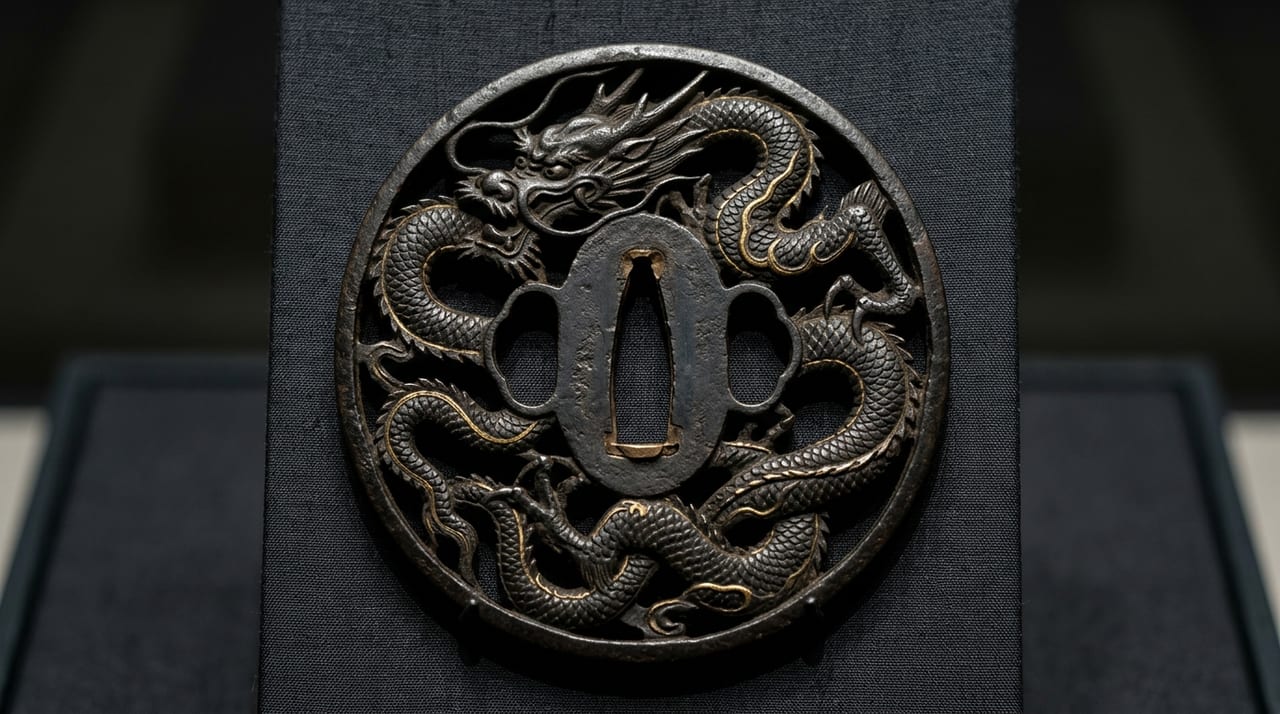
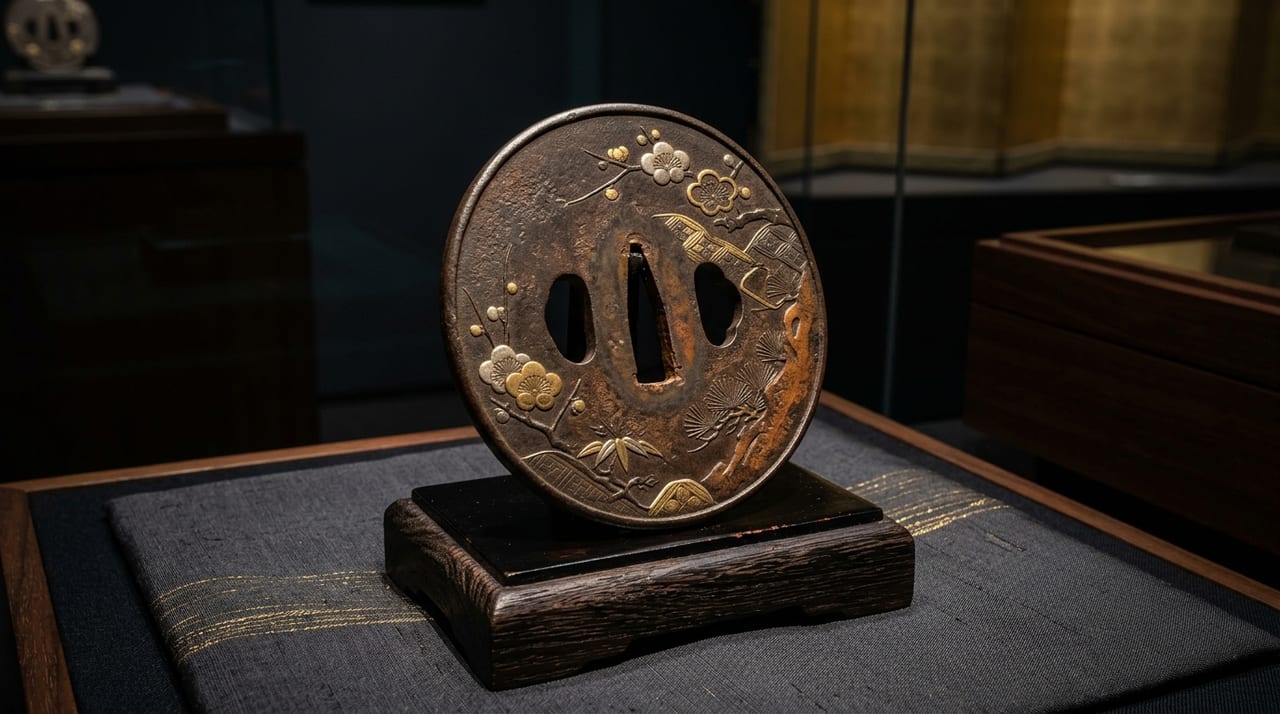
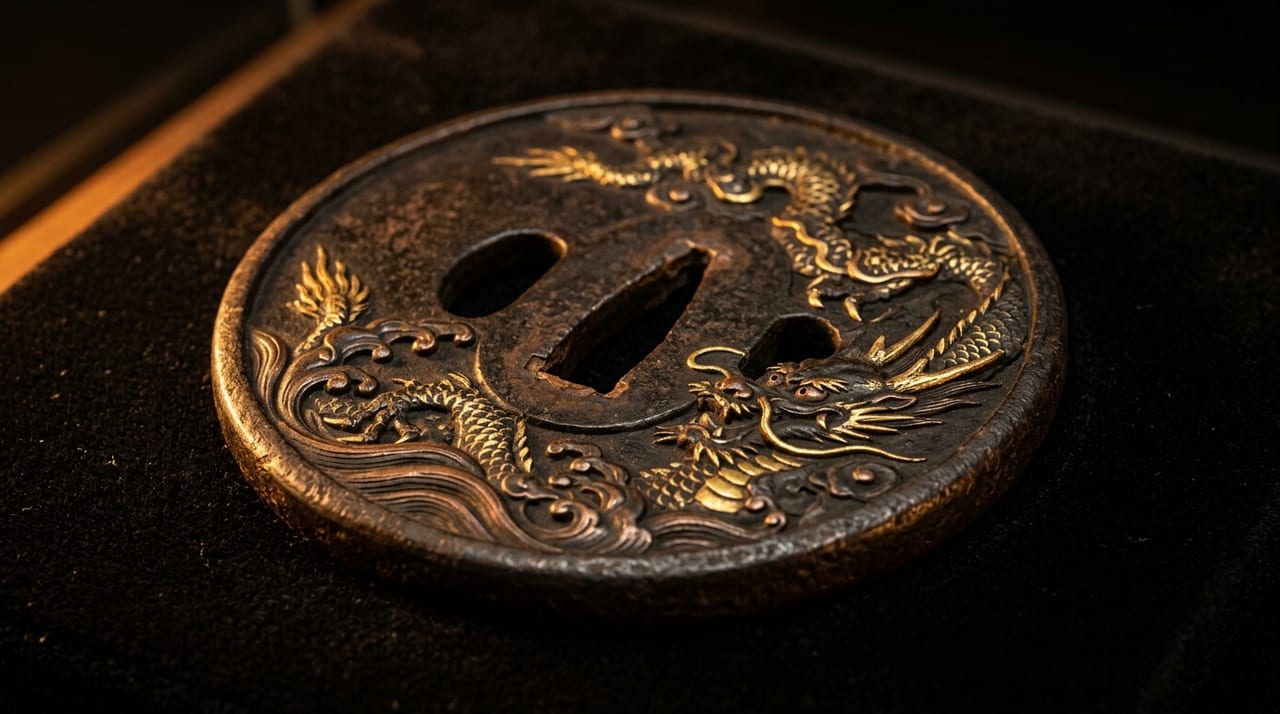
The Masters of Nara Kinkō — The New Horizon of Individual Art Opened by Sugiura Jōi, Nara Toshinaga, and Tsuchiya Yasuchika
 * Image is for illustrative purposes only.
Table of Contents
The Emergence of Nara Kinkō — Toward the Age of the Individual Artist
In the mid-Edo period (late seventeenth to early eighteenth century), a revolutionary change occurred in the world of tōsōgu (sword fittings). The paradigm of tōsōgu history underwent a fundamental transformation: from the Gotō family system of production — "producing works in quantity following the norms of the school, with a unified design" — to a mode of creation in which "individual artists confronted each piece with their own aesthetic vision."
The Gotō family was a distinguished house that had built a position of monopoly as the official metalworkers serving the shogunal and daimyo households from the late Muromachi through the early Edo period. The style they established — "Gotō-bori," in which classical flora and fauna are expressed through high-relief carving in gold on a shakudō ground — reached a high level of technical achievement; yet, at the same time, it had the effect of subordinating practitioners to established norms and inhibiting the expression of individuality.
It was the group of metalworkers based in Nara (present-day Nara Prefecture), commonly known as "Nara kinkō," who broke through this stagnation. Nara is an ancient capital with an accumulated heritage of Buddhist culture and aristocratic craftsmanship stretching back to the Asuka and Nara periods, and it was alive with rich sculptural stimuli — the treasures of temples and shrines, imported objects, and more. This cultural soil nurtured a new metalworking art centered on realism and individuality.
The three masters who left their names to posterity are Sugiura Jōi, Nara Toshinaga, and Tsuchiya Yasuchika. Each of the three possessed a completely distinct personality, and it is precisely this diversity that attests to the richness of Nara kinkō.
Sugiura Jōi (1701–1761) — The Pioneer Who Opened the Path of Nara Kinkō
Sugiura Jōi was the pioneer of Nara kinkō, the metalworker who first blazed the path that his successors would follow. It is said that he learned his techniques from a craftsman in the Gotō lineage, and while inheriting a high level of carving skill, he gradually ventured toward freer expression, step by step away from stylistic constraints.
What characterizes Jōi's style is "an intellectual balance between realism and formalism." In his treatment of classical motifs such as dragons, tigers, hawks, peonies, and chrysanthemums, he continues in the Gotō tradition; yet the density of his carving and the vitality within it clearly surpasses the work of his teachers. The detailed rendering of fur and feathers in particular has a refinement that connects forward to Nara Toshinaga, and his direct influence on pupils and successors is incalculable.
The historical role Jōi played lies in the establishment of the self-awareness of "a metalworker who signs his work with his own mei (signature)." By convention, works produced by the Gotō family do not display individual makers' names, but Jōi's works bear a mei, which became the axis of authentication and appraisal. This single fact symbolizes the dawning of "the age of individual art" in the history of Japanese tōsōgu.
Nara Toshinaga (1667–1737) — The Supreme Master of Nara Kinkō
Of the three masters, it is Nara Toshinaga who has received the highest appraisal and produced the greatest number of designated important works. His name is still spoken of today as a byword for Nara kinkō itself.
Technical characteristics of Toshinaga
Toshinaga's carving has reached a level that can only be described as "ultra-precise realism." The density with which he concentrates — within the surface area of a small tsuba (hand guard), menuki, or kozuka — every individual hair of an animal's coat, the pattern of veins across a leaf, the folds of a figure's garment, and the subtleties of a facial expression, ventures into the realm of sculptural art rather than craft technique.
His skillful differentiation of materials is also one of Toshinaga's great strengths. He combines iron, shakudō, shibuichi (an alloy of silver and copper), gold, silver, yamagane, and other materials with virtuosity, using contrasts of tone and texture to create a sense of three-dimensional space. A composition such as placing a dragon in vigorous motion rendered in high-relief gold carving on a subdued shakudō ground, with the waves expressed in the subtle tone of shibuichi, is an advanced form of expression in which the materials themselves become part of the depiction.
Representative subjects and compositional power
The subjects Toshinaga favored include "tiger and bamboo," "hawk and pine," "dragon and waves," "elder and immortal figures," and "kara-jishi and peony." These are traditional auspicious designs, but in Toshinaga's hands their symbolic formalism disappears and there arises a vividness as if a living moment of life had been captured.
His compositional power in containing a self-contained world within a small surface is equally outstanding. The handling of negative space, the flow of the gaze, the suggestion of foreground, middle ground, and distance — a painterly compositional sensibility has been brought into metalworking, and this is the reason Toshinaga's works are described as "paintings in tōsōgu form."
Numerous examples have been designated as NBTHK Jūyō Tōsōgu or Tokubetsu Jūyō Tōsōgu, and they are held in major collections both in Japan and abroad. Their market value is exceptionally high, and whenever a genuine piece comes to light it immediately attracts attention.
Tsuchiya Yasuchika (1670–1744) — The Innovator Who Embraced Western Styles
Of the three masters, it is Tsuchiya Yasuchika who stands out most distinctively and continues to astonish later scholars. Yasuchika's innovation lies in his active incorporation of "yōfū" — Western styles.
Even in Edo Japan under the sakoku system of national seclusion, trade with the Netherlands continued through Dejima in Nagasaki, and Western books, prints, and objects reached intellectuals and craftsmen through limited channels of distribution. Yasuchika was keenly stimulated by these incoming materials and converted that stimulation into expression in tōsōgu.
Specific methods of incorporating Western styles
Among the techniques Yasuchika attempted, the introduction of "perspective" is particularly noteworthy. In Japanese painting, flat and bird's-eye spatial representation was the mainstream, but Yasuchika's works possess a sense of receding depth. The intellectual operation of reinterpreting the techniques of Western printmaking into three-dimensional sculpture was an attempt with almost no precedent among the metalworkers of his time.
His boldness is equally conspicuous in the realm of subject matter. Plant designs presumed to have been referenced from European botanical books and natural history illustrations, Western-style architectural landscapes including castles and towers, and depictions of animals — lions, elephants, peacocks — that the Japanese of the time had never actually seen: the very selection of subject matter was a challenge to the received conception of tōsōgu.
This "fusion of Japanese and Western" is of a piece with the "rangaku" (Dutch studies) boom that occurred in the mid-Edo period, and Yasuchika's works are not only a technical achievement but also historical documents that bear material witness to the cultural contact between Japan and the West in the seventeenth and eighteenth centuries.
Comparing the Three Masters — Diversity as the Strength of Nara Kinkō
| Item | Sugiura Jōi | Nara Toshinaga | Tsuchiya Yasuchika |
|---|---|---|---|
| Primary motifs | Classical flora and fauna | Realistic animals and figures | Western and exotic motifs |
| Carving characteristics | Balance of realism and formalism | Ultra-precise realism and compositional power | Japanese-Western fusion and perspective |
| Material characteristics | Inherits and extends the Gotō style | Contrast of diverse materials | Original material choices |
| Historical role | Pioneer as individual artist | Pinnacle of Nara kinkō | Most distinctively original innovator |
The personalities of the three are each contrasting, but they share a common stance: "independence from the Gotō style" and "confronting materials with one's own eyes and hands." This common spiritual foundation is what gives the designation "Nara kinkō" its meaning.
Successors of Nara Kinkō and Its Influence on Edo Metalworking
The methodology established by the three masters spread widely among the metalworkers of Edo in general. Among them, Yokoya Sōmin (1670–1733) was a metalworker who broke away from the Gotō school to found the Edo machi-bori (town carving) tradition, establishing his own metalworking style by combining painterly realistic depiction with the iro-e technique of gold, silver, and copper applied together with carving. Sōmin's sources lay in Edo painting, including that of Hanabusa Itchō, and he stood in a relationship of parallel existence and competition with the three Nara masters. Sōmin's lineage formed a great current known as "late-Edo realistic metalworking."
This current continued until the Bakumatsu period and, through metalworkers across the country, exerted an indirect influence on the modern crafts of the Meiji era and beyond. The seed of "realism through the individual eye" that Nara kinkō sowed fundamentally transformed the soil of Japanese metalworking art.
Conclusion — Elevating Tōsōgu to "Individual Art"
The greatest achievement of the three masters of Nara kinkō was the elevation of tōsōgu from "a school's product" to "an individual's artistic expression." An intensity of personality so powerful that authorship can be judged by mei and style alone — this is an exceptionally rare achievement even in the history of Japanese crafts.
Sugiura Jōi opened the path, Nara Toshinaga reached the pinnacle, and Tsuchiya Yasuchika broadened the horizon. The breadth of possibility that the three demonstrated in different directions is precisely why Nara kinkō occupies a place in the history of tōsōgu as a singular "event." Today, their works standing quietly in the depths of museum glass cases are the crystallization of Edo-period intellect and aesthetic sensibility, woven in the medium of metal.