Swordsmith Redistribution in the Bunmei-Entoku Period (1469–1500)—Production Center Transformation and Bizen Concentration Following the Ōnin War
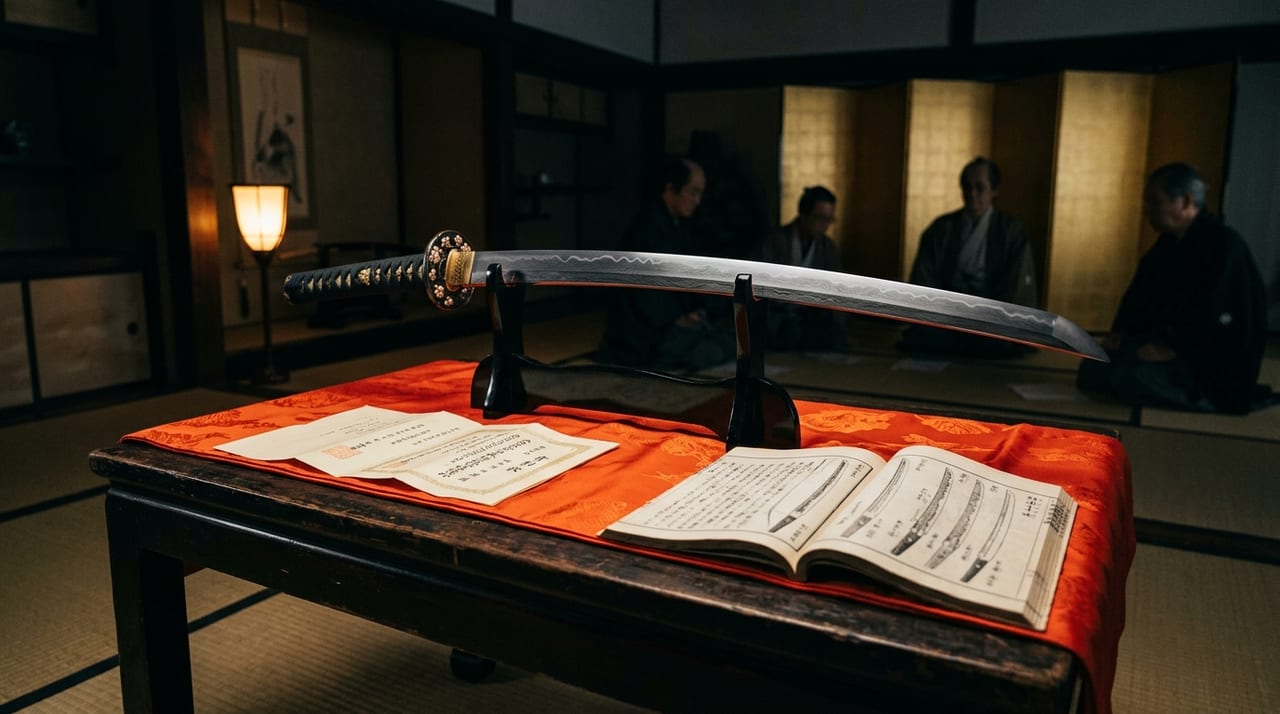 * Image is for illustrative purposes only.
Table of Contents
The Impact of the Ōnin War on Japanese Sword Production Centers
The Ōnin War, which lasted from 1467 to 1477, fundamentally transformed the map of Japanese sword production centers. In particular, the roughly twenty-year period from the Bunmei era (1469–1487) through the Entoku era (1489–1492) was a historic turning point marked by large-scale migration of sword makers and the reorganization of production regions.
The most significant change was the decline of Kyoto, which had long been the center of Japanese sword making. As the principal battleground of the Ōnin War, Kyoto saw many sword-forging workshops destroyed by fire, and many leading sword makers were forced to flee to other regions or abandon their craft. The sword makers of the Mishina and Horikawa schools, who had been based in Yamashiro Province (present-day Kyoto Prefecture), were no exception, and it is said that Kyoto's sword-making population declined to only a fraction of its pre-war numbers.
The Historic Concentration of Resources in Osafune, Bizen
The most important destination for sword makers who survived the Ōnin War was Osafune in Bizen Province (present-day Setouchi City, Osafune Town, Okayama Prefecture). Osafune had been a center of sword production since the Kamakura period and had produced renowned sword makers such as Mitsutada, Nagamitsu, Kagemitsu, Kanemitsu, Nagayoshi, Morimitsu, and Yasumitsu.
From the Bunmei era onward, the concentration of sword makers in Osafune accelerated dramatically. Multiple factors contributed to this phenomenon.
- Geographic safety. Bizen Province was located near directly-controlled territories of the Muromachi shogunate, and the region was spared the direct devastation of large-scale warfare. The workshops of Osafune, positioned on elevated terrain, were situated in locations relatively protected from looting by invaders.
- Stable supply of materials. Near the borders of Bizen, Mimasaka, and Harima provinces existed multiple high-quality deposits of iron sand, making it easy for sword makers to obtain raw materials. Furthermore, proximity to the Yoshii River, which offered convenient river transport, gave the region a favorable position for the distribution of finished products.
- The existence of established craft communities. Osafune possessed lineages of sword makers dating back to the Kamakura period, as well as accumulated master-apprentice relationships and networks of fellow craftspeople. For sword makers who migrated from other regions, integration into such communities offered significant advantages in terms of acquiring technical skills and securing commissions.
Technical Characteristics of Bunmei-era Bizen Blades
The Bizen blades of the Bunmei and Entoku periods—the generation following the so-called "Bunmei Bizen" and "Ōei Bizen"—developed distinctive technical characteristics.
Diversification of the hamon was its most representative feature. In addition to the "chōji-midare" pattern, which had been the trademark of Kamakura-era Bizen blades, the following hamon patterns began to be favored:
- "Gunome" pattern
- "Shallow chōji"
This development was related to the increased emphasis on practical combat purposes during this age of warfare.
Changes in blade width were also pronounced. Bizen blades from the Bunmei era onward became narrower in width compared to the robust blades of the Kamakura and Nanboku-chō periods, with a tendency toward reduced weight. This is thought to have been a response to the tactical demands of the early Sengoku period, when infantry combat became the dominant form of warfare.
Additionally, the establishment of mass-production systems was also characteristic of the Bunmei era. To handle large numbers of orders, division of labor within workshops advanced, and rather than having a single sword maker oversee all processes, a system was established in which specialized craftspeople took charge of different stages—rough forging, fire forging, tempering, and polishing.
Dispersal of Sword Makers to Mino, Echizen, and Satsuma
Parallel to the concentration in Osafune, post-Ōnin War sword maker migration also followed another pattern: inflow into Mino Province (present-day Gifu Prefecture), Echizen (present-day Fukui Prefecture), and Satsuma (present-day Kagoshima Prefecture).
| Region | Primary Sources of Inflow | Characteristics and Achievements |
|---|---|---|
| Mino Province (present-day Gifu Prefecture) | Kyoto and Yamato | During the late Muromachi period, daimyo such as the Saitō and Toki clans actively patronized sword makers, eventually forming a unique "Mino-den" sword culture. The Seki smiths rose rapidly and became one of the largest sword production centers in the subsequent Sengoku period |
| Echizen (present-day Fukui Prefecture) | Yamato and Yamashiro | Sword makers of the lineage of Fujishima Tomoshige took root and formed the sword culture of the Hokuriku region |
| Satsuma (present-day Kagoshima Prefecture) | Yamato and Bizen | Its geographic distance from the center of power paradoxically worked in its favor, and under the patronage of the Shimazu clan, it laid the foundation for a unique sword culture known as "Satsuma shintō" |
Sword Distribution and Market Structure in the Bunmei and Entoku Eras
Sword distribution also underwent major changes during this period. While the Kyoto sword market contracted, new distribution centers emerged across the country.
In Bizen, sword distribution became active through sea routes of the Seto Inland Sea, originating from Osafune. In many cases, the supply of swords to Shikoku, Kyushu, and the Kinai region was handled by intermediary merchants called "katanaya" (sword dealers).
Additionally, it was also characteristic of this era that large orders from daimyo began to drive the market. It became increasingly common for influential daimyo to place orders for dozens or hundreds of blades at a time to equip the warriors under their command, and this in turn supported the establishment of mass-production systems in Osafune.
Modern Impact—The Prototype of Regional Concentration
The sword maker redistribution of the Bunmei and Entoku eras directly led to the distribution of Japanese sword production centers seen today. The reason that large numbers of sword smiths continue to gather in certain areas is because they maintain the structures of regional concentration formed during this period.
- Okayama Prefecture (former Bizen)
- Seki City, Gifu Prefecture (former Mino)
- Oku-Izumo, Shimane Prefecture (center of tatara iron production)
It can be said that the destructive warfare of the Ōnin War paradoxically gave rise to the modern clustering structures of sword production centers. The history of sword makers' migration and redistribution during the Bunmei and Entoku eras is also a testament to how Japanese sword culture survived and endured through turbulent times.