Kaji-machi (Sword-Smithing Towns) of the Edo Period — The Economic Structure of Production Clusters and the Reality of Craftsman Communities
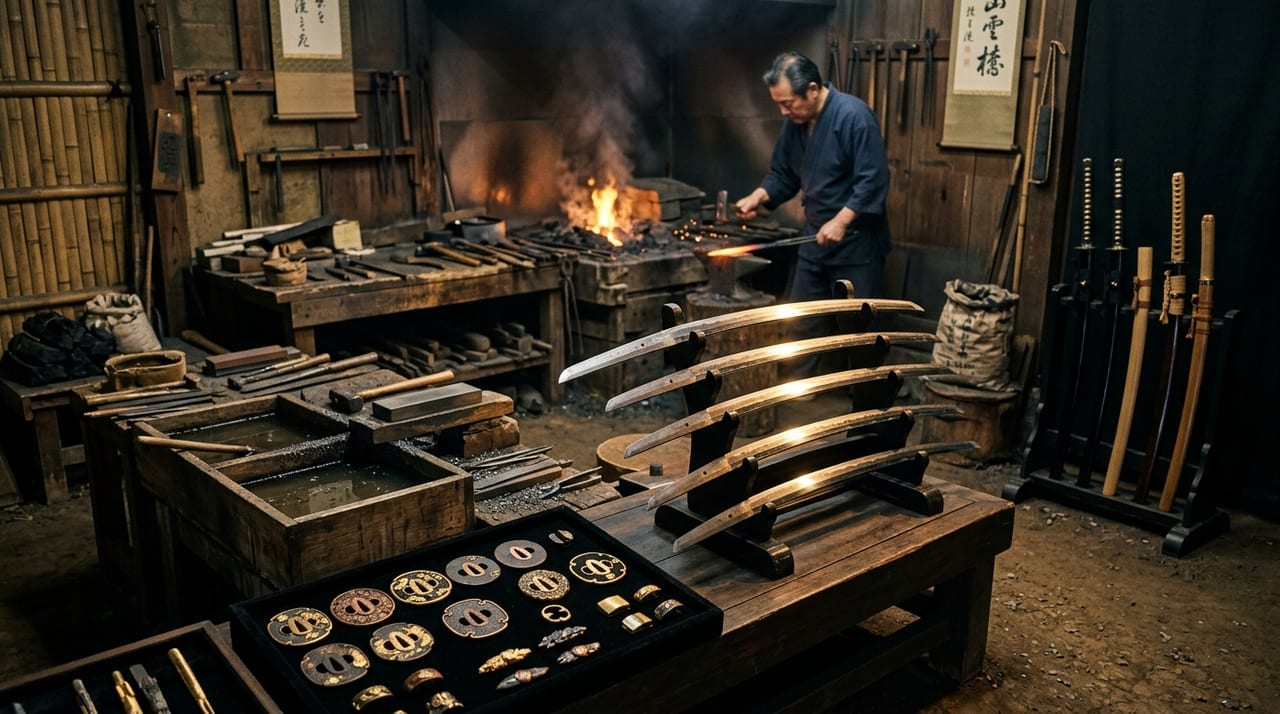 * Image is for illustrative purposes only.
Table of Contents
Production Clusters of Tōkō — Why Did Tōkō Concentrate in Specific Regions?
When the sword-production centers of Japan are plotted on a map, it becomes clear that tōkō were not distributed evenly but were concentrated in specific regions. As representative examples of kaji-machi — communities where large numbers of tōkō lived together — the following production centers can be cited.
- Osafune, Bizen Province (present-day Osafune-chō, Setouchi City, Okayama Prefecture)
- Seki, Mino Province (present-day Seki City, Gifu Prefecture)
- Sanjō, Yamashiro Province (present-day Kyoto City)
- Kamakura, Sagami Province (present-day Kamakura City, Kanagawa Prefecture)
This phenomenon of production-cluster formation presents an economically interesting question. The reasons why competing tōkō concentrated in the same region are analyzed from the following four angles.
- "Access to Raw Materials"
- "Technological External Economies"
- "Access to Markets"
- "Socio-institutional Factors"
Access to Raw Materials — Geographical Conditions of Iron Sand, Charcoal, and Water
The most important material in sword production is tamahagane, whose raw materials are iron sand and charcoal. Proximity to iron-sand deposits and charcoal supply sources was the most fundamental condition for the formation of kaji-machi.
Behind the development of Osafune in Bizen Province lay the iron sand brought from the Chūgoku Mountains and abundant forest resources. The network of material transport using the waterway of the Yoshii River also played an important role in Osafune's development as a major production center. The riverside location was advantageous both for bringing in materials and shipping out finished products, and was also well-suited for securing the clean, clear water essential for yaki-ire.
In Seki, Mino Province, charcoal from the Nagara River basin and iron resources of Gifu Prefecture supported the sword-smithing industry. Furthermore, Seki was a key inland hub, and its proximity to the distribution networks of the Tōsandō and Nakasendō roads also promoted the formation of production clusters. A system naturally took shape in which orders and raw materials from all parts of the country flowed into Seki, consolidating its foundations as a production center.
Technological External Economies — The Accumulation of Skill and Mutual Learning
The technical synergies that arise when people in the same trade gather in one region are called "external economies" in economics. In sword-smithing production centers as well, these technological external economies operated powerfully.
The accumulation of skill at Osafune was not solely due to the presence of individual outstanding tōkō but was also the product of technical dialogue and mutual refinement among them. The "benefits of agglomeration" were at work: craftsmen in the same trade learned from and were inspired by each other's work, raising the overall level of skill.
Particularly important was the development of specialized division of labor known as shitashoku. In sword-smithing production centers, the co-residence of specialist craftsmen for each stage of production — as listed below — formed a complete production cluster.
- Tōkō, who produce the blade
- Togishi, who specialize in togi (polishing)
- Sayashi, who make the saya (scabbard)
- Kinkōshi, who produce metal fittings, and others
This specialist-division-of-labor structure of production centers enabled higher-quality and more efficient production than having a single craftsman handle all stages, raising the overall standard of finished products.
It was precisely this fertile ground of accumulated skill that allowed such master smiths as "Seki no Magoroku (Kanemoto)" and "Seki no Matashirō (Kanesada)" to emerge from Seki. Through competition and cooperation with other tōkō, each tōkō honed his own distinctive technical identity. Even today, the brand "Seki no Hamono" carries on this legacy.
The Domain System and Kaji-machi — Coexistence of Okakaetōkō and Machikatatōkō
Under the domain system of the Edo period, the status of tōkō differentiated into two types: okakaetōkō and machikatatōkō.
| Category | Employment / Management | Source of Income | Characteristics |
|---|---|---|---|
| Okakaetōkō | Employed by the domain | Stipend (fuchi) from the domain lord | Domains sought to protect and monopolize the industry, though treatment was sometimes unstable depending on the domain's finances. Each domain developed its own system — such as the Naminohira school of Satsuma domain and the Hayashi school of Kaga domain — nurturing a blade style with regional character |
| Machikatatōkō | Outside direct domain control; independent commercial activity | Orders from ordinary samurai and merchants | Active in major cities such as Edo, Osaka, and Kyoto; Edo in particular functioned as the "greatest sword market in the realm" |
Throughout the Edo period, large numbers of machikatatōkō were active in Seki, supplying a wide range of swords from mass-produced items known as kazuuchimono to individually commissioned pieces. Kazuuchimono were swords that prioritized price and quantity over quality, and were mass-produced as practical weapons for ashigaru (foot soldiers) and lower-ranking samurai. This mass-production system is the very origin of the industrial cluster by which Seki is still known today as "the town of blades."
Daily Life of Edo-Period Tōkō and the Craftsman Community
The daily lives of the tōkō who lived together in kaji-machi have gradually come to light from documentary records and archaeological materials. A tōkō's day began with the hi-ire (lighting of the forge fire) in the early morning. The forge was lit, iron was heated, hammers were swung together with apprentices, and by evening work ended and the forge fire was extinguished. This daily routine was intertwined with the annual calendar of events; on certain days, work was suspended and attendance at shrine visits or ritual ceremonies was required.
The craftsman community within kaji-machi was often regulated by guild-like organizations called za. Za oversaw the maintenance of technical standards, price controls, and the operation of the apprenticeship system, preserving order among fellow craftsmen. The master-apprentice relationship was the core of the social structure of kaji-machi; apprentices lived in their master's house, spending every aspect of daily life under his guidance as they learned the craft. This apprenticeship system was not merely a mechanism for transmitting technique but also a place for character formation, passing on to the next generation the ethics, aesthetic sensibility, and professional pride of the tōkō.
Present-day Seki City (Gifu Prefecture) has inherited the tradition of the Edo-period sword-smithing production center and has developed into one of the world's foremost industrial clusters for edged tools. The economic and social structure of kaji-machi is also attracting attention as a prototype in contemporary industrial-cluster research. When appreciating a sword, reflecting on the history of the production center and craftsman community that lie behind it lends even deeper meaning to the sword's beauty.
Conclusion — The Diversity of Nihontō Born from Production Clusters
The production clusters of tōkō were formed through a complex interplay of materials, technology, markets, and institutions. Each production center — Bizen, Mino, and Yamashiro — nurtured its own distinct sword culture within its regional conditions and historical context, giving rise to the rich diversity of nihontō.