Sankin-kōtai and the "Travel Sword" — The Sword-Carrying Culture Born of Long-Distance Travel in the Edo Period and the Sword Management of Rural Samurai
 * Image is for illustrative purposes only.
Table of Contents
Sankin-kōtai and the Samurai Sword — A Traveling Sword Culture
The sankin-kōtai system imposed on daimyo by the Edo shogunate (fully established from 1635, following the revision of the Buke Shohatto) had an unexpected influence on nihontō culture. The daimyo processions that traveled between Edo and the home domain every year (with some domains on a biennial system) were not merely a political obligation but also a testing ground for sword-carrying culture.
The sankin-kōtai processions were accompanied not only by the daimyo himself but by large numbers of samurai, from karō (senior retainers) and kumigashira (unit commanders) to samurai retainers and ashigaru (foot soldiers). In the case of large domains, the procession could number from several hundred to over a thousand, and every member carried some form of sword. The practical knowledge of sword-carrying generated by this "moving armed group" is, from a modern perspective, remarkably fascinating.
Swords on the Road — The Development of Tabi-goshirae
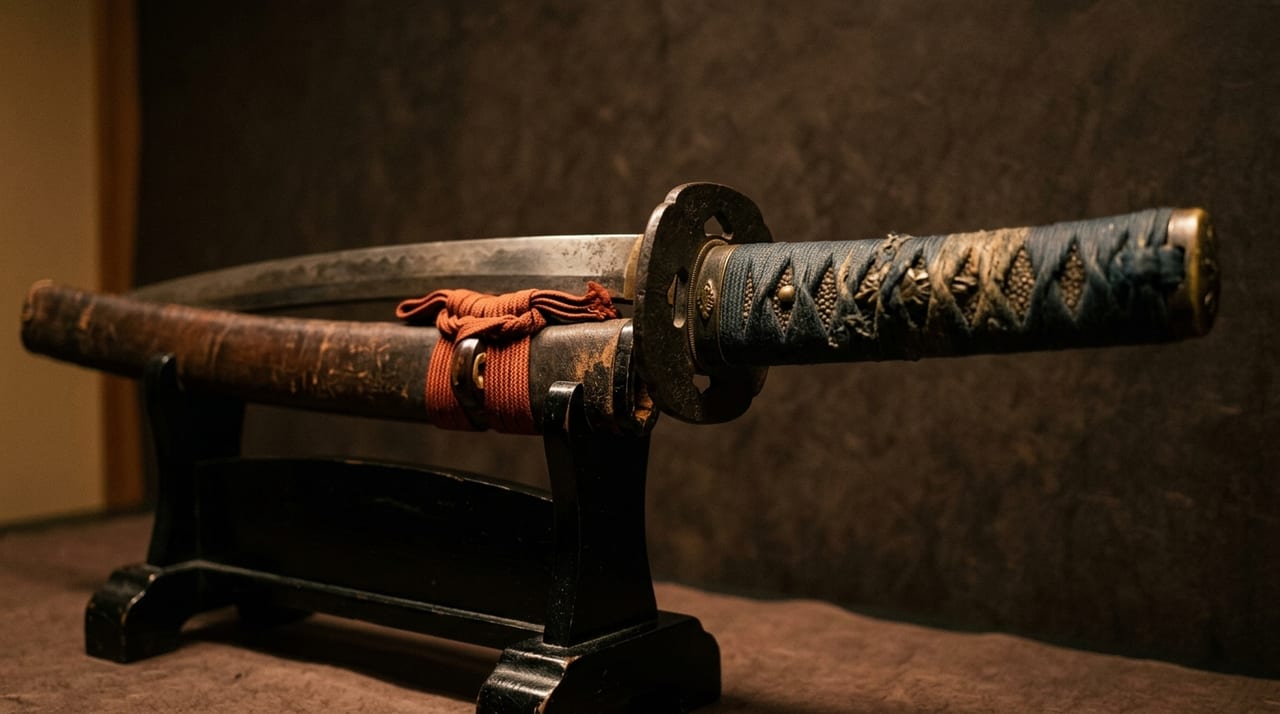
On long-distance marches on foot, "tabi-goshirae" (travel koshirae) developed that prioritized durability and practicality over ceremonially ornate koshirae. In tabi-goshirae, practicality was emphasized in the following respects.
- Saya finish: Rather than thin lacquer coats or a plain black finish, materials were chosen that were less prone to showing scratches and dirt, and more resistant to moisture and impact — such as leather-wrapped saya or mokume-finished saya.
- Menuki and fuchi-kashira: Practical shapes were preferred over elaborately crafted metalwork, and robust designs were required so that the mekugi holes would not widen and the fittings would not be damaged by the vibrations of travel.
- Tsuka wrapping material: Materials that would not easily degrade grip even when wet from sweat or rain were chosen — cotton cord rather than silk, or in some cases same-kawa (ray skin) alone with no cord wrap.
- Wearing method: On sankin-kōtai journeys, methods suited to walking were adopted rather than formal wearing methods; while tachi were used on horseback and at ceremonies, the predominant form during overland marches on foot was to thrust a uchigatana through the waist belt. Records indicate that some attendants carried only the somewhat lighter wakizashi, since on long-distance marches the balance of the sword's center of gravity directly affected the burden on the body.
The Home Domain and Edo — Two Systems of Sword Management
Another challenge created by sankin-kōtai was "sword management across two bases." Daimyo in principle maintained residences in both the home domain and Edo, and swords had to be managed separately at each location.
The domain residence in the home province housed the "hereditary prized swords" passed down through the generations. These were ordinarily managed by the o-dōgugata (armaments steward) as the domain's treasures, and were brought out for important ceremonies and gifts. The swords brought out for the sankin-kōtai journey, on the other hand, were selected with a balance of practicality and prestige in mind. The finest heirlooms were not taken on journeys; rather, mid-grade fine swords or practical gendaitō were often used for the road.
At the Edo residence as well, formal-dress swords kept in readiness for audiences with the shogun and swords for everyday samurai life were managed separately. It was customary to use a specific koshirae appropriate to one's rank when attending an audience (hiken) with the shogun, and this was called "denchū-zashi."
Sword Management of Rural Samurai — The Hidden Pillars Supporting Sankin-kōtai
While the daimyo was stationed in Edo, the domain administration in the home province was run by rural samurai centered on the "rusuiyaku" (caretaker official). Their sword management faced challenges quite different from those of samurai accompanying the sankin-kōtai procession.
Rural samurai had an obligation to maintain their equipment — "kinban-jitaku" (duty-post readiness) for service in Edo — so they could respond at any time to a summons to the capital. With regard to swords, regular application of rust-preventing oil, moisture management of the saya, and inspection of the mekugi were carried out as daily routines. Among the rural samurai in agricultural areas, there were those who combined everyday farm work with samurai duties; for such individuals, the management costs provided by the domain were often insufficient to cover sword maintenance, and the expense frequently fell to them personally.
Some domains enacted domain laws concerning the sword management of rural samurai. Records remain indicating that in the Higo Kumamoto domain, rural samurai submitted their swords once a year to the domain's tōken-bugyō (sword magistrate) for inspection of condition and repair as needed.
Sword Accidents on the Road and How They Were Handled
On the long marches of sankin-kōtai, sword-related problems also arose. The most common were damage to the saya and loosening of the koiguchi. The vibration of long-distance walking and moisture from sweat damaged the interior of the saya, causing "saya-zumari" (saya-binding) in which the sword became difficult to draw, and conversely the danger of the saya loosening and the sword sliding out.
To deal with such situations, daimyo processions included samurai designated as "katana-ban" (sword attendants) responsible for swords. They inspected the condition of swords at each shukuba (post town) along the way, carried out minor repairs themselves, and when specialist repair was needed they called upon the sword craftsmen — kaji and togishi — of the post town.
Old documents from various localities confirm that kaji and togishi who anticipated this demand had set up business in post towns along sankin-kōtai routes. In particular, records exist indicating that sword repair businesses at post towns on major highways such as the Tōkaidō, Nakasendō, and Ōshū-dōchū operated in conjunction with inns.
What Sankin-kōtai Left for Sword Culture
With the abolition of the sankin-kōtai system (following the Meiji Restoration), the tabi-goshirae culture it had sustained also gradually declined. However, the practical koshirae techniques that developed on the road — in particular the saya-shi's methods that reconciled durability with functional beauty — have been handed down in part to modern shirasaya production and craft koshirae.
The economic stimulus that sankin-kōtai provided to tōkō and sword craftsmen throughout the country is also not to be overlooked. The provincial tōshō who handled sword repair and adjustment on the road honed practical skills distinct from those of first-rank tōkō in Edo and Osaka. This "practical skill of provincial kaji" continues to be valued today as a sword culture more closely tied to everyday life, distinct from the prestige of the Gokaden.
The fact that the political institution of sankin-kōtai unintentionally diffused sword culture throughout Japan, nurturing a unique sword management and repair culture in each region, is one of the important perspectives in the study of nihontō.