The Science of Yaki-ware and Hi-ware: The Mechanisms by Which a Blade Fractures and the Preventive Techniques Practiced by Tōshō
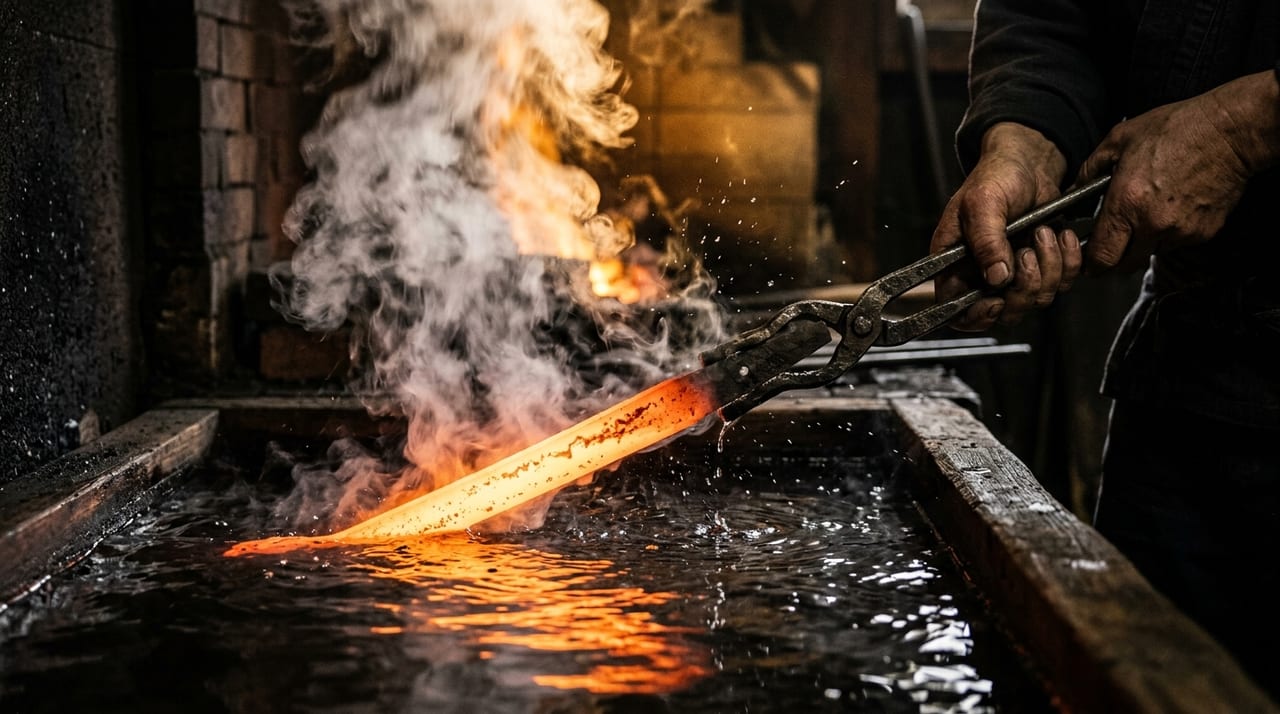 * Image is for illustrative purposes only.
Table of Contents
What Is Yaki-ware? — Blade Fracture Caused by Rapid Cooling
One of the most tension-filled moments in the Japanese sword-making process is yaki-ire (quenching). Plunging the red-hot blade rapidly into water produces the hamon, but this process simultaneously carries the risk of "yaki-ware."
Yaki-ware is the collective term for cracks and fractures that occur in the blade due to the rapid cooling of yaki-ire. More specifically, it is the destructive phenomenon whereby thermal stress — generated when the martensitic transformation (the structural change caused by yaki-ire) proceeds unevenly between the cutting edge and the mune and jigane sections — exceeds the tensile strength of the steel, causing the blade to split.
"Hi-ware," on the other hand, is sometimes used as a broader term referring not only to fractures during yaki-ire but also to cracks in the blade caused by overheating or rapid cooling during tanren. Usage of the terms differs from tōkō to tōkō, but in this article both are treated together as "heat-treatment-induced blade fracture."
The Mechanism of Fracture — Martensitic Transformation and Residual Stress
To understand yaki-ware, one must grasp the metallurgical changes that occur in steel during yaki-ire.
When the blade is heated to the yaki-ire temperature (approximately 800–850°C), the steel transforms into an austenite structure. When this is rapidly quenched in water, the high-carbon zones of the cutting edge transform into martensite, forming a hard and brittle structure. Meanwhile, the low-carbon portions of the mune and jigane remain as pearlite and bainite type structures.
The problem lies in the fact that this transformation is accompanied by volumetric expansion. Because martensitic transformation causes approximately 4–5% volumetric expansion, residual stress is generated as the force of the cutting edge trying to expand and the force of the already-cooled mune and jigane trying to contract pull against each other. When this tensile stress concentrates unevenly across the cross-section of the blade, cracks form at the stress concentration points, and in the worst case the blade fractures completely.
The risk is particularly high in the following cases:
- When the tsuchioki mixture is not uniform
- Near the "munemachi," where the cross-section of the blade changes abruptly
- Steel containing forge cracks or internal defects
When these factors coincide, the blade can split in two at the moment of yaki-ire with a sharp cracking sound.
Tsuchitori, Water Temperature, and Blade Temperature — Three Control Variables
There are primarily three variables that a tōshō can practically control to prevent yaki-ware.
- The first is the composition and thickness of the tsuchitori. Tsuchioki is the clay mixture applied to the blade before yaki-ire; by applying it thinly to the cutting edge and thickly to the mune, it creates a difference in cooling speed during yaki-ire and generates the hamon. Since the thickness of the clay functions as a "buffer" for the cooling rate, if the clay on the mune is too thin, rapid-cooling stress concentrates there and the blade becomes prone to cracking. Veteran tōshō develop, through years of experience, an intuitive judgment of "this thickness for this steel," and this constitutes part of each individual tōkō's "secret tradition" of yaki-ire.
- The second is water temperature management. The temperature of the water used for yaki-ire is generally in the range of approximately 15–25°C, but the optimal value varies depending on the composition of the steel, the season, and the shape of the blade. If the water temperature is too low, the cooling rate becomes too fast and the risk of cracking increases; if it is too high, sufficient hardness cannot be achieved. In winter the water temperature can fall below 10°C, and some tōshō adjust by using lukewarm water.
- The third is the angle and speed of immersion. The angle, speed, and orientation (edge upward, downward, or diagonal) at which the blade is plunged into the water determines which part is rapidly cooled first. The distribution of residual stress differs greatly depending on whether the cutting edge enters first, the mune side enters first, or the entire blade is plunged in at once. Many tōshō "plunge the blade in quickly with the edge facing downward," but even a slight difference in the angle used to draw out the hamon affects both the shape of the hamon and the risk of cracking.
The Relationship Between Internal Defects in Steel and Yaki-ware
One of the predisposing factors of yaki-ware is internal defects in the steel — in particular, "kitae-ware" (forge cracks). Fine cracks, delamination, and bubble traces produced during the tanren process may not be visible to the naked eye, but can be brought to the surface by the thermal stress of yaki-ire and become the starting points of fractures.
For this reason, tōshō carefully adjust the number of rounds of orikaeshi tanren, the heat level, and the intensity of hammer strikes from the tanren stage onward in order to prevent internal defects from forming. Some tōkō incorporate a step of having a togishi perform an "ara-togi" (rough polish) before yaki-ire, examining the surface to confirm there are no signs of cracking. When defects in the steel are suspected, not a few tōshō make the decision to halt yaki-ire and re-forge.
How a Tōshō Responds When Yaki-ware Occurs
Unfortunately, yaki-ware is something even a skilled tōshō cannot completely prevent. Especially when the properties of the steel are not uniform, or during seasonal transitions when water temperature and humidity are unstable, fracture accidents can occur even for experienced craftsmen.
How a fractured blade is handled depends on the extent of the fracture.
| Extent of fracture | Response |
|---|---|
| Fine cracks near the hamon ("ko-ware") | May be removable by a togishi through polishing |
| Large fractures that penetrate the blade (complete fracture) | The blade has no option but to be discarded |
Many tōshō keep the fractured steel rather than discarding it, holding onto it as "material for reflection" and analyzing what caused the fracture. They look back on the clay thickness, water temperature, immersion angle, and condition of the steel, and apply the lessons to the next yaki-ire. This accumulation is what forges the tōshō's skill in yaki-ire.
Prevention Through the Fusion of Modern Science and Traditional Technique
Among modern tōshō, there are those who use metal microscopes, hardness testers, and thermocouples (temperature sensors) to evaluate the risk of yaki-ware in advance. By introducing tools for simple measurement of carbon distribution in steel and precision water-temperature management devices, scientific approaches that do not rely solely on accumulated experience are gradually spreading.
Ultimately, however, the finished quality of the blade depends greatly on the intuitive judgment of the tōshō's "eyes, ears, and hands." The technique of reading the color of the steel during yaki-ire, the way the steam rises from the water, and the sound at the moment of immersion — interpreting all of these in combination and controlling the razor-thin balance between hamon formation and fracture — remains the core of a craftsman's art that still cannot be fully reduced to writing or numbers.
For a tōshō, yaki-ware and hi-ware are "failures," but at the same time they are the finest teachers of the profound depths of heat treatment. Continuing to face the fear of fracture is the foundation of the technical maturity that a tōshō needs to produce a great sword.