 * Image is for illustrative purposes only.
Ashikaga Yoshiteru
足利義輝
13th Shogun of the Muromachi Shogunate, the Swordsman Shogun
Description
Ashikaga Yoshiteru (1536-1565) was the 13th shogun of the Muromachi shogunate, a rare warrior known by the epithet "the Swordsman Shogun." Amid the upheaval of the Sengoku period he struggled to restore the authority of the shogunate. His life ended in a fierce death in which he wielded a sword himself, and it is full of the tragic brilliance of a warrior who, though standing at the summit of the warrior class, sought to master the way of the sword.
Yoshiteru is also said to have been an accomplished martial artist. Despite his noble station as shogun, it is widely known that he received instruction from Tsukahara Bokuden, the foremost swordsman of his day. Bokuden is also said to have passed the secret technique "Hitotsu no Tachi" on to Yoshiteru, but Bokuden also taught it to Kitabatake Tomonori, Hosokawa Fujitaka and others, so it cannot be stated with certainty that Yoshiteru mastered the secret technique. It is also said that Kamiizumi Nobutsuna (Ise-no-kami), founder of the Shinkage-ryū, demonstrated his martial teachings in Yoshiteru's presence and received a letter of commendation (kanjō).
In Yoshiteru's time the authority of the shogunate had declined markedly, and Miyoshi Nagayoshi held real power. In 1549 Yoshiteru was driven out of Kyoto by the Miyoshi family and fled to Ōmi, enduring a string of hardships. In 1558, however, he returned to Kyoto and sought to restore the authority of the shogunate. He displayed outstanding skill in mediating peace with Sengoku daimyō and in diplomatic negotiations. Through his dealings with Mōri Motonari, Takeda Shingen, Uesugi Kenshin and others, he made maximum use of the authority of the shogun.
However, the image of Yoshiteru as a man who especially loved swordsmanship and swords is seen by some scholars as having been shaped largely in later times, from his valiant fighting during the Eiroku Incident.
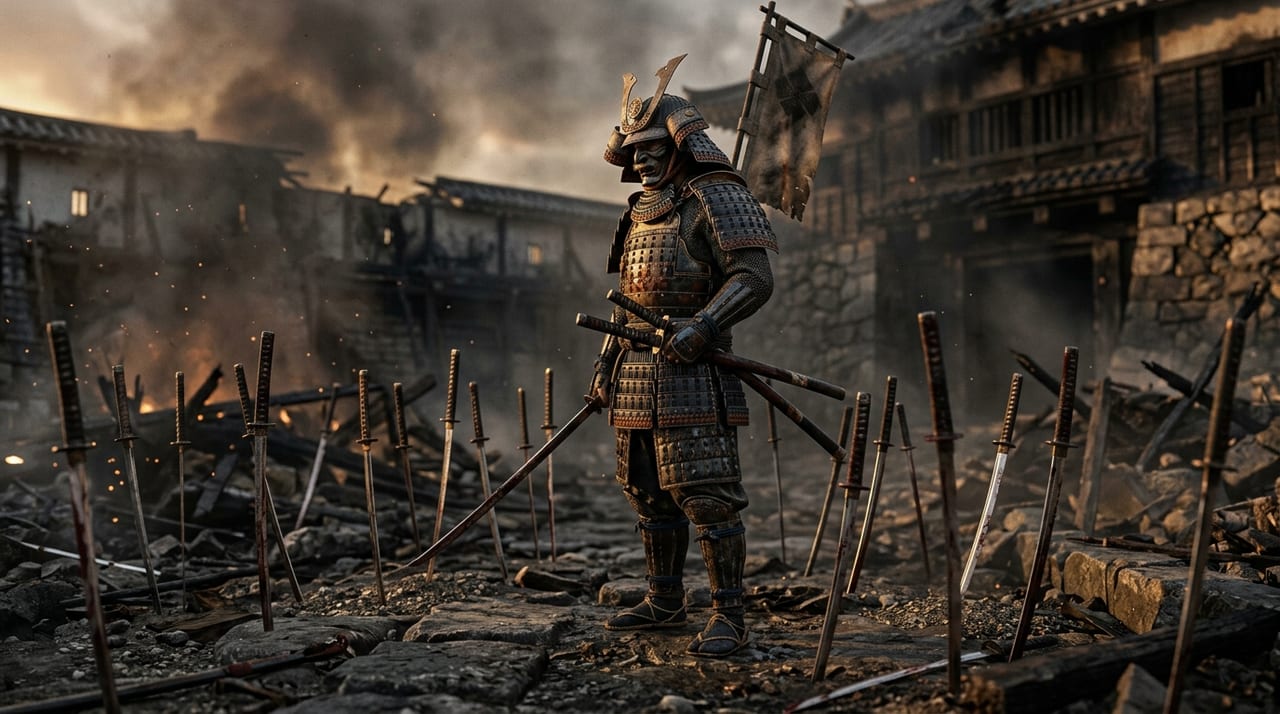
On the 19th day of the 5th month of Eiroku 8 (17 June 1565), during the Eiroku Incident, Yoshiteru was surrounded at the Nijō Palace by the forces of Miyoshi Yoshishige (later Yoshitsugu), the Miyoshi Triumvirate (Miyoshi sanninshū) and Matsunaga Hisamichi (son of Matsunaga Hisahide). According to Luís Fróis's História de Japam, Yoshiteru did not flee. He wielded a naginata himself and later drew his sword and fought valiantly. The anecdote that he "drove his sword into the tatami and replaced it each time the edge chipped as he fought" appears in later works such as the Nihon Gaishi and is considered to have low credibility. It is nonetheless told as an episode showing his spirit as a warrior. His death, in which he fought to the end against the vast enemy host, was a fierce last stand truly worthy of the name "the Swordsman Shogun."
After Yoshiteru's death, Ashikaga Yoshihide, installed by the Miyoshi Triumvirate and others, became the 14th shogun. His younger brother Ashikaga Yoshiaki entered Kyoto with the support of Oda Nobunaga and became the 15th shogun. Yoshiteru's life, in which he fought with sword in hand until the end, is one of the most dramatic proofs that the Japanese sword, as a weapon, goes beyond mere tool and is inseparably bound to the spirit of the warrior.