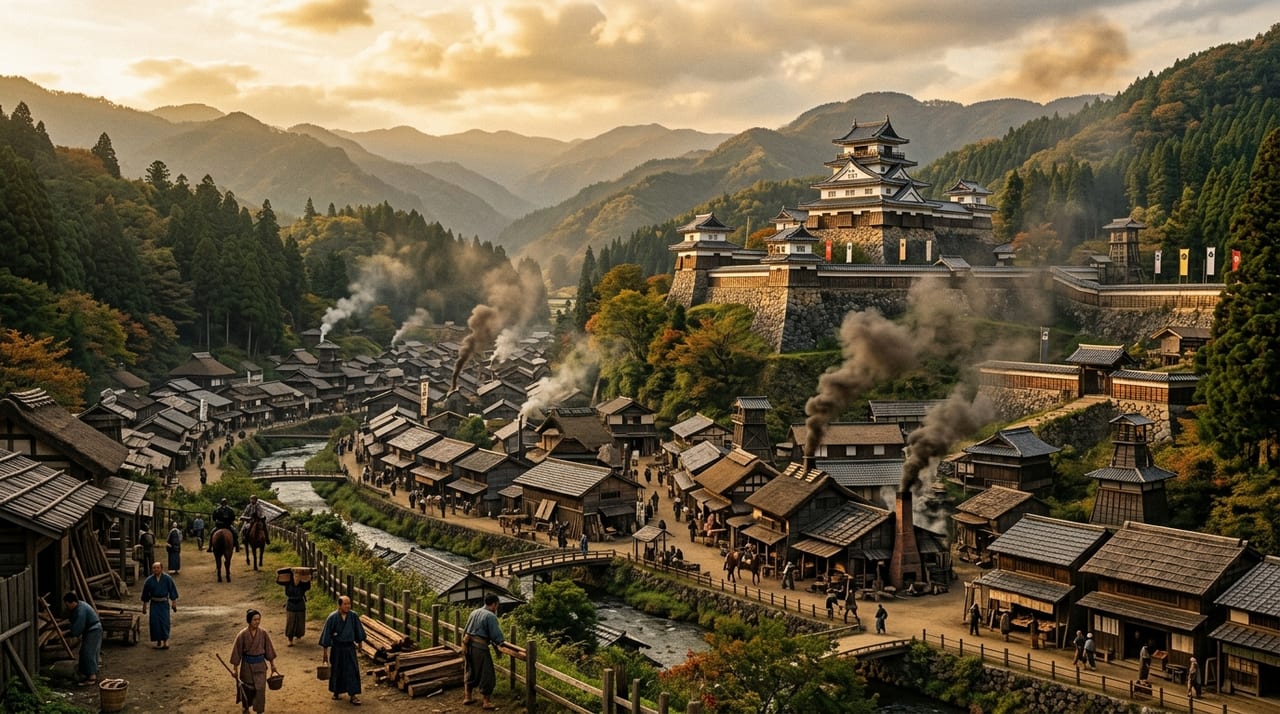
 * Image is for illustrative purposes only.
Regional Sword Culture After the Ōnin War
応仁後の地方刀剣文化
After the Ōnin War ended in 1477, sword production shifted from Kyoto to regional centers across Japan. Sengoku warlords patronized local smiths, sparking a bloom of distinctive regional sword cultures in Kyushu, the Kantō region, the Chūgoku region, and Shikoku that enriched the diversity of Japanese sword tradition.
Description
Kyoto's Collapse and Regional Dispersal after the Ōnin War
The Ōnin War (1467–1477) devastated Kyoto and dealt irreparable damage to the authority of the Muromachi shogunate. This decade-long conflict triggered a massive population migration that evacuated bearers of court culture, learning, and crafts previously centered in Kyoto to the provinces. The sword-making industry was no exception: a portion of swordsmiths, sword-fitting artisans, and polishers of the Yamashiro tradition, who had been active in Kyoto, flowed out to the provinces and settled there seeking patronage from regional warlords. This "localization of artisans" became a catalyst for the greatest regional diversification in Japanese sword history. Simultaneously, the traditions rooted in the provinces since before Ōnin—such as Bizen, Mino, Yamato, and Sagami—gained the opportunity to develop more independently, freed from central control. Bizen Osafune transformed into mass-production systems as Sue-Bizen, while Mino Seki achieved rapid growth as a supply base for Sengoku-period swords. Yet more intriguing was the fact that regions hitherto peripheral to sword production began to form their own distinctive sword cultures.
Kyushu Sword Culture: Hizen, Chikuzen, and Satsuma
In Kyushu, Hizen Province (present-day Saga and Nagasaki prefectures), Chikuzen Province (present-day Fukuoka Prefecture), and Satsuma Province (present-day Kagoshima Prefecture) developed distinctive sword cultures. Of paramount importance to Kyushu's regional swords is the Naminohira Yukiyasu lineage, which inherited traditions stretching back to the late Heian period and maintained its transmission through the post-Ōnin era. The Naminohira school was centered in Yayama, Satsuma Province (present-day Yayama district, Kagoshima City), and met the demands of warriors serving under the Shimazu clan. The Naminohira school's characteristic style features a tightly packed itame-pattern jigane with jiniete, and practical suguha hamon with small waves interspersed—displaying the robust forms that embody Satsuma's martial spirit. Meanwhile, in Chikuzen Province, the Samonji lineage maintained its transmission after Ōnin, and swordsmiths developed their own Sagami-tradition techniques. Major Sengoku warlords of Kyushu—Ōtomo Sōrin, Ryūzōji Takanobu, and Shimazu Yoshihiro—actively supported local swordsmiths, laying the groundwork for domain-sponsored swordsmith systems. The Shimazu clan was particularly devoted to protecting the Satsuma tradition, creating the foundation for this lineage to continue as Satsuma shinzō and modern Satsuma sword culture in the Edo period.
Eastern Territories Swords: Kantō and Tōhoku
The post-Ōnin sword culture of the Kantō and Tōhoku regions is closely tied to the rise of Sengoku warlords including Hōjō Sōun, Uesugi Kenshin, Takeda Shingen, and Date Masamune. Smith communities of Sagami Province (present-day Kanagawa Prefecture) tenaciously inherited the Sagami tradition from the Kamakura period, forming the foundation for later Kantō sword production. In Echigo Province (present-day Niigata Prefecture), under Uesugi Kenshin's patronage, a community of Echigo swordsmiths developed and supported Shingen and Kenshin's fierce battles with their blades. In the northeast, Dewa Province (present-day Yamagata and Akita prefectures) and Mutsu Province (present-day Miyagi, Iwate, and Fukushima prefectures) developed their own regional sword cultures. In particular, Dewa swordsmiths became the soil from which great Edo-period masters like Suishinshi Masahide and Taikei Naotane would later emerge. These eastern swords possess a generous and robust individuality distinct from the precision of the Gokaden, embodying the diversity of geographically rich sword culture.
Chūgoku and Shikoku Sword Cultures
In the Chūgoku region, distinctive smith communities developed in Bingo Province (present-day eastern Hiroshima Prefecture), Aki Province (present-day western Hiroshima Prefecture), Iwami Province (present-day western Shimane Prefecture), and Nagato Province (present-day Yamaguchi Prefecture). The rise of the Mōri clan and the activities of their subordinate swordsmiths played a decisive role in shaping the sword culture of the Chūgoku region. Aki swordsmiths, while strongly influenced by Bizen-tradition techniques, left works expressing distinctive characteristics unique to the Chūgoku region in their jigane forging and hamon patterns. In Shikoku, swordsmiths were active in Iyo Province (present-day Ehime Prefecture) and Tosa Province (present-day Kōchi Prefecture), but did not develop as distinctive a tradition as other regions; many craftsmen adopted techniques from Bizen and Mino to meet local lords' demands.
Artistic Significance of Regional Sword Culture
The greatest artistic legacy that post-Ōnin regional sword culture left to Japanese sword history is the establishment of "regionality" as an aesthetic category. Removed from the classical value system of the Gokaden, provincial swords possessed the potential for their "roughness" falling short of ancient traditions to be evaluated instead as direct expression of the region's nature, people, and culture. In contemporary sword appreciation, regional swords are evaluated as "wakimono" in a separate aesthetic category from swords of major Gokaden production centers. Many regional-sword works possess distinctive attractions not found in Gokaden blades: the unique landscape of jigane using locally-sourced special iron sand, the individuality of heat treatment created by the region's climate and water quality, and distinctive characteristics of form and fittings reflecting the local martial spirit.
Collecting Perspectives and Possibilities
Collecting regional swords is often a field where prices are more modest compared to swords from major Gokaden production centers, affording considerable room to discover hidden gems. In particular, Kyushu pieces such as Satsuma and Naminohira swords have a loyal following, offering the pleasure of collecting within the historical context of the Shimazu clan and Satsuma domain. Eastern swords such as those from Echigo and Dewa often possess historical connections to renowned warlords like Uesugi, Takeda, and Date, and are highly popular with history-minded collectors. In authenticating regional swords, careful observation of regionally distinctive elements—such as characteristics of locally-sourced iron, region-specific forging techniques, calligraphic style of signatures, and nakago forms—is essential, and this itself becomes an intellectual journey of coming to know the iron, people, and culture of various regions of Japan.
Characteristics of This Era
- Artisan dispersal — post-Ōnin migration of smiths to provincial domains created geographically distinct production centers
- Regional identity in steel and hamon — local ore, charcoal, and water produced aesthetically distinctive blades reflecting regional culture
- Proto-domain-smith system — Sengoku warlords' patronage laid the groundwork for the formal domain-sponsored swordsmith institutions of the Edo period
- Historical warrior connections — many regional swords can be linked to specific Sengoku commanders, providing history-rich provenance for collectors