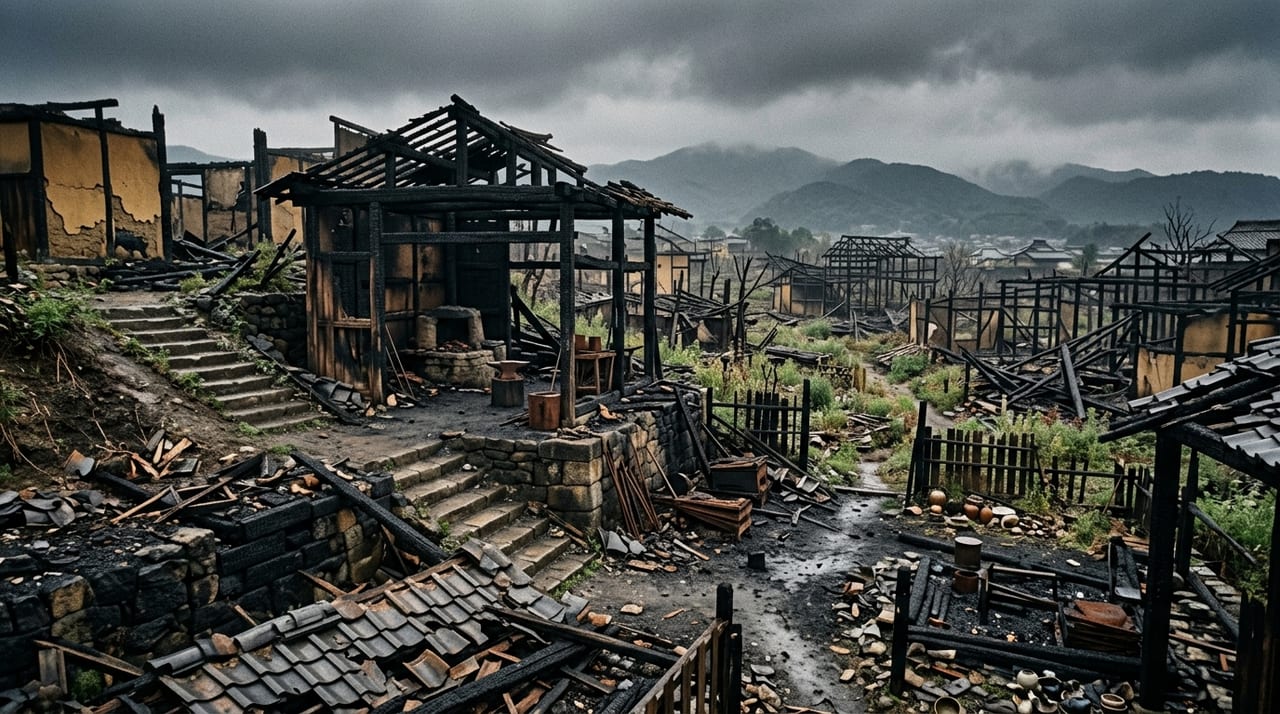
 * Image is for illustrative purposes only.
Yamashiro Smithing Decline in the Ōnin War Aftermath
応仁後の山城鍛冶衰退期
In Kyoto, reduced to ashes by the Ōnin War (1467–1477), swordsmith activity also declined sharply. Prestigious Yamashiro tradition lineages such as the Rai and Awataguchi schools had already passed their peak in the Kamakura to Nanboku-chō period. Yamashiro's sword culture declined rapidly, which in turn was a distant cause of the flourishing of regional sword cultures such as Bizen and Mino.
Description
Ōnin War and the Devastation of Kyoto
The Ōnin War, which broke out in Ōnin 1 (1467), turned Kyoto into a battlefield for more than ten years, and its flames burned much of the city. The Yamashiro tradition, which had once been Japan's foremost sword-producing center, had already seen its prestigious schools, the Rai school, the Awataguchi school, and the Sanjō school, pass their peak in the Kamakura to Nanboku-chō period. The war further reduced the activity of Kyoto's swordsmiths. After the Ōnin War, “Yamashiro-mono” rapidly declined in output, and in the mid-to-late Muromachi period it lost its leading role completely to Bizen and Mino.
Dispersal of Yamashiro Swordsmiths
Smiths descended from the Rai school had already split off into various regions around the Nanboku-chō period, long before the Ōnin War, as Nakajima Rai in Settsu and the Enju school in Kyushu. Technical transmission in Yamashiro proper became increasingly fragile, and the essence of the Yamashiro tradition was gradually lost, including the fine ko-itame and deep nie suguha of the former Awataguchi and Rai schools. Post-Ōnin Yamashiro blades are classified as “sue-kotō,” but compared with works of the Kamakura and Nanboku-chō periods, an overall decline in quality cannot be denied.
The Rise of Bizen and Mino
In contrast to the decline of Yamashiro, this era was when Bizen Province (Okayama) and Mino Province (Gifu) rose as Japan's largest sword-producing regions. The Osafune line in Bizen was not directly harmed by the Ōnin War, and its smiths continued to work vigorously. Bizen blades of this period, called “Sue-Bizen,” had lower individual craftsmanship as a result of prioritizing mass production, yet the region still boasted an astonishing industrial concentration in which several hundred smiths were active. In the Mino tradition, the Seki smiths, who traced their descent from Shizu and Kaneuji, achieved remarkable development from the mid-Muromachi period, and the practical “Mino-kitae” blades, excellent in utility, were favored by samurai throughout the country.
The Gekokujō Era and Swords
The social characteristic of this period is “gekokujō” ── a trend in which those of lower standing overthrew those above them. Shugo daimyō were overthrown by shugodai and kokujin, and emerging daimyō rose one after another. Warriors of the emerging forces, unconcerned with family status, sought practical and powerful swords, and tended to choose the vigorous practical blades of Bizen and Mino over the refined style of the Yamashiro tradition. The prestige of Yamashiro blades was still recognized, but a structure became fixed in which actual demand was borne by regional production centers. Swordsmiths of this era lost their stable patrons, the court nobility and the bakufu, and were forced to work in an unstable economic environment, responding to the short-term demand of provincial warlords.
Technical Rupture and Transmission
The most serious problem for the Yamashiro tradition was that the secret forging methods the Rai and Awataguchi schools had been proud of were lost along with the cessation of both schools. Much of the technique passed down through oral instruction from master to disciple was lost due to the cessation of the schools and the severing of master–disciple relationships. This included the methods for forging dense, fine jigane with tight ko-itame, the quenching technique for deep nie suguha, and the details of nakago finishing. Although revival of the Yamashiro tradition was attempted in the shintō period of the Edo era, the historical assessment has become established that full-scale reproduction was ultimately never achieved. This technical rupture is regarded as one of the major losses in the history of Japanese swords.
Characteristics of This Era
- Post-Ōnin Yamashiro blades show an overall decline in both jigane and hamon compared with Kamakura-period masterpieces. The effects of the broken technical transmission appear directly in the works.
- The prestigious Rai and Awataguchi schools had already ceased, and the former technical standard of Yamashiro proper was not reproduced. It was an era in which a gap emerged between traditional authority and actual technical transmission.
- The rise of the Mino tradition and Sue-Bizen was remarkable. Practical Kane-lineage Mino blades and mass-produced Bizen blades swept the market, while Yamashiro-mono retained a presence only as expensive rare items.
- The gekokujō society transformed sword demand. An increasing number of warlords prioritized combat performance over family status and tradition, and the criteria for evaluating swordsmiths also shifted from “works of prestigious lineages” to “practical cutting performance.”
- Some swordsmith activity is also seen in the Kyoto recovery period. However, together with the loss of authority of the Muromachi bakufu, stable patronage was lost, and swordsmiths' livelihoods became extremely unstable.