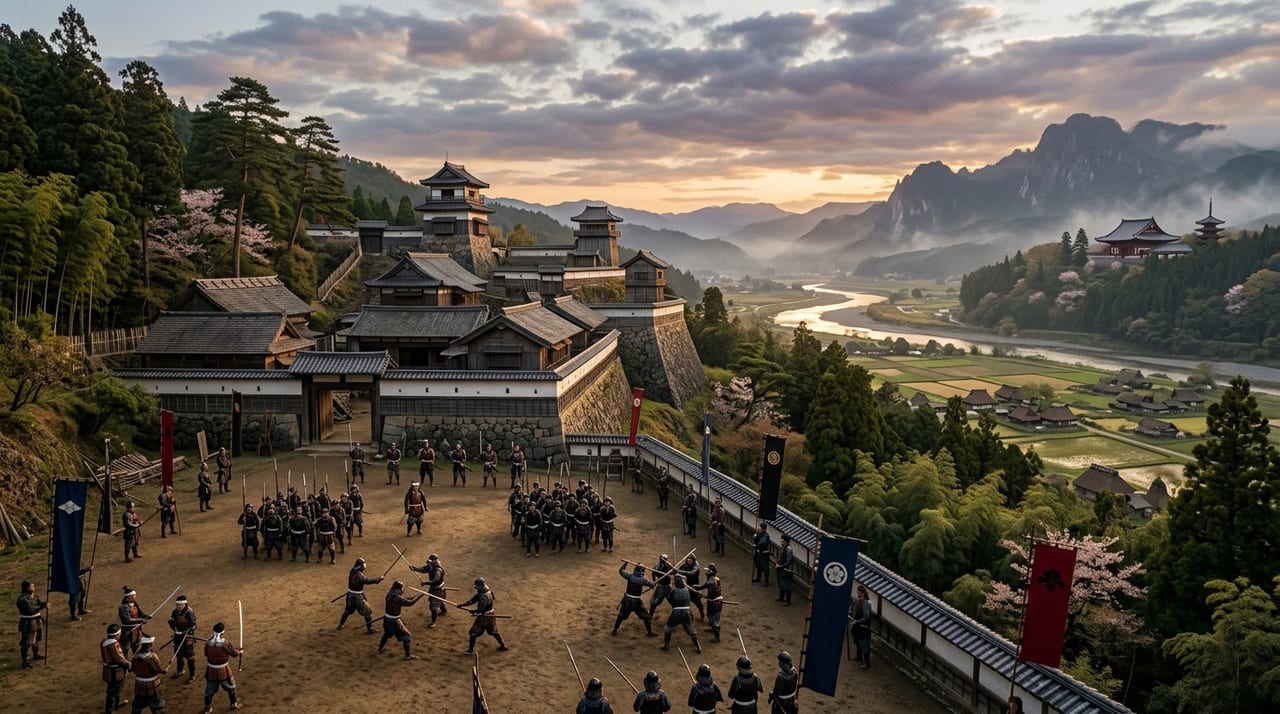
 * Image is for illustrative purposes only.
Rise of the Uchigatana and Changing Sword-Wearing Customs
打刀への移行と携帯様式の変容
Between the mid-Muromachi and Sengoku periods, the dominant sword form shifted from the tachi (edge-down, suspended from the belt) to the uchigatana (edge-up, thrust through the belt), fundamentally transforming blade geometry, length, and fighting technique.
Description
From Tachi to Uchigatana: A Revolution in How Swords Were Carried
One of the most important changes in the history of Japanese swords was a shift in how they were carried. The tachi (太刀), the dominant sword of the Heian and Kamakura periods, was worn hung from the waist with the edge facing down. The tachi was a long, curved sword suited to mounted combat, marked by a slender profile and deep curvature.
From the mid-Muromachi period (15th century), however, the uchigatana (打刀), worn thrust through the waist sash with the edge facing up, began to rise in prominence. The spread of the uchigatana reflected a fundamental change in warfare, from mounted combat centered on cavalry to infantry (kachi, 徒) fighting and massed close combat.
Structural Features of the Uchigatana
The uchigatana differed from the tachi in several ways. In length, the tachi averaged 2 shaku 5 sun to 3 shaku, while the uchigatana tended to be somewhat shorter, about 2 shaku to 2 shaku 8 sun. (However, blades of 2 shaku or longer are classed as katana, and those under 2 shaku as wakizashi.) In curvature, the tachi had koshi-zori (the curve peaks near the base of the blade), whereas the uchigatana increasingly had chū-zori (medium curvature) or saki-zori (curvature concentrated toward the tip). This was a technical adaptation that optimized handling when drawing the sword, reflecting the change to wearing it edge-up.
The tang (nakago) also changed. The tachi's tang was long and somewhat curved to match the koshi-zori shape, while the uchigatana's tang became short and straight, making the sword suitable for both one-handed and two-handed cutting.
Relationship to Ōdachi and Nodachi
From the Muromachi through the Sengoku periods, extremely long swords called ōdachi (大太刀) and nodachi (野太刀), with blades longer than 3 shaku, also enjoyed a brief vogue. These massive battle swords were swung downward from horseback, and some survive today in a form that was ō-suriage (大磨上), meaning the blade was shortened by grinding down the tang and remodeled to uchigatana size. The ō-suriage of nodachi into uchigatana vividly demonstrates the practical, utility-focused spirit of the Sengoku period.
Codification of the Wakizashi
As the uchigatana spread, the short sword called the wakizashi (脇差), under 2 shaku (about 60 cm), also came to be carried at all times. Even before wearing the long and short swords as a pair, the daishō (大小), was codified as the formal dress of the samurai in the Edo period, Sengoku warlords carried the uchigatana and wakizashi as a matched pair in actual combat. This custom was put into writing in the early Edo period and became established as a marker of samurai status.
Impact on Swordsmiths
The spread of the uchigatana placed concrete technical demands on swordsmiths. Optimizing proportions became necessary, including blade length, curvature, kasane (the thickness of the back, or spine side), moto-haba (width at the base), and saki-haba (width at the tip), and the smiths of each school adopted designs suited to the demands of their time. In particular, smiths of the Mino tradition (Gifu), such as Kanemoto and Kanesada, excelled at producing uchigatana that combined mass-producibility with practicality, and they received great demand from Sengoku daimyō.
Characteristics of This Era
- Edge-up (ha-ura outward) carry replacing edge-down tachi suspension
- Shift to chu-zori or saki-zori curvature and medium kissaki
- Shorter blade length (approx. 60–85 cm) with a shorter, straight tang
- Pairing with wakizashi as daisho precursor
- Conversion of large odachi into uchigatana by suriage (shortening the tang/blade)