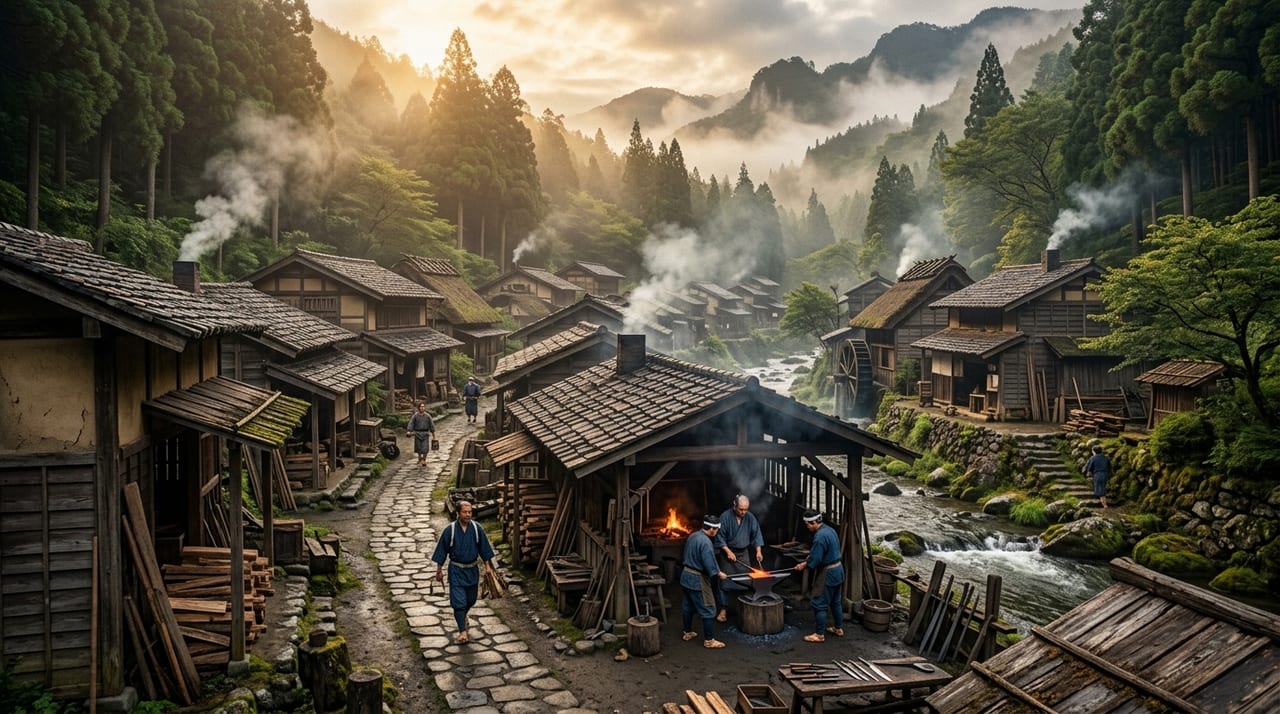
 * Image is for illustrative purposes only.
Mino Tradition
美濃伝
A sword-making tradition developed in Mino Province (present-day Gifu Prefecture). Shizu Kaneuji introduced the Sōshū technique and established its foundation; during the Sengoku period following the Ōnin War, blacksmith groups in Seki and Akasaka set up mass-production systems. Prized by Sengoku warlords for their practical quality, uniform standards, and abundant supply capacity, this became the production center that contributed most to the popularization of Japanese swords.
Description
The Origins of the Mino Tradition——Shizu Saburō Kaneuji
The origins of the Mino tradition are traced to Shizu Saburō Kaneuji, who was active from the late Kamakura period into the early Nanboku-chō period. Kaneuji was originally a smith of Yamato Province. It is said that, as one of the Masamune Juttetsu, he went to Sōshū and received direct instruction from Masamune, and afterward moved to Mino Province and developed his own distinctive style. The Sōshū-tradition techniques Kaneuji brought to Mino, including an intense nie-deki hamon, a powerful jigane of ō-itame mixed with masame, and an imposing overall configuration (taihai), brought a revolutionary change to Mino, where Yamato-style works had previously been mainstream. Kaneuji's works show a bold nie-deki hamon approaching that of Masamune. Because of their strength and dignity, they have received the highest-level evaluations from successive generations of sword appraisers, although they do not reach the level of the Tenka Sansaku. Works signed by Kaneuji are few and forged signatures are numerous, so careful appraisal is required. This great smith's skill became the foundation of later Mino smithing and played a decisive role in arming Japan during the Sengoku period.
The Development of the Muromachi Period——The Era of Kaneshige and Kanetomo
From the Nanboku-chō period into the early Muromachi period, Kaneuji's disciples and successors formed smith groups across Mino. Before the Ōnin War (1467–1477), Mino blades were largely the work of individualistic smiths, and each smith developed a distinct style. Representative smiths of this period include Kaneshige and Kanetomo, who each upheld the techniques of the Shizu tradition while displaying their own individuality. The jigane was the Mino-specific texture of ō-itame mixed with masame, and the hamon was based on the nie-deki gunome-midare of the Shizu tradition. Later, in the late Muromachi period, a lineage of Magoroku Kanemoto created a hamon form unique to the Mino tradition, called sanbonsugi. Sanbonsugi is a hamon in which gunome peaks appear in consecutive groups of three, and it became a visual landmark that allowed Mino blades to be recognized even from a distance. This hamon form combined functional beauty with aesthetic expression, and in the Sengoku period it became the trademark symbolizing Mino blades.
Mass Production in the Sengoku Period——The Prosperity of Seki Smiths
As the Sengoku period took full shape after the Ōnin War, smith groups centered on Seki in Mino Province established its position as one of the two great sword-producing centers, alongside Bizen. Geographically, Seki lies in the center of Mino Province and had the three conditions favorable for production: forests supplying good charcoal, distribution routes for sand iron and iron materials, and a concentration of skilled smiths. The characteristic of Seki smithing lies in a production system that emphasized organized division of labor and quality control over individual artistry. By dividing forging, quenching, polishing, and mounting of blades into separate tasks, efficient production became possible. This system met the mass demand of Sengoku daimyō, and Mino blades became indispensable for arming soldiers of daimyō including Oda Nobunaga, Toyotomi Hideyoshi, and Tokugawa Ieyasu.
Sanbonsugi and the Aesthetics of the Mino Tradition
The hamon most famously associated with the Mino tradition, “sanbonsugi,” has long been called “Seki no Magoroku sanbonsugi,” and it is a hamon symbolizing the lineage of Magoroku Kanemoto. The peaks of sanbonsugi evoke cedar trees standing in orderly rows. Combining functional beauty with ornamental beauty, this hamon satisfied both the practical demands and the aesthetic sensibilities of warriors. Even today, “sanbonsugi” is passed down as a symbol of the regional culture of Mino, Seki, and Gifu, and the cutlery culture of modern Seki City, known worldwide as a cutlery-producing center, is directly rooted in this medieval Mino sword tradition. The Mino tradition is also distinctive in its jigane. A texture called masa-nagare, in which masame mixes into itame, is characteristic, and it gives Mino a surface appearance distinct from the itame of Bizen, the masame of Yamato, and the ō-itame of Sōshū.
Principal Smiths of the Sengoku Period
Two smiths of the Sengoku-period Mino deserve special mention: Kanemoto and Kanesada. Kanemoto is best known through its second generation, called “Magoroku Kanemoto,” which is counted among the saijō ō-wazamono for its cutting ability. Even today, “Seki no Magoroku” is understood in the world of kitchen knives and cutlery as a byword for the highest cutting ability. Kanesada is most highly regarded through its second generation, called “Nosada,” which is known for Hosokawa Tadaoki's “Kasen Kanesada” and others. Many Seki smiths passed the character “Kane” (兼) down through generations, and the custom of using “Kane” widely in Seki smiths' names remains alive today.
Legacy for Later Generations
The practical spirit of the Mino tradition was carried on as the tradition of Seki smiths after the Edo period, and it became the foundation of the modern cutlery industry from the Meiji era onward. Present-day Seki City is known as one of the world's leading cutlery-producing centers, and the source of its technology lies in the medieval Mino sword tradition. From the standpoint of sword collecting, signed works by prominent smiths such as Shizu Kaneuji, Magoroku Kanemoto, and Nosada Kanesada carry high market value, and fine pieces with certificates of appraisal are always the object of fierce competition in the sword market. Even unsigned Mino blades that have features such as sanbonsugi, masa-nagare, and shirake-utsuri are highly valued. The appeal of the Mino tradition, which combines the functional beauty of a practical blade with the beauty of an ornamental sword, continues to shine across the ages.
Characteristics of This Era
- Sanbon-sugi hamon (three-cedar pattern) — the visual signature of Mino-den; rhythmic triple peaks of gunome
- Masame-nagare — itame mixed with flowing masame; distinct from Bizen or Yamato steel
- Nie-based hamon inherited from Sōshū via Shizu Kaneuji
- Organized mass production system — enabled large-scale supply to Sengoku-era armies