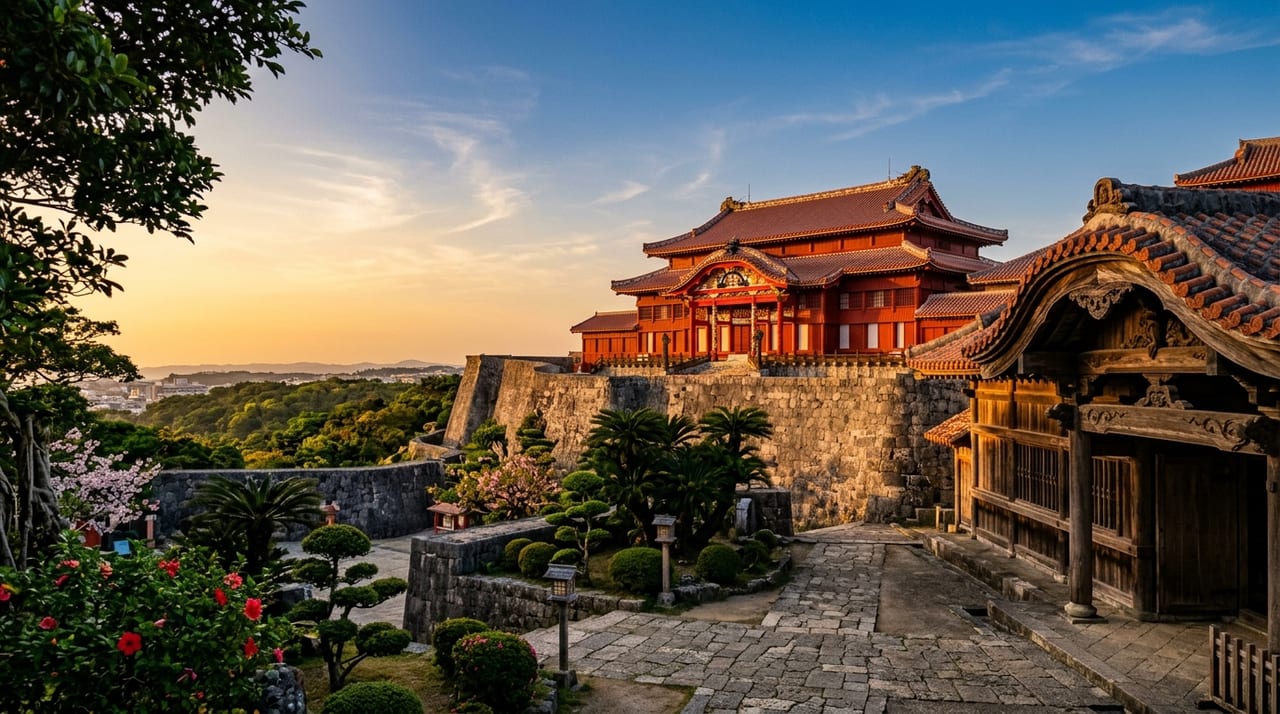
 * Image is for illustrative purposes only.
Sword Culture of the Ryukyu Kingdom
琉球王国の刀剣文化
As an independent kingdom at the hub of maritime trade in East Asia, the Ryukyu Kingdom treated Japanese swords as an important trade good. No Japanese-sword smiths worked in Ryukyu, so all of its blades were made on the Japanese mainland. The treasure swords passed down to the Shō royal house, however, carry Ryukyu-specific mountings (koshirae).
Description
The Ryukyu Kingdom and the Geopolitics of Swords
The Ryukyu Kingdom was established in 1429, when Shō Hashi unified the three polities of Hokuzan, Chūzan, and Nanzan. It prospered through tributary relations with China (Ming and Qing) and through entrepôt trade linking Southeast Asia, Japan, and Korea. Based at Naha port, Ryukyu proclaimed the ideal of “bankoku shinryō” (bridge of all nations) and imported and exported a wide range of weapons and crafts from many regions. Japanese swords were an important trade good for Ryukyu.
Ryukyuan Martial Weapons and Japanese Swords
Ryukyu is known for developing its own system of weapons (Ryukyu kobudō, Ryukyuan classical martial arts). One of these weapons, the sai, was carried by officials such as the ufuchiku during the Ryukyu Kingdom period and is said to have been used to apprehend criminals. Meanwhile, no Japanese-sword smiths appear anywhere in the Ryukyu period, and all Japanese swords found in Ryukyu were made on the mainland.
Satsuma Invasion
With the invasion by the Satsuma domain in Keichō 14 (1609), the Ryukyu Kingdom was placed under the effective control of Satsuma.
Treasure Swords of the Shō Royal House
The Shō royal house, the kings of Ryukyu, handed down three treasure swords: Chiyoganemaru, Jiganemaru, and Chatan Nakiri. The blades of all three are Japanese swords made on the mainland, but the mounting of Chiyoganemaru is a Ryukyu-specific design, with a hilt for one hand and a gold kabutogane (helmet-shaped fitting). The three swords were designated National Treasures in 2006 as part of the “Materials Related to the Shō Royal House of Ryukyu.” They are held by the Naha City Historical Museum.
Characteristics of This Era
- Japanese swords as trade goods: Japanese swords were an important trade good for Ryukyu, but no Japanese-sword smiths appear throughout the Ryukyu period, and all of the blades were made on the mainland.
- Treasure swords of the Shō royal house: Chiyoganemaru, Jiganemaru, and Chatan Nakiri are three swords with mainland-made Japanese blades. Chiyoganemaru has a Ryukyu-specific mounting with a one-handed hilt. In 2006 they were designated National Treasures as part of the “Materials Related to the Shō Royal House of Ryukyu.”