New Arrivals — Browse our catalog for the latest authentic Japanese sword arrivals. Browse →
March 4 – April 4, 1609 (Keichō 14) — from the fleet's departure at Yamakawa to the surrender of Shuri Castle
Shuri Castle and Okinawa's main island, Ryukyu Kingdom (present-day Naha, Okinawa Prefecture)
Forces
Satsuma Domain (Shimazu clan) forces
Ryukyu Kingdom forces
About 14 min read
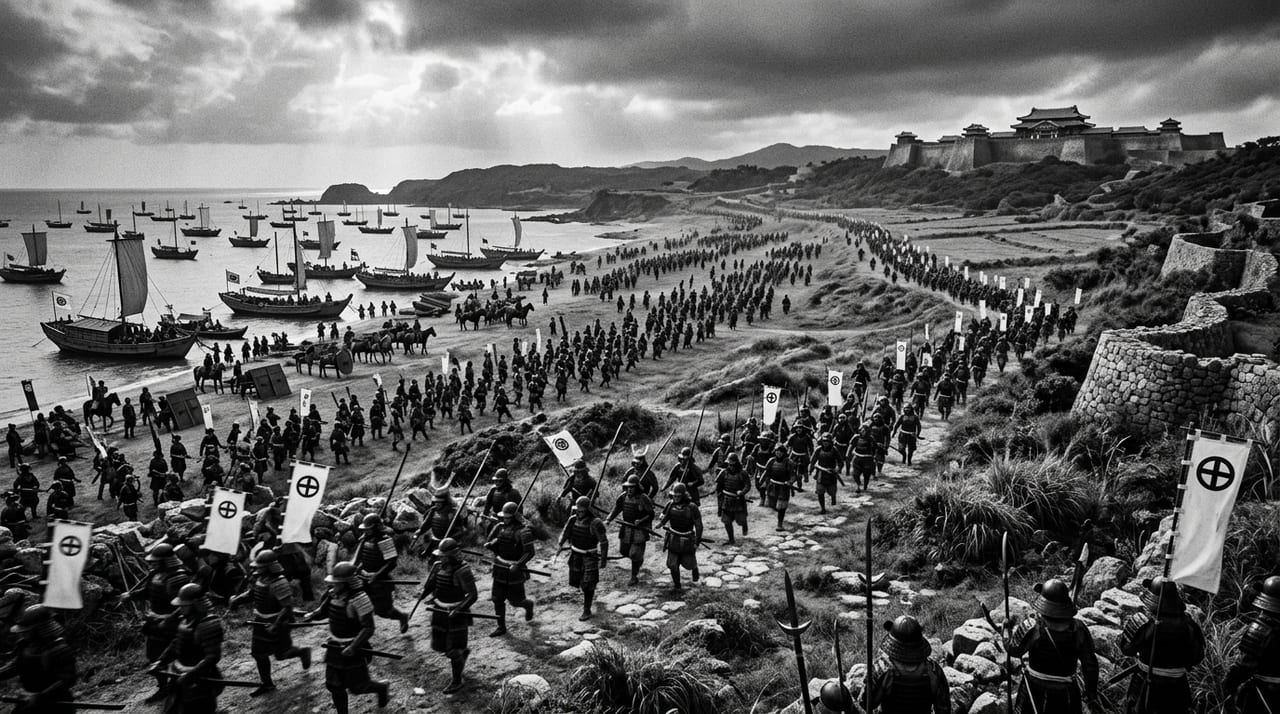
In March 1609 (Keichō 14), a force led by the Satsuma retainer Kabayama Hisataka, acting on the orders of Satsuma domain lord Shimazu Iehisa (Tadatsune), invaded the Ryukyu Kingdom. Roughly 3,000 troops departed from Yamakawa Harbor (present-day Ibusuki City, Kagoshima Prefecture), sailed via Amami Ōshima, Tokunoshima, and Okinoerabujima, and landed at Unten Harbor in northern Okinawa. They then advanced south through Nakijin toward Shuri Castle. In early April, Shuri Castle surrendered and King Shō Nei stepped down. Shō Nei was taken captive to Satsuma, later received an audience with shogun Tokugawa Hidetada in Edo, and was permitted to return home only about two and a half years afterward. From this event on, the Ryukyu Kingdom maintained a peculiar dual subordination — to Japan (Satsuma domain and the Edo shogunate) and to China (Ming, later Qing) alike — that lasted until the shogunate's final years.
Since medieval times, Ryukyu had built its own foreign relations centered on tribute to Ming and Qing China, while also maintaining trade with the Shimazu clan of Satsuma. The relationship mixed rivalry and cooperation, with the Shimazu at times protecting Ryukyuan tribute and trading vessels. During Toyotomi Hideyoshi's invasions of Korea (1592–1598), the Shimazu had demanded that Ryukyu share the burden of provisions and military expenses, but Ryukyu's response reportedly fell short of Shimazu expectations. Even after Tokugawa Ieyasu opened the Edo shogunate, a plan to use Ryukyu as an intermediary in restoring relations with Ming China failed to materialize. These grievances, combined with Shimazu ambitions in overseas trade, led to a Ryukyu expedition being planned with the shogunate's approval. The Shimazu also invoked a long-held claim that Ryukyu had historically been a tributary of their clan, using it to justify the campaign. Lingering resentment within Satsuma over the burdens of the Korean campaigns is also cited as a domestic factor. The shogunate's acquiescence is thought to have reflected its own interest in both gauging Shimazu strength south of Kyushu and probing indirectly for an opening with Ming China.
On the 26th day of the second month of Keichō 14, the Satsuma force assembled at Yamakawa Harbor and was reviewed by lord Iehisa. On the 4th day of the third month, once favorable winds arrived, the fleet — some eighty-odd ships, equipped with over 700 firearms — set sail under commander-in-chief Kabayama Hisataka and deputy commander Hirata Masumune. On the 7th they reached Fukae-ga-ura on Amami Ōshima and subdued it without significant resistance. After remaining on Ōshima for a time, the fleet departed on the 20th, passing Tokunoshima on the 22nd and Okinoerabujima on the 24th before entering Unten Harbor past evening on the 25th. Some three weeks after leaving Yamakawa, the island-hopping advance proceeded largely without major fighting, since Ryukyu lacked a coordinated defense at the time. Amami, Tokunoshima, and Okinoerabu were nominally Ryukyuan territory but remote from the royal capital of Shuri and had no independent defenses of their own, a further factor behind the rapid advance.
Two days after landing at Unten, on the 27th, the Satsuma force reached Nakijin Castle, a strategic stronghold in the north, but found it already abandoned and set it ablaze. Nakijin had once been the royal seat of the Hokuzan kingdom and retained standing as the key northern fortress even after Ryukyu's 15th-century unification, lending the occupation symbolic weight. The force continued south, and on the 1st day of the fourth month reached Naha Harbor and moved to encircle Shuri Castle. Negotiations followed, and an agreement was reached in which the regent, Prince Gushichan, and the sanshikan councilors were handed over as hostages, formally delivered the next day, the 2nd. Judging further resistance untenable, the Ryukyu side accepted the terms, and King Shō Nei soon stepped down from Shuri Castle, bringing about its surrender. Shuri Castle itself was never the scene of a fierce siege; the campaign is instead remembered for how a show of force was followed by negotiation and the handover of hostages, culminating in a negotiated surrender.
After the surrender, Shō Nei was taken captive to Satsuma, departing for Kagoshima on the 15th day of the fifth month. The following year, Keichō 15 (1610), he had an audience with the retired shogun Tokugawa Ieyasu at Sunpu, and on the 28th day of the eighth month, with the second shogun Tokugawa Hidetada at Edo Castle. This was the first time a King of Ryukyu had appeared directly before a shogun, and it carried great political weight for the Shimazu as proof of Ryukyu's conquest. The Edo audience was staged as Ryukyu appearing as a foreign land come to pay homage, and the Shimazu would thereafter continue to use such "journeys to Edo" by Ryukyuan delegations as a diplomatic ritual demonstrating loyalty to the shogunate. Back in Kagoshima, Shō Nei was made to sign a sworn oath acknowledging the Shimazu as an "ancient suzerain" and pledging subordination, along with the Fifteen Regulations (okite jūgo-ka-jō) that laid out the basic framework for governing Ryukyu. Among other provisions, the Regulations placed Ryukyu's foreign trade under Satsuma's control.
Shō Nei was not permitted to return to Ryukyu until Keichō 16 (1611), roughly two and a half years after his capture. In the interim, Satsuma conducted a land survey and fixed the assessed yield of the islands south of Okinawa's main island at just over 89,000 koku, establishing annual tribute owed to the Shimazu on that basis. A resident magistrate's office was set up at Naha, and Ryukyu's foreign trade was placed under Satsuma's supervision. Yet the Ryukyu Kingdom itself was not dissolved: the Shō royal line continued, and its tribute relationship with Ming, and later Qing, China was likewise maintained. Ryukyu thus came to occupy a distinctive position of dual subordination to both Japan and China — the so-called "dual subordination to Japan and China" — for roughly 260 years, until the shogunate's final years. The arrangement gave Satsuma a mechanism for securing the benefits of trade with China via Ryukyu, and it remained valuable to the Edo shogunate as a window onto foreign affairs. Ryukyu would pass through the early modern era retaining nominal independence while remaining, fiscally and militarily, under Satsuma's control.
In the Ryukyu Kingdom, treasured swords passed down within the royal Shō family were revered as symbols of kingship. The three blades known as Chiyoganemaru, Chiganemaru, and Chatan Nakiri were heirlooms handed down through generations of the Shō family; Chiganemaru, a wakizashi dating to the 15th century, is said to have been presented to King Shō Shin in the early 16th century by a lord (aji) from Miyako Island. Rather than weapons for actual combat, these swords were kept at Shuri Castle as ceremonial treasures giving visible form to royal authority; today they are held at the Naha City Museum of History as part of the "Materials Related to the Shō Family, Kings of the Ryukyu Kingdom" and are designated National Treasures. After 1609, once Satsuma's resident magistrate's office was permanently established at Naha, the sword-bearing culture of Japan's warrior society came into contact with Ryukyuan society in a way it never had before. Even so, no record indicates the Shō family's treasured swords were themselves confiscated by Satsuma; alongside the survival of the royal line, these swords are believed to have continued as symbols of Ryukyuan kingship. The contrast between Satsuma's combat-oriented warrior sword culture and Ryukyu's ceremonial, dynastic sword culture reflects one facet of the relationship of domination this invasion brought about, seen through the lens of the sword. The invasion is also a reminder of how varied the roles of the Japanese sword have been throughout history — not only as a weapon, but as a symbol of sovereignty and status.