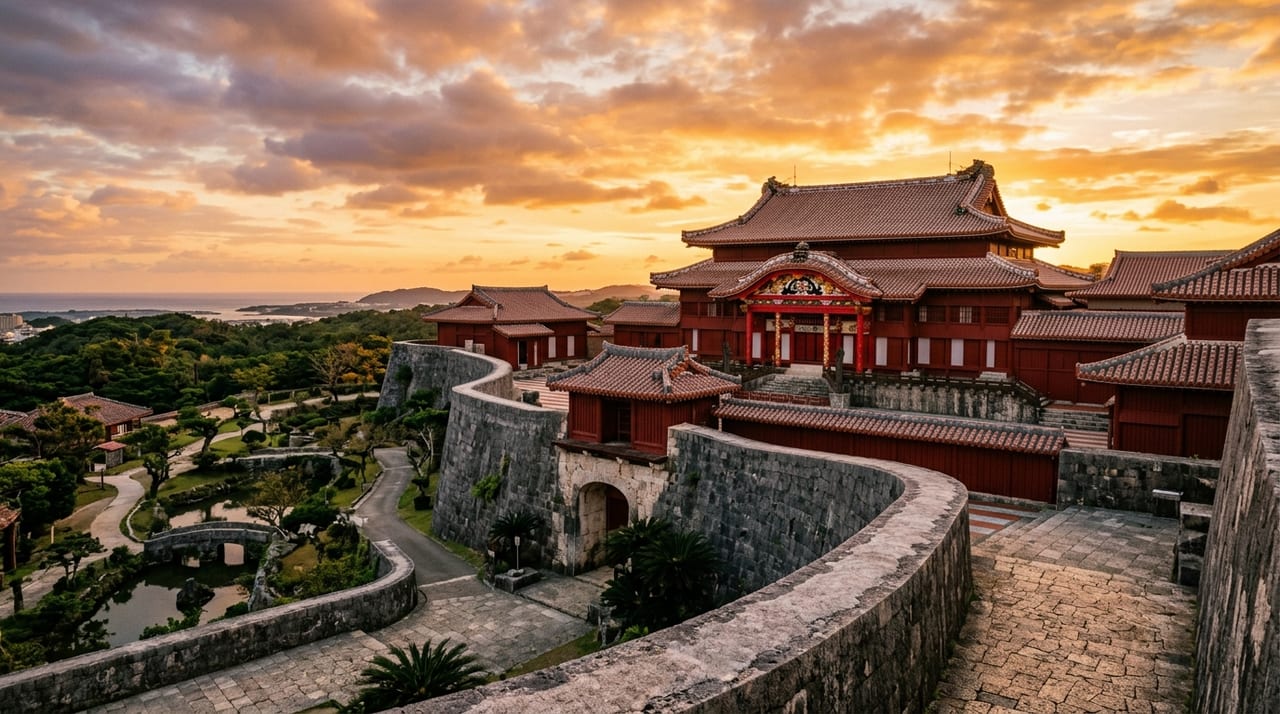
 * Image is for illustrative purposes only.
Shuri Castle
首里城
Shuri Castle is a historic castle in the Okinawa region (Believed to have been founded around the 14th century). Its lord was Kings of Ryūkyū (Shō dynasty).
Overview
About the Castle
Shuri Castle functioned as the royal palace of the Ryūkyū Kingdom for about 450 years from the first half of the 15th century, serving as the center of politics, diplomacy, and culture. Its founding date is unclear, but after the Sanzan period (Hokuzan, Chūzan, Nanzan), when Shō Hashi unified the three mountains in 1429 and established the Ryūkyū Kingdom, Shuri Castle became the royal castle. Thereafter the royal line changed from the First Shō dynasty to the Second Shō dynasty, yet Shuri Castle consistently remained a symbol of royal authority. Its architectural style is unique, fusing Chinese palace architecture, Japanese castle architecture, and Southeast Asian design. The vermilion-lacquered pillars and dragon decorations of the main hall (Seiden) reflect Chinese splendor, while the curved shapes of the stone walls show the stonework techniques unique to Ryūkyū.
Culture and Crafts
The castle walls, built from Ryūkyū limestone, form graceful curves, and this craftsmanship embodies the Ryūkyū-specific castle culture known as “gusuku.” From the 14th to the 16th century the Ryūkyū Kingdom prospered as a relay trading state in East Asia, accumulating enormous wealth as a key hub of maritime trade linking China, Japan, Korea, and Southeast Asia. The kingdom's motto, Bankoku Shinryō, meaning “a bridge to the world,” expresses this international character, which was the source of Shuri Castle's cultural richness. In 2000 it was registered as a World Heritage Site under the name “Gusuku Sites and Related Properties of the Kingdom of Ryūkyū.” On October 31, 2019, however, a fire destroyed six buildings, including the main hall (Seiden), North Hall (Kitadono), and South Hall (Minamidono), a devastating event.
Present State
Reconstruction of the main hall began in November 2022, and a completion ceremony on November 22, 2026 and public opening from the following day, November 23, were announced. Public viewing of the restoration process has also drawn strong interest from many people. Shuri Castle is a castle that has been burned and rebuilt many times, and it is precisely the unbending spirit that has revived it each time that is the soul of Ryūkyū. Shuri Castle has an architectural philosophy fundamentally different from castles on mainland Japan, and its unique style, in which Chinese palace culture and Southeast Asian decorative beauty blend into one, is highly regarded worldwide as a crystallization of East Asian cultural exchange. Around Shuri Castle are heritage sites from the Ryūkyū Kingdom period, such as Shikinaen (World Heritage Site) and the Kinjō-chō stone-paved road. Together with the castle, they allow visitors to comprehensively experience Ryūkyū culture.
The Spirit of Bushidō
The traditional Okinawan dance Ryūkyū buyō also contains martial elements, and its connection to Ryūkyū's weapon culture has been pointed out. Shuri Castle is the spiritual anchor of Okinawa, and its history as the “Castle of Revival” that never ceases despite repeated burning and rebuilding moves people's hearts.
Connection to Swords
The sword culture of the Ryūkyū Kingdom is an extremely intriguing subject that underwent unique development, differing from both the swords of mainland Japan and those of China. The swords transmitted to the Ryūkyū royal house had blades made in mainland Japan, and some, such as Chiyoganemaru, had mountings (koshirae) tailored in a style unique to Ryūkyū. This character as a “crossroads of East Asian sword culture” clearly reflects the international position of the Ryūkyū Kingdom. The ceremonial swords of the Ryūkyū king were treasure swords represented by Jiganemaru, and they were passed down through generations as symbols of the legitimacy of royal authority. The blade of Jiganemaru is a Japanese sword from the Muromachi period, presumed to be the work of Ōei Nobukuni. The invasion of Ryūkyū by the Satsuma domain in Keichō 14 (1609) brought a decisive turn to the weapon culture of Ryūkyū. Under Satsuma rule, possession of weapons in Ryūkyū is said to have been restricted, and one theory holds that this weapons ban promoted the development of unarmed combat known as tī, which later spread worldwide as tōde and then karate. This theory, that martial arts grew out of the confiscation of Japanese swords, is often cited when discussing the sword culture of Ryūkyū. On the other hand, the Ryūkyū royal government collected mainland-made Japanese swords as treasures, and three of them, Chiyoganemaru, Jiganemaru, and Chatan Nachiri, transmitted to the Shō family, survive to this day. These treasure swords are held by the Naha City Museum of History as part of the National Treasure “Materials related to the Shō family, kings of Ryūkyū,” and they carry Ryūkyū's unique sword culture, different from that of mainland Japanese swords, into the present. Ryūkyū swords are few in number and surviving examples are limited, but precisely because of their rarity they are extremely important to sword researchers. Ryūkyū's sword culture is a product of cultural exchange across the sea and a valuable window for reconsidering the world of Japanese swords from the perspective of all of East Asia. Shuri Castle and Ryūkyū's swords offer an important key for freeing the history of Japanese swords from a “mainland-centered” viewpoint and understanding it within the broader context of East Asia.
Highlights
- Reconstruction of the main hall — The central building of the royal palace, burned in the 2019 fire, whose restoration has been underway toward completion in November 2026
- Shureimon — The symbolic gate of the Ryūkyū Kingdom bearing the plaque “Shurei no Kuni,” and the design of the 2,000-yen banknote
- Sonohyan-utaki Ishimon (World Heritage Site) — A sacred site where the king prayed for safety when setting out
- Naha City Museum of History — Holds the National Treasure “Materials related to the Shō family, kings of Ryūkyū,” including the treasure swords Chiyoganemaru and Jiganemaru
- Castle walls and curved stone walls — The elegant craftsmanship of gusuku architecture using Ryūkyū limestone
- Panoramic view of the castle from Ryūtan Pond — An excellent photo spot overlooking the grandeur of Shuri Castle
* Opening hours and admission fees are subject to change. Please check the official website before visiting.