 * Image is for illustrative purposes only.
Nakajō Castle (Nakagusuku)
中城城(中グスク)
Nakajō Castle (Nakagusuku) is a historic castle in the Okinawa region (Castle foundations laid in the early 14th century. Expanded to the current six-courtyard structure by Gosamarumorisharu in the early 15th century. Following Gosamarumorisharu's subjugation in 1458, the castle fell into disuse and came under direct administration of the Ryukyu Royal Government). Its lord was Early Nakajō Aji (14th century) → Gosamarumorisharu (greatly expanded in the early 15th century) → Amamawari (briefly controlled after Gosamarumorisharu's subjugation in 1458) → Under Ryukyu Royal Government administration.
Overview
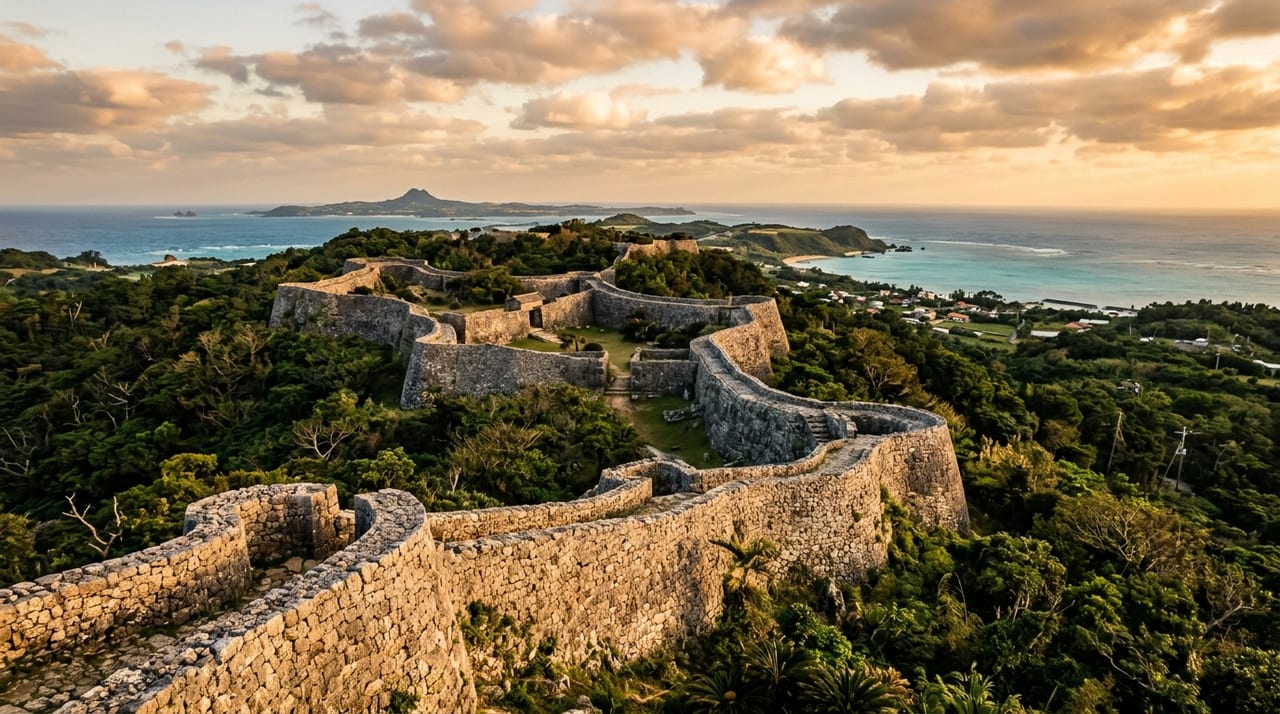
Nakajō Castle (Nakagusku-jō) is a gusuku from the Ryukyu Kingdom era located in Nakajō and Kita-Nakajō Villages, Nakagami District, Okinawa Prefecture. Registered in 2000 as a constituent asset of the UNESCO World Heritage Site "Gusuku Sites and Related Properties of the Ryukyu Kingdom," it stands as one of Okinawa's finest stone fortress ruins. Built atop a hill approximately 160 meters above sea level, the castle comprises six courtyards—north, south, east, southeast, rear, and west. It is renowned for its diverse stone-stacking techniques employing locally quarried Okinawan coral limestone: wild-stone stacking, coursed stacking, and alternating stacking all coexist within this single fortress, making it a veritable encyclopedia of gusuku architecture.
The figure who contributed most significantly to Nakajō Castle's construction and expansion was Gosamarumorisharu, a brilliant military commander active in the early 15th century. As a trusted aide to King Shōtaikkyū of the Chūzan Kingdom, Gosamarumorisharu relocated from Zakimi Castle to Nakajō Castle to defend this strategic stronghold in central Okinawa, establishing the formidable stone fortress that stands today. His technical mastery of fortress construction and military organizational acumen earned considerable regard; Nakajō Castle's stonework is particularly admired for its refined technique and excellent preservation, earning recognition as "Okinawa's finest stonework."
However, in 1458, Gosamarumorisharu fell victim to slanderous accusations from Katsuren Aji Amamawari, a fellow loyalist of the first Shō dynasty. Wrongfully charged with treason through these calumnies and assailed by Amamawari's forces at King Shōtaikkyū's command, Gosamarumorisharu is said to have perished alongside his kinsmen by his own hand rather than resist. This incident, known as the "Gosamarumorisharu-Amamawari Rebellion," stands as one of the most tragic episodes in Ryukyuan history. After Gosamarumorisharu's death, Nakajō Castle fell into near-abandonment and was later placed under direct administration by the Ryukyu Royal Government.
From the castle ruins, one commands sweeping panoramic views spanning from central Okinawa across the East China Sea toward the Pacific Ocean, particularly celebrated as a vantage point overlooking the East China Sea to the southwest and the townships of central and southern Okinawa. Today the site attracts visitors year-round and is counted among Okinawa's three greatest gusuku alongside Nakijin Castle (Northern Mountain stronghold) and Katsuren Castle (Amamawari's seat), all recognized as World Heritage gusuku sites.
Connection to Swords
The relationship between Nakajō Castle and Japanese swords is rooted in the distinctive historical context of diplomatic and commercial relations between the Ryukyu Kingdom and Japan (Yamato), positioning it as a unique intersection of sword culture distinct from mainland Japanese castles. The Ryukyu Kingdom (15th–19th centuries) flourished as a transpacific trading hub linking China (Ming and Qing dynasties), Japan, and Southeast Asia. Among its trade goods were Japanese swords (known as "Japanese swords" or "Yamato swords"). China's Ming Dynasty prized Japanese blades as imports, and historical records document that Ryukyuan trading vessels carried Japanese swords purchased from merchants in Hakata and Sakai as tribute items for the Ming court. Nakajō Castle reached its zenith in the early 15th century, precisely coinciding with Ryukyu's great age of commerce (1400–mid-16th century), and the castle guarded by Gosamarumorisharu served as one crucial military stronghold of this international trading network. Gosamarumorisharu's connection to Japanese swords also relates to the culture of the "Ryukyu sword" carried by Ryukyuan ajis (regional lords). While the blades themselves were obtained through Satsuma and other sources as Japanese-manufactured pieces, Ryukyuan craftsmen distinguished their swords by applying unique scabbards, hilts, and guards (koshirae). Throughout the Ryukyu era, no Ryukyuan blade smiths have been confirmed to forge sword blades. Historic masterpieces transmitted to the Ryukyu Kingdom—the National Treasures Chiyokanemaru, Jikikanemaru, and Kitaniyakiri—are held in the Naha City History Museum and testify to the weaponry culture of this age connected to Gosamarumorisharu's era. Following the 1609 Satsuma invasion of Ryukyu (the Shimazu clan's conquest), Ryukyu fell under Japanese (Satsuma and Edo Shogunate) control, and Satsuma sword culture began influencing Ryukyuan martial tradition. Satsuma swords and fittings spread among the Ryukyuan warrior elite, and Ryukyuan gentry sword culture increasingly overlapped with that of mainland warriors. Nakajō Castle, as a gusuku from the era of Satsuma influence, occupies an important position in the history of Japanese-Ryukyuan sword cultural exchange.
Highlights
- Nakajō Castle Ruins (World Heritage Site, National Special Historic Site) — Gosamarumorisharu's six-courtyard stone fortress featuring three stonework techniques: wild-stone stacking, coursed stacking, and alternating stacking in unified design
- Observation platform views — Panoramic vistas of the East China Sea, Pacific Ocean, and central-to-southern Okinawa
- Gosamarumorisharu and Amamawari historical exhibits — Detailed accounts at the Nakajō Castle Site Management Center of one of Ryukyuan history's most tragic events
- Katsuren Castle Ruins (Uruma City) — The gusuku associated with Amamawari, complementary World Heritage site, approximately 20 minutes by car
- Nakijin Castle Ruins (Nakijin Village) — Northern Mountain stronghold and Gosamarumorisharu's former base, another gusuku, approximately 90 minutes by car
- Okinawa Prefectural Museum & Art Museum (Naha City) — Exhibits of Ryukyu swords, Ryukyu Kingdom weaponry culture, and trade history
* Opening hours and admission fees are subject to change. Please check the official website before visiting.