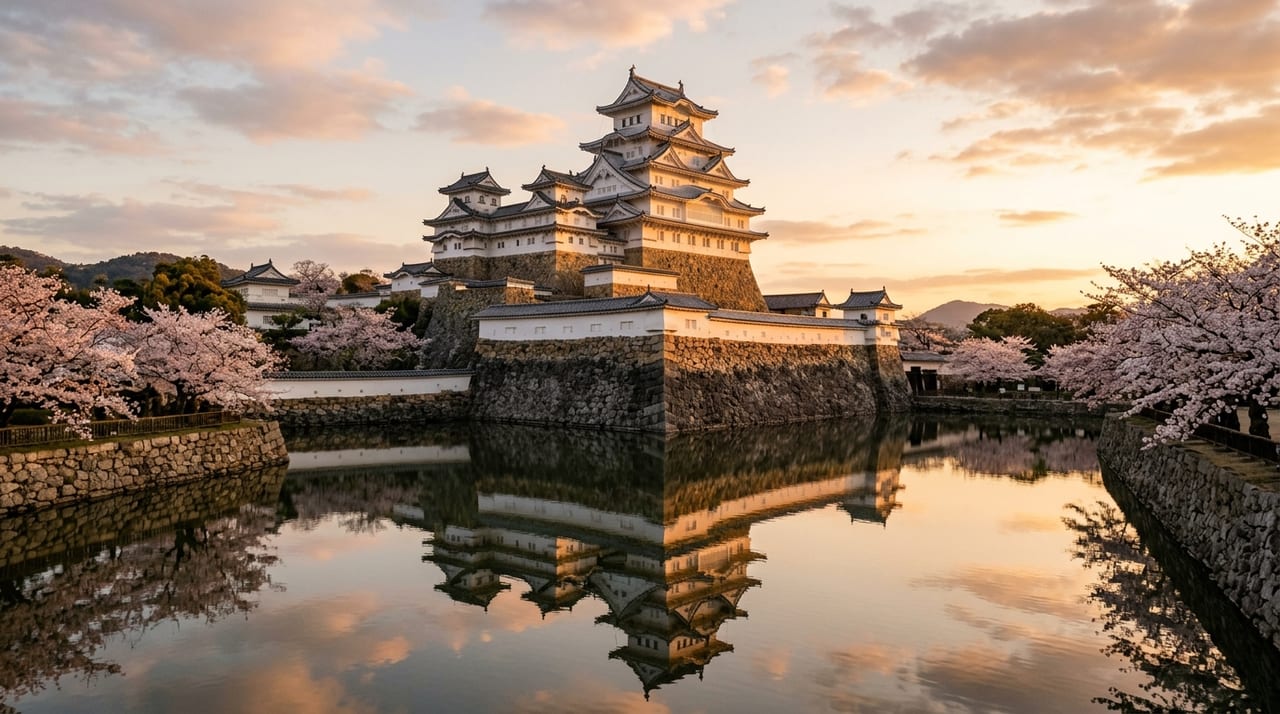
 * Image is for illustrative purposes only.
Katsuren Castle
勝連城
Katsuren Castle is a historic castle in the Okinawa region (Gusuku Era to Ryukyu Kingdom Unification Period (12th–15th centuries; abandoned 1458)). Its lord was Katsuren Aji (Amamawari was the last lord) → Ryukyu Kingdom.
Overview
Katsuren Castle is a gusuku (a Ryukyuan fortification) built on a hillside near the base of the Chinen Peninsula in central Okinawa, in Uruma City (formerly Yonashiro and Katsuren towns). Registered in 2000 as a constituent property of the UNESCO World Heritage site "Gusuku Sites and Related Properties of the Kingdom of Ryukyu," it stands as one of Okinawa's most representative cultural heritage sites. A gusuku is a distinctive Ryukyuan fortification style characterized by curved stone walls ingeniously crafted from natural bedrock and coral limestone, featuring multiple enclosures (kuruwá). The founding date of Katsuren Castle is subject to various theories, but tradition places it around the 12th century, when it initially served as the residence of the Katsuren Aji (local lord). The castle comprises four enclosures (first through fourth) arranged in stepped formation, situated on a high vantage point offering magnificent views of the Pacific Ocean, Nakijin Bay, and the Chinen Peninsula. The stone walls reach a maximum height of 13 meters, with coral limestone blocks stacked in the nozura-zumi technique to create beautiful curved lines. The last and most renowned lord of Katsuren Castle was Amamawari (?–1458). Renowned for his exceptional leadership and martial prowess, Amamawari unified neighboring aji to bring Katsuren to its zenith of prosperity. He actively advanced trade with China and Southeast Asia, accumulating foreign goods including ceramics, spices, and metalwork. Excavations have unearthed numerous ceramics from Chinese kilns such as Jingdezhen and Longquan, copper coins, and bronze artifacts, confirming the castle's role as a major center of foreign trade in Ryukyu. In 1458 (Chōroku 2), Amamawari rebelled against the Ryukyu royal government but was defeated by royal forces from Shuri Castle, and Katsuren Castle fell. Thereafter, the castle came under royal control and gradually fell into disrepair. After survey and restoration efforts since the Meiji period, the castle ruins are now open to the public as a historic site managed by Uruma City. Excavations continue to the present day, with new artifacts and structures constantly being discovered. A 2019 excavation unearthed a metal fragment believed to be a Western coin, attracting international attention as evidence of indirect trade networks between 15th–16th century Ryukyu and the Western and Middle Eastern worlds. Regarding swords, iron blade fragments have been found among the castle's artifacts, confirming both the martial equipment of the aji and swords as trade goods. During Amamawari's era, swords from China and Japan flowed into Katsuren Castle as trade goods and functioned as symbols of the aji's authority.
Connection to Swords
During Amamawari's era, swords from China and Japan flowed into Katsuren Castle as trade goods and were highly prized as symbols of the aji's authority. The iron artifacts unearthed in excavation surveys include sword fragments, providing valuable evidence of the adoption of sword culture in Ryukyu. Following the Ryukyu unification in 1429, the Shuri royal government actively procured superior swords from mainland Japan; however, no sword smiths in Ryukyu are known to have forged Japanese sword blades. Instead, Japanese-forged blades imported via Satsuma and other routes were fitted with distinctively Ryukyuan fittings (scabbard, hilt, etc.), becoming known as "Ryukyu swords." Katsuren Castle and its surroundings may well have been influenced by this sword culture.
Highlights
- UNESCO World Heritage "Gusuku Sites and Related Properties of the Kingdom of Ryukyu" constituent property
- Stage of Amamawari's trading prosperity and rebellion
- Curved beauty of coral limestone walls built with nozura-zumi technique
- High vantage point overlooking the Pacific Ocean and Nakijin Bay with panoramic views
- 2019 discovery of Western coin-like metal fragments
* Opening hours and admission fees are subject to change. Please check the official website before visiting.