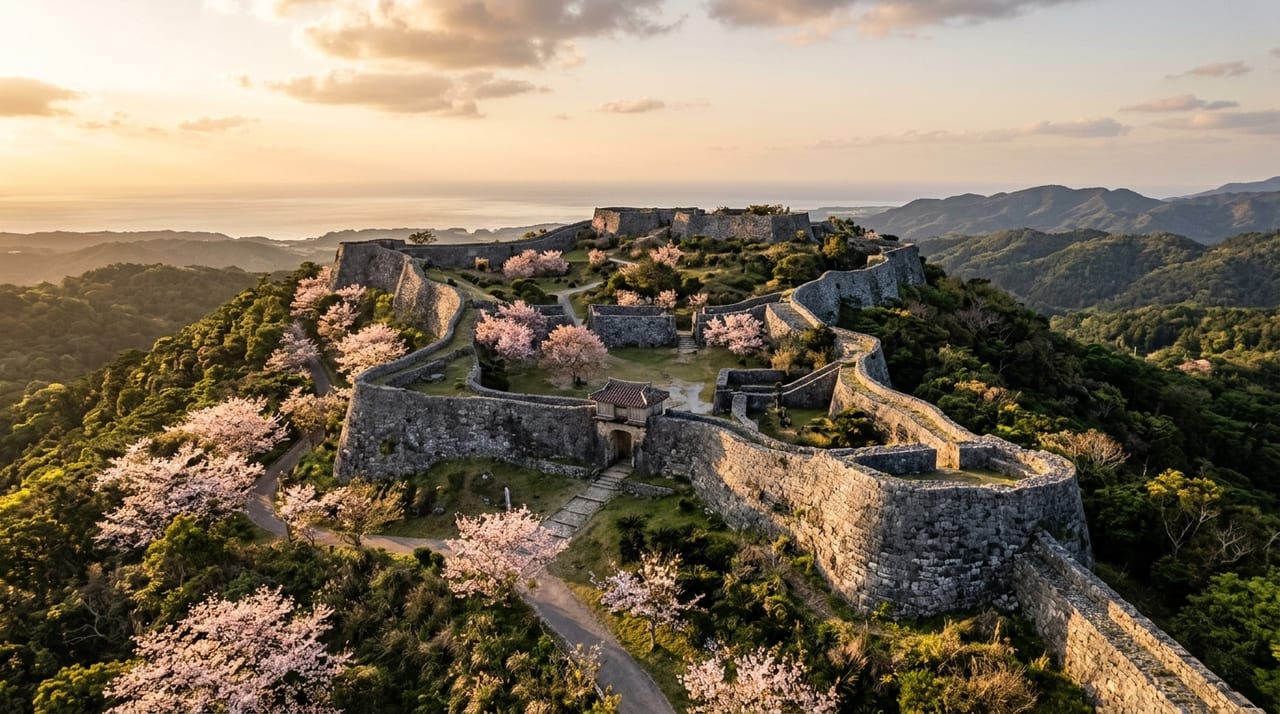
 * Image is for illustrative purposes only.
Nakijin Castle (Hokuzan Castle)
今帰仁城(北山城)
Nakijin Castle (Hokuzan Castle) is a historic castle in the Okinawa region (Built around the 13th–14th centuries; captured in 1416 by Shō Hashi of Chūzan). Its lord was King of Hokuzan / First Sho Dynasty (Ryukyu Kingdom).
Overview
Nakijin Castle (Nakijin Gusuku) is a gusuku (castle) from the Kingdom of Ryūkyū period, located in Nakijin Village in northern Okinawa Prefecture. From the 14th to the 15th century, it functioned as the capital of the "Hokuzan Kingdom," which ruled the northern part of Okinawa Island. In 2000, it was registered as a UNESCO World Heritage Site as "Gusuku Sites and Related Properties of the Kingdom of Ryūkyū," and it is one of the castle ruins that best represent Ryūkyū.
The etymology of gusuku remains debated, but it generally means "castle." It is a crystallization of a uniquely Okinawan stone-building culture, completely different from castle architecture on the mainland. The walls of Nakijin Castle are nozura-zumi (unworked fieldstone masonry), built by stacking hard Paleozoic limestone with little processing, and its beautiful stone walls that curve along the terrain are considered among the finest in Okinawa.
The castle sits on a hill about 100 meters above sea level and is one of the largest gusuku in Okinawa, enclosed by walls extending about 1.5 kilometers. The view of the East China Sea from inside the castle after passing through the main gate, Heirō Gate, is spectacular and evokes the power of the King of Hokuzan in those days. In the early 15th century, Shō Hashi of the First Shō Dynasty, who unified the Kingdom of Ryūkyū, destroyed the Hokuzan Kingdom in 1416 and used Nakijin Castle as a regional base of the Kingdom of Ryūkyū.
At the Nakijin Village History and Culture Center, adjacent to the castle ruins, artifacts unearthed in excavations of the Nakijin Castle site are on display, including trade goods from China, Japan, and Southeast Asia as well as everyday tools of the time. In spring, kanhizakura (Taiwan cherry) blooms beautifully against the castle walls, and it is known as one of the earliest cherry trees to bloom in Japan.
Connection to Swords
The connection between Nakijin Castle and swords is rooted in the complex history of trade and cultural exchange between the Kingdom of Ryūkyū and mainland Japan and China. From the 14th to the 16th century, the Kingdom of Ryūkyū, as an entrepôt trading state, sat at the center of the East Asian and Southeast Asian trade network and established its own international standing as "Ryūkyū in the Age of Exploration." Through this trade network, Japanese swords ("nihontō") were exported via Ryūkyū to China and Southeast Asia as one of the important trade goods.
The treasure swords handed down to the Shō royal family of Ryūkyū are all Japanese swords made on the mainland. Among them, the National Treasure "Chiyoganemaru" (held by the Naha City Museum of History) is said to have belonged to the King of Hokuzan, Han'anchi. When Nakijin Castle was captured in 1416, Han'anchi is said to have slashed a sacred guardian stone with this sword and then thrown it into the Shigema River. The sword was later picked up and presented to the King of Chūzan.
The Okinawan martial art "tī" (the origin of later karate), a bare-handed fighting art without weapons, developed, though some theories hold that its background lay in the weapons ban imposed by Satsuma. However, in the period before the Ryūkyū Kingdom's weapons ban, in medieval Ryūkyū when gusuku culture flourished, various weapons, including swords, were used in combat. Artifacts excavated at the Nakijin Castle site also include armor and other military gear.
Highlights
- World Heritage walls — Approximately 1.5 km of nozura-zumi stone walls of Paleozoic limestone, with striking curved beauty
- Heirō Gate and views of the East China Sea — The main gate, Heirō Gate, and the spectacular blue sea seen from within the castle
- Kanhizakura (Taiwan cherry) — Japan's earliest cherry blossom, blooming from January to February, with reddish-purple flowers that stand out against the walls
- Nakijin Village History and Culture Center — Displays excavated trade goods from China, Japan, and Southeast Asia
- Nighttime illumination — An event that lights up the World Heritage stone walls in an ethereal way
- Nakijin Gusuku Sakura Festival — A festival held every year during the cherry blossom season in January and February
* Opening hours and admission fees are subject to change. Please check the official website before visiting.