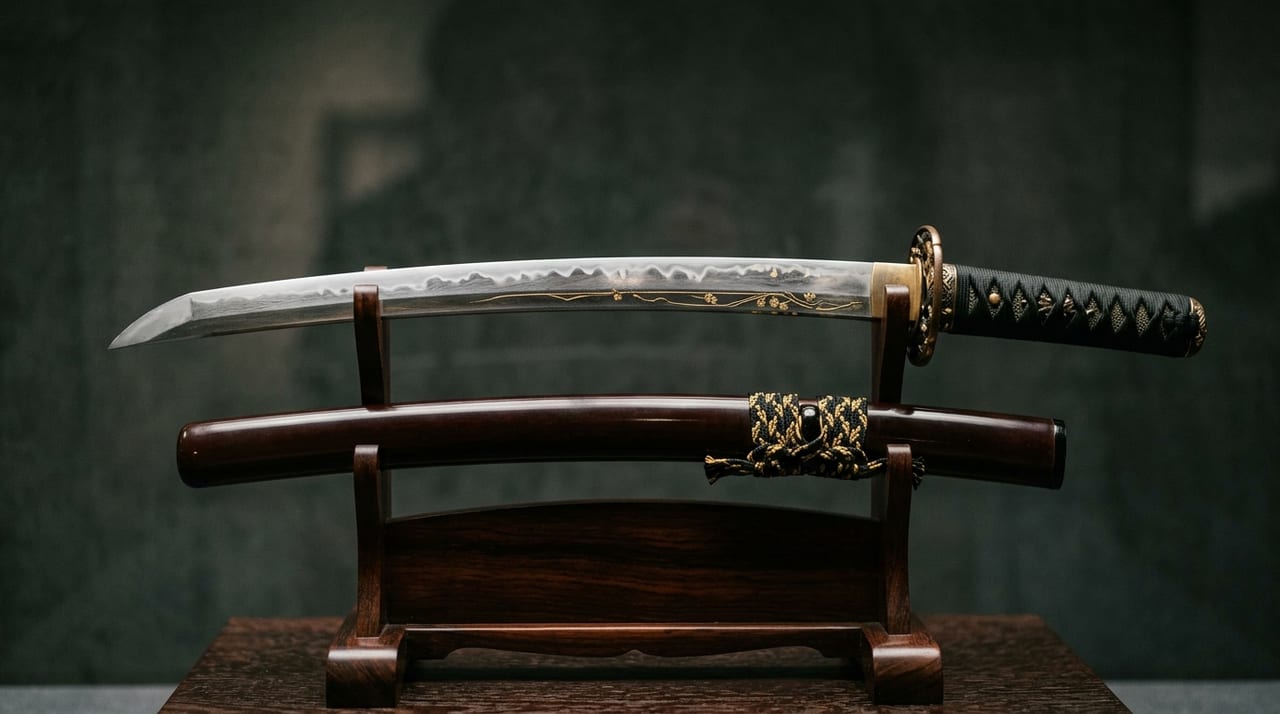
 * Image is for illustrative purposes only.
Ishida Masamune
石田正宗
Also known as: Ishida; Mitsunari's Sword; Ishida Kirikomi Masamune; Kirikomi Masamune
Description
Overview of the Sword
Ishida Masamune is an uchigatana (a long sword) forged by Masamune (Sōshū Masamune), who is regarded as the greatest swordsmith in the history of the Japanese sword. It takes its name from having once been owned by Ishida Mitsunari (1560–1600), the foremost of the Five Magistrates who served Toyotomi Hideyoshi. Masamune's works were prized as "treasures of the realm" and are recorded in large numbers in the Kyōhō Meibutsuchō. Ishida Masamune holds a special place among them because of its association with Mitsunari, a statesman of rare ability, and it embodies the political drama of the late Sengoku period. Although its blade length is 2 shaku 2 sun 7 bu (approximately 68.78 cm), it condenses within a small world the Sōshū-den steel and the vivid hamon characteristic of Masamune. Among connoisseurs it is highly regarded as one of the finest surviving works by Masamune. The union of Mitsunari's political talent with Ishida Masamune, the summit of sword art, is one of the most eloquent examples of where the beauty and history of the Japanese sword intersect.
Masamune's Forging Technique and the Beauty of Ishida Masamune
The swords of Masamune are known for large grains of nie called ōnie that boil up along the cutting edge, producing a dramatic effect called "tobiyaki" (flying burn), in which the nie scatter across the entire hamon. The jihada of Ishida Masamune is well forged, with fine ji-nie and chikei, and the depth of the steel's luster shows different expressions depending on the angle of viewing. The hamon is based on ko-notare, mixed with ko-gunome, and includes kinsuji and sunagashi. Among Masamune's certain authentic works, this blade is one of the few pieces of evidence that proves Masamune's skill, and it therefore holds high academic value. The nakago was originally a long tachi that was shortened by ō-suriage, and it bears no signature. The steel's expression is extremely rich, and the fine, long kinsuji running vertically and horizontally through the blade prove to present-day viewers that Masamune's forging was an artistic act that went far beyond mere heat treatment.
Ishida Mitsunari and the Provenance of This Sword
Ishida Mitsunari came from Ishida Village in Sakata District, Ōmi Province (present-day Nagahama, Shiga Prefecture). As a retainer of Toyotomi Hideyoshi, he displayed outstanding administrative and logistical ability and supported the practical affairs of the Toyotomi government as one of the Five Magistrates. In the Edo period that followed, his conflicts with the military-minded daimyo were exaggerated and his image as a "disliked figure" became fixed. In recent research, however, he has been reassessed as a rare rationalist and a capable bureaucrat. In the Korean campaigns (the Bunroku and Keichō campaigns), Mitsunari was in charge of logistics and supply, and in modern terms he functioned as a "military logistics genius." This ability earned him Hideyoshi's complete trust, and he came to hold the position of foremost of the Five Magistrates, overseeing the finances, legal system, and diplomacy of the Toyotomi government. The provenance records that Mitsunari owned this Masamune sword, and the blade came to be called "Ishida Masamune" because of its connection with him. According to the Kyōhō Meibutsuchō, Ukita Hideie purchased it from Mōri Wakasa no Kami for four hundred kanmon and presented it to Mitsunari. The transfer of a blade by the greatest smith to the greatest administrator is remembered in the history of the sword as a meeting of two "greatest" figures.
Tension on the Eve of Sekigahara and Mitsunari's Resolve
In Keichō 5 (1600), conflict within the Toyotomi government reached its height, and Ishida Mitsunari raised troops to overthrow Tokugawa Ieyasu. The Western Army, led by Mōri Terumoto and claiming the legitimacy of the Toyotomi government, collapsed before the Eastern Army in the main battle of Sekigahara on the 15th day of the 9th month. Mitsunari fled, was captured in Ōmi, and was executed at Rokujō-gawara on the 1st day of the 10th month of Keichō 5 (1600). He died aged forty-one. However, Ishida Masamune had been given by Mitsunari as a token of thanks in Keichō 4 (1599), the year before, to Yūki Hideyasu (the second son of Tokugawa Ieyasu), who had escorted Mitsunari when he retreated to Sawayama Castle after the Incident of the Seven Generals. By the time of the Battle of Sekigahara, the sword had already left Mitsunari's hands.
The Renown of Masamune and the Rarity of His Works
Many swords are attributed to Sōshū Masamune, but very few bear his signature, and most are unsigned blades attributed to Masamune. Certain authentic works are therefore limited in number, and Ishida Masamune holds a special position among them for the clarity of its provenance and its good state of preservation. While it displays the typical style of the Sōshū-den, which emphasizes the beauty of nie, Ishida Masamune is distinctive among Masamune's works for its prominent ko-gunome and its firmly tightened cutting edge.
Transmission to the Present and Its Evaluation
Ishida Masamune is now held by the Tokyo National Museum (Taitō, Tokyo) and is designated as an Important Cultural Property. Its value as a rare, certain authentic work by Masamune is heightened by the clear provenance linking it to the historical figure Ishida Mitsunari. In the game "Touken Ranbu," Ishida Masamune also appears as a sword of the Masamune lineage, and awareness of it among younger generations is growing through the game. Among the surviving works of Masamune, which are regarded as the summit of Japanese swords, Ishida Masamune stands at the highest level of sword collections as a blade that connects Ishida Mitsunari and Yūki Hideyasu, figures from around the Battle of Sekigahara.
Legends & Stories
Presentation of the Sword to Mitsunari
According to the Kyōhō Meibutsuchō, the circumstances by which Ishida Mitsunari came to hold the Masamune sword are recorded as follows: Ukita Hideie purchased it from Mōri Wakasa no Kami for four hundred kanmon and presented it to Ishida Mitsunari. That Mitsunari, as foremost of the Five Magistrates, was a senior official who supported the Toyotomi government explains the bond with this sword by the age's greatest smith. Afterwards, when Mitsunari retreated to Sawayama Castle following the Incident of the Seven Generals, he presented this sword in return to Yūki Hideyasu, who had served as his escort. Hideyasu is said to have been delighted, named it "Ishida Masamune," and used it as his favorite. After Hideyasu's death, it was passed down to his descendants, the Tsuyama Matsudaira family.
Rokujō-gawara: Mitsunari's End and the Fate of the Sword
On the 1st day of the 10th month of Keichō 5 (1600), Ishida Mitsunari, Ankokuji Ekei, and Konishi Yukinaga were executed at Rokujō-gawara. As Mitsunari was led to the place of execution, he asked for water, but none was available, and he was offered a dried persimmon. He declined it, saying, "Persimmons are poison to the phlegm." When asked, "Why bother now?" he is said to have answered, "One who lives for a great cause does not neglect his health even up to the moment before death." This anecdote symbolizes Mitsunari's rationalism and the strength of his convictions, and it was passed down for generations. Ishida Masamune had already passed into the hands of Yūki Hideyasu by this time. Yet when this sword is viewed as "Ishida Mitsunari's sword," the life of an administrator who fell for his convictions can be seen through the depths of the blade.
Masamune's Divine Craftsmanship: The Legacy of the Supreme Swordsmith
Masamune (dates of birth and death unknown; active in the late Kamakura period) was a swordsmith of Kamakura in Sōshū (Kanagawa Prefecture). He inherited and developed the techniques of his teachers Yukimitsu and Kunimitsu, and established the peak of the sword's aesthetic and technical achievement. Masamune's innovation lay in the intense and rich hamon known as "nie-deki." In contrast to the tranquil hamon of the Yamashiro-den and Yamato-den, the dramatic nie scenery of the Sōshū-den brought an entirely new aesthetic to the Japanese sword. Masamune's works caused later smiths to form the great school known as the "Sōshū-den," and the tradition was carried on by his disciples, including Sadamune. Among the surviving works of this supreme swordsmith, Ishida Masamune holds an important place in academic research on the Japanese sword as a special piece of evidence with a clear historical provenance.