New Arrivals — Browse our catalog for the latest authentic Japanese sword arrivals. Browse →
October 21, 1600 (Keichō 5, 9th month, 15th day)
Sekigahara, Mino Province (present-day Sekigahara, Gifu)
Forces
Eastern Army
Western Army
About 10 min read
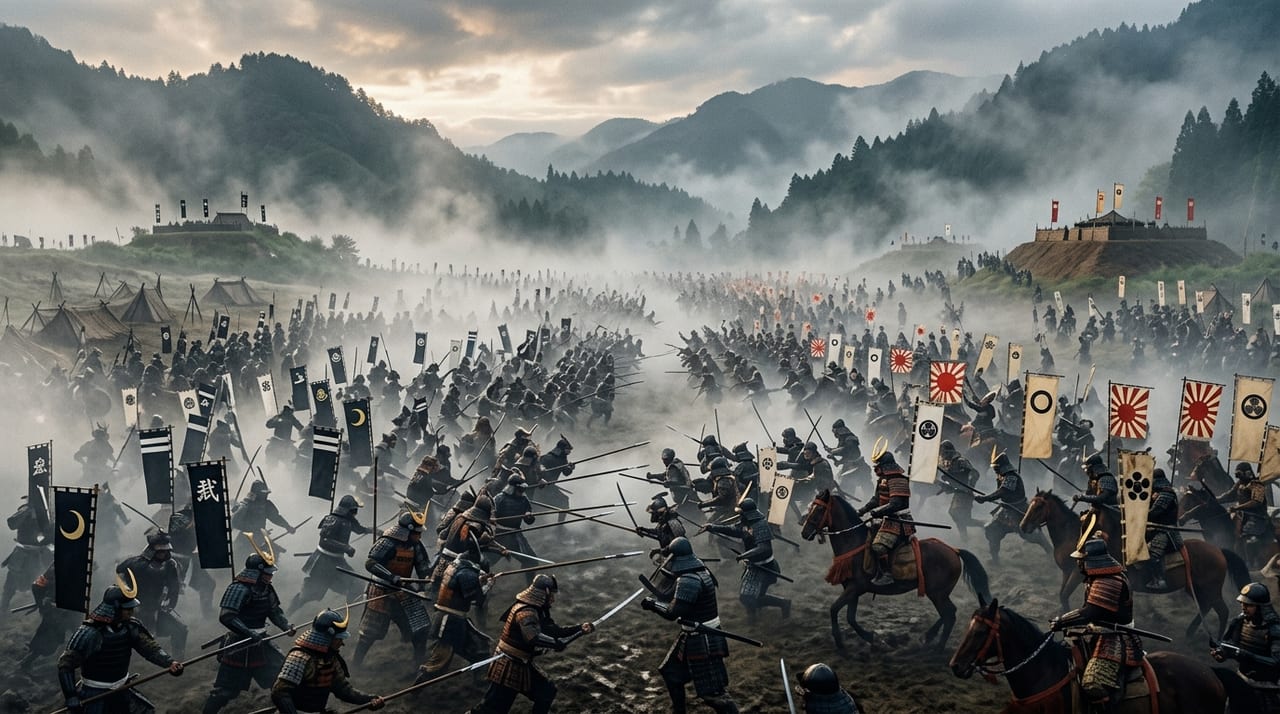
The Battle of Sekigahara is a decisive battle that determined the fate of the realm, said to be the largest field battle in Japanese history. On the 15th day of the 9th month of Keichō 5 (1600; October 21 in the Western calendar), the Eastern Army led by Tokugawa Ieyasu and the Western Army led by Ishida Mitsunari clashed at Sekigahara in Fuwa District, Mino Province (present-day Sekigahara, Gifu).
In Keichō 3 (1598), the ruler of the realm, Toyotomi Hideyoshi, died of illness at the age of 62. His heir, Hideyori, was still a child, so government affairs were left to a council system of the Five Elders (Go-Tairō) and the Five Magistrates (Go-Bugyō). However, Tokugawa Ieyasu, chief of the Five Elders, soon began to violate the order of the Toyotomi house. Ieyasu's arbitrariness was obvious: unauthorized marriages between daimyo in defiance of Hideyoshi's testamentary wishes, the poaching of retainers, and more. Ishida Mitsunari, the central figure among the magistrates, was enraged by this. He openly declared his opposition to Ieyasu and formed the Western Army, with Mōri Terumoto installed as its supreme commander. Ieyasu, for his part, rallied the daimyo of the eastern provinces, and hostilities were about to begin.
Swords of this era were not mere weapons; they were also symbols of a warlord's political power and authority. One of the swords Ieyasu is said to have favored most is the "Sohayanotsurugi." This tachi, still held at the Kunōzan Tōshō-gū in Shizuoka, is said to have been a protective blade that Ieyasu never let go of in his lifetime, and a source of spiritual support even on the battlefield. Another sword closely associated with the name of Ishida Mitsunari is the "Ishida Masamune." In Keichō 4 (1599), the year before Sekigahara, after the attack by the Seven Generals, Mitsunari retreated to Sawayama Castle, escorted by Yūki Hideyasu. In return, Hideyasu was given this sword. Passed down to the Echizen Matsudaira and Tsuyama Matsudaira families, it is also known as the "Kirikomi Masamune," named for the cut marks left on it (it is currently held by the Tokyo National Museum).
Around the time of Sekigahara, swordsmiths across the country were inevitably swept up in the waves of the times as well. Mino (present-day Gifu Prefecture) was one of the leading sword-producing regions of the time, and many smiths kept working at their forges within a short distance of the Sekigahara site. Swords of the Mino tradition are known for sturdy construction that prioritized practicality, and as battlefield blades for an age of chaos they were widely favored by warlords on both the Eastern and Western sides.
Early in the morning of the 15th day of the 9th month, the two armies deployed across the Sekigahara basin, shrouded in thick mist. The Western Army left its commander-in-chief, Mōri Terumoto, at Ōsaka Castle, while Ukita Hideie, Ōtani Yoshitsugu, Shimazu Yoshihiro, and others took up positions at the front. The Eastern Army, centered on Ieyasu's main camp, had Fukushima Masanori, Kuroda Nagamasa, and Hosokawa Tadaoki forming its wings.
The battle began with a fierce assault by the Western Army, but in the afternoon the situation changed completely. Kobayakawa Hideaki, who had been counted on as a main force of the Western Army, suddenly launched an attack from his position on Mount Matsuo against the troops of Ōtani Yoshitsugu. Whether this betrayal was the result of prior persuasion by Ieyasu or Hideaki's own judgment is debated, but its impact was immense. Ōtani Yoshitsugu's force was destroyed despite its valiant resistance, and with this as a signal, the Western Army's commanders one after another defected to the Eastern Army or left the field. The fighting ended in just under six hours, and the Western Army suffered a catastrophic defeat.
After the battle, Ieyasu rewarded the meritorious, and the lords of the Eastern Army received substantial increases in their domains. In this process, many famous swords changed hands as gifts. The custom of presenting swords as rewards to victors continued throughout the Sengoku period, and Sekigahara became an occasion for a large-scale movement of famous blades that could be called its culmination.
Ishida Mitsunari, who had served as the Western Army's de facto commander-in-chief, was captured after the battle and executed.
The Battle of Sekigahara brought a major turning point to Japan's sword culture. Thereafter, as a stable and peaceful age under the Tokugawa continued, the emphasis of swords shifted from practical weapons to art objects and spiritual symbols. The transition from the era of mass-produced blades (kazuuchi-mono) of the Sengoku period to the culture of shintō (new swords) of the Edo period accelerated precisely from Sekigahara as the dividing line. Swordsmiths after Keichō, though they lost the venue to test their skills, went on to develop new sword cultures of polishing, mountings, and appraisal.
After unifying the realm, Tokugawa Ieyasu continued to take a keen interest in the management of swords. The foundations of the appraisal culture that later led to the compilation of the Kyōhō Meibutsuchō were nurtured in parallel with the formation of order after Sekigahara. Under the peace of the shogunate, sword arts blossomed, following a distinctly Japanese cultural trajectory in which battlefield swords were elevated into works of art.
Sekigahara still remains in Gifu Prefecture as a battlefield site, where one can trace the encampment sites of each commander. For sword enthusiasts, it is also a sacred place where one can feel the last great battle of the Sengoku period firsthand and imagine the feelings toward swords of the commanders who gathered there.
天下分け目の関ヶ原合戦において刀剣が果たした役割と、戦後の論功行賞・大名配置転換が刀剣需要と職人集団に与えた影響を読み解く。
2026-09-25
越中国と能登・加賀の刀剣文化、御用鍛冶や扶持といった地方流派の職制、関ヶ原の戦い後に見られた刀工移住の歴史的傾向を解説する。
2026-10-17
五代将軍徳川綱吉の生類憐みの令が広めた殺生忌避の空気の中で、切捨御免と辻斬りをめぐる武家社会の規範がどう変容したかをたどる。
2026-09-27
2026-08-16