New Arrivals — Browse our catalog for the latest authentic Japanese sword arrivals. Browse →
1572–1575 (Genki 3 – Tenshō 3)
Iwamura, Ena District, Mino Province (present-day Iwamura-chō, Ena, Gifu)
Forces
Takeda forces (Akiyama Torashige, later garrisoning Iwamura Castle)
Oda forces
About 16 min read
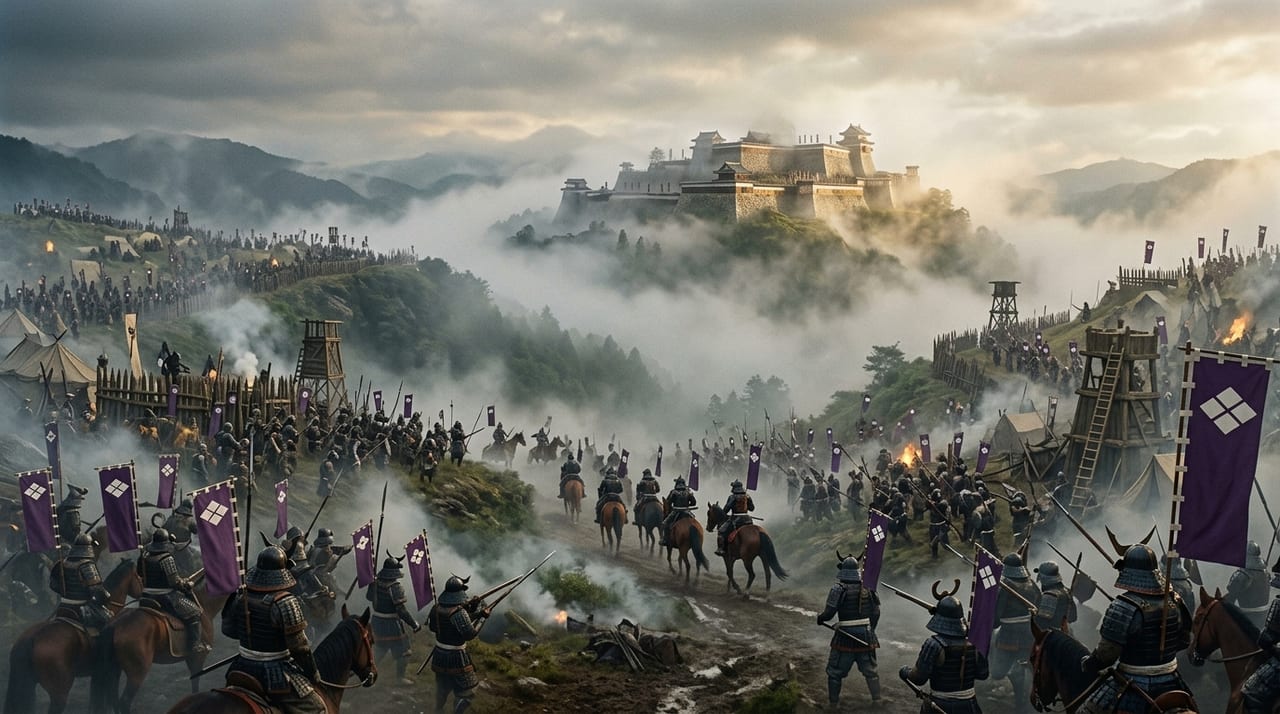
Iwamura Castle, situated in the Tōnō region of eastern Mino Province at an elevation of 717 meters, is counted among Japan's Three Great Mountain Castles alongside Bitchū Matsuyama Castle and Takatori Castle, and is known as the highest-elevation mountain castle in the country. According to tradition it was built in Bunji 1 (1185) by Katō Kagekado, a close retainer of Minamoto no Yoritomo, and thereafter served as the seat of the Tōyama clan (the Tōnō Tōyama), becoming the central stronghold of the Tōnō region. Known by the poetic epithet "Castle in the Mist" for the deep fog that often envelops it, this castle achieved nationwide renown through the struggle between the Takeda and Oda clans that unfolded from Genki 3 (1572) to Tenshō 3 (1575), and at its center, the tragedy of its female castle lord, Lady Otsuya.
After the death of Iwamura's lord, Tōyama Kagetō, his wife Lady Otsuya—aunt of Oda Nobunaga—assumed the role of female castle lord, governing the Tōnō region in his stead. Nobunaga placed deep trust in his aunt and sought to draw Tōnō firmly into Oda's sphere of influence, going so far as to send his own son Gobōmaru to be adopted into the Tōyama family. At the time, Tōnō was a contested borderland where Takeda and Oda power struggled for supremacy, and Iwamura Castle stood at its strategic front line. For Nobunaga, securing Tōnō was an indispensable measure for shoring up the rear of his home territories of Mino and Owari and for blocking any Takeda advance. Even after her husband's death, Lady Otsuya, despite being a woman, demonstrated real skill in domain administration, shouldering heavy responsibility as Oda's representative in Tōnō. The formidable defenses of this castle, built atop a 717-meter summit, matched the importance of its role as the linchpin of that rule.
In Genki 3 (1572), as part of his campaign to advance westward, Takeda Shingen dispatched his senior retainer Akiyama Torashige (also known as Nobutomo)—one of the celebrated Twenty-Four Generals of Takeda—to conquer the Tōnō region at the head of the clan's elite cavalry corps. Akiyama laid siege to Iwamura Castle and proposed peace terms to Lady Otsuya: the lives of the castle's soldiers and townspeople would be spared, her adopted son Gobōmaru would become Torashige's own adopted son, and Lady Otsuya herself would marry Torashige. Drawn by Akiyama's skillful diplomacy and personal charisma, Otsuya accepted these terms, and Iwamura Castle passed into Takeda hands without major bloodshed. Upon learning that the son he had sent to the Tōyama family had become a hostage of the Takeda, Nobunaga is said to have flown into a rage, but as he was in the midst of his own campaigns at the time, he was unable to mount an immediate counterattack. This single episode tilted the balance of power across the entire Tōnō region decisively in Takeda's favor, badly shaking the eastern defensive line of Oda territory. Akiyama Torashige was a hereditary senior retainer of the Takeda house, known as a shrewd strategist skilled both in commanding the frontier forces of Shinano and in diplomatic negotiation; that he was far more than a mere fierce warrior, but also a subtle political operator adept at peace overtures and intrigue, is evident from the very success of this marriage stratagem. Torashige's flexible strategic vision played an important role in Shingen's western campaign, but ironically, the very success of his scheme provoked Nobunaga's fury and became one cause of the tragic outcome that would later befall him. Tōnō, where Iwamura Castle stood, bordered directly on Oda's home territories of Mino and Owari, and losing this ground meant, for Nobunaga, a threat far greater than the mere loss of territory. Shingen's campaign to advance westward was a broad strategy of applying simultaneous pressure on Oda-Tokugawa territory from multiple fronts—Tōnō, Tōtōmi, and Mikawa—and Akiyama Torashige's conquest of Iwamura formed one wing of that strategy. Even after Shingen died of illness in Genki 4 (1573) and Katsuyori succeeded him, Iwamura Castle continued to function as the Takeda's stronghold for controlling Tōnō, until the catastrophic defeat at Nagashino overturned that strategic advantage at its root.
In May of Tenshō 3 (1575), Nobunaga crushed Takeda Katsuyori's forces at the Battle of Nagashino, using the power of his musket corps to inflict a devastating blow on the elite Takeda cavalry. This victory decisively crippled Takeda military strength. Riding this momentum, Nobunaga ordered his eldest son, Oda Nobutada, to retake Iwamura Castle. Akiyama Torashige, facing Nobutada's assault, surrendered on the condition that the lives of his soldiers and family be spared, but Nobunaga broke this promise, traditionally said to have executed both Akiyama Torashige and Lady Otsuya at Gifu by inverted crucifixion, though an alternative account holds that Lady Otsuya was instead put to death by Nobunaga's own hand at Komakiyama. That Nobunaga showed no mercy even to his own blood-related aunt has been passed down as a symbol of his ruthlessness and of the cutthroat intrigue that defined the Sengoku era. This execution is believed to have carried strong political weight beyond mere military victory, serving as a warning to anyone who might side with the Takeda. The fate Lady Otsuya ultimately accepted symbolized the ruthlessness of an age in which political scheming and blood ties were inseparably intertwined. For Nobunaga, the recapture of Iwamura Castle carried significance beyond merely retaking a single fortress—it became a crucial step in re-establishing Oda control over the whole of the Tōnō region.
The Tōnō region where Iwamura Castle stands lies at the eastern edge of the Mino-den sword-making tradition, centered on the town of Seki. Mino-den, one of Japan's Five Great Sword Traditions, produced bladesmiths such as Kanemoto and Kanesada who forged countless practical swords renowned for their quality—unbreakable, unbending, and sharp—earning tremendous support from Sengoku-era warlords. Kai Province, the Takeda clan's home territory, by contrast was not an independent sword-producing region; many of the famous blades owned by Shingen and Katsuyori are said to have been forged by smiths from other provinces, including Sōshū, Bizen, and Echizen. The devastation of the elite Takeda cavalry by Oda-Tokugawa musketry at Nagashino also symbolized the broader tactical shift from close-quarters swordplay to long-range firearms warfare. After Iwamura Castle passed into Oda hands, the sword culture of Mino and Owari is believed to have taken even deeper root in the Tōnō region, and throughout the Edo period, bladesmiths in the castle town of Iwamura Domain continued to be patronized as craftsmen essential to arming the domain's samurai. Today, the Ena City Iwamura Historical Museum displays arms and swords connected to Iwamura Castle, conveying to the present day the evolution of its sword culture from the age of the female castle lord through the Edo period.
The castle town below Iwamura still bears vivid traces of this history, once the stage for the contest between the Takeda and Oda clans. Since the Edo period, the town—lined with sake breweries and long-established merchant houses—has been designated an Important Preservation District for Groups of Historic Buildings, retaining the atmosphere of that era to this day. The magnificent stone ramparts known as the "six-tiered walls," running along the south side of the main citadel, were built in the late Edo period, yet their scale and precision represent the pinnacle of castle architecture. The sight of the castle ruins floating on a sea of mist from autumn into early winter continues to draw travelers, rivaling the scenery of the celebrated "castle in the sky," Takeda Castle in Hyōgo. The Battle of Iwamura Castle was more than a mere territorial dispute; it distilled the human drama of the Sengoku era into a single episode—a female castle lord who chose a political marriage to protect her castle and her people, and the cold vengeance of the nephew who would not forgive her. This tragedy carved Iwamura's place in history as "the Castle of the Female Lord"; during the Edo period, a succession of daimyō including the Matsudaira and Niwa clans served as its lords, and it endured as the seat of Iwamura Domain until the end of the shogunate. The broadcast of the NHK Taiga drama "Onna Jōshu Naotora" ("The Female Castle Lord Naotora") brought renewed attention to Iwamura as a site connected to a female ruler, and to this day, amid its mist-shrouded stone walls, the story of Lady Otsuya and Akiyama Torashige continues to speak to all who visit of their extraordinary fate.
This entire sequence of events surrounding Iwamura Castle distilled every element of Sengoku-era diplomacy—political marriage, hostage-taking, betrayal—into a single case that continues to draw keen interest from historians and writers alike. Walking the castle ruins today, one can still sense both the resolve of Lady Otsuya, who governed her domain as a female castle lord, and the ruthlessness of the age that ultimately toyed with her fate.