New Arrivals — Browse our catalog for the latest authentic Japanese sword arrivals. Browse →
3rd–11th months of Tenshō 12 (1584)
Komaki and Nagakute, Owari Province (present-day Komaki City and Nagakute City, Aichi Prefecture)
Forces
Tokugawa–Oda Nobukatsu Alliance
Hashiba (Toyotomi) Forces
About 12 min read
In Tenshō 12 (1584), the Battle of Komaki and Nagakute was one of the last large-scale confrontations of the late Sengoku period. It pitted Hashiba Hideyoshi, who sought to fill the power vacuum left after the Honnōji Incident (1582), against the combined forces of Tokugawa Ieyasu and Oda Nobukatsu, who resented Hideyoshi's high-handed conduct. Militarily, the battle ended in something close to a draw, but politically it became a decisive step toward Hideyoshi's establishment of hegemony.
In the 6th month of Tenshō 10 (1582), Oda Nobunaga died in the Honnōji Incident. Hashiba Hideyoshi then rapidly expanded his power through the Battle of Yamazaki and the Battle of Shizugatake. However, Oda Nobukatsu, the second son of Nobunaga, disliked Hideyoshi's high-handedness and allied with Tokugawa Ieyasu to take a hostile stance against him.
At this point, Ieyasu held a firm base in the Tōkai region and was known as a daimyo with a high degree of independence even under Nobunaga's regime. It has been said that Ieyasu was the only powerful figure at this time who could oppose Hideyoshi's unification of the realm.
In the 3rd month of Tenshō 12 (1584), Nobukatsu had three senior retainers who were in league with Hideyoshi put to death. Using this as a pretext, Hideyoshi led a large army into Owari. In response, Ieyasu marched out to support Nobukatsu, and the two armies faced each other in a standoff around Mount Komaki.
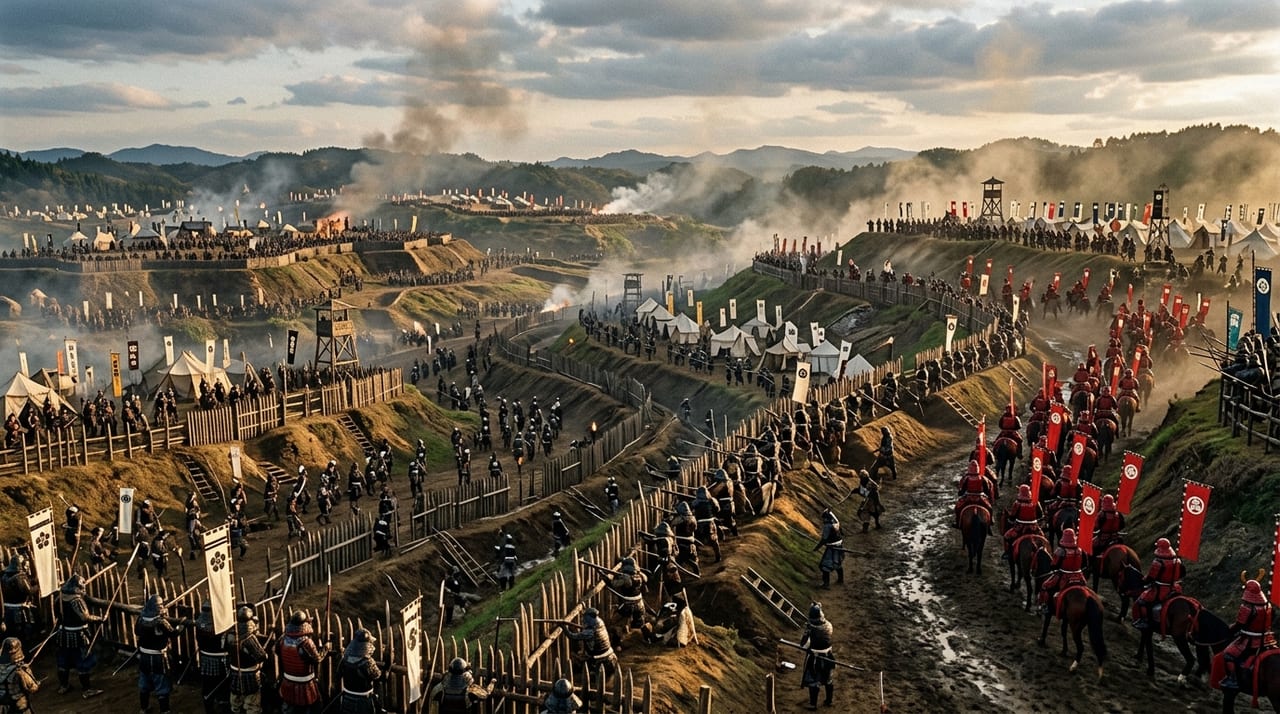
Ieyasu established his headquarters at Mount Komaki (present-day Komaki, Aichi Prefecture) and carefully built fortifications. He dug moats, erected palisades, and adopted a posture of mobile defense. Hideyoshi also constructed extensive fortifications in response, and the two armies remained locked in a standoff for several months.
The fighting at this stage was not a head-on clash between large armies but a continuous series of positional warfare and skirmishes. Faced with Hideyoshi's overwhelming numbers, Ieyasu avoided reckless frontal assaults and patiently waited for an opportunity. This caution was a strategic philosophy that Ieyasu would consistently maintain in the later Battle of Sekigahara and the Siege of Osaka.
Ikeda Tsuneoki, a member of Hideyoshi's side who sought to break the deadlock, proposed a flanking surprise attack on Ieyasu's home base at Okazaki. Hashiba Hidetsugu was named commander-in-chief, and a detached force of about 20,000 men, including Ikeda Tsuneoki, Ikeda Motosuke (Yukisuke), Mori Nagayoshi, and Hori Hidemasa, began to march south.
However, Ieyasu quickly detected this movement. He organized a pursuit force with Sakakibara Yasumasa and Ōsuka Yasutaka as the vanguard, and on the 9th day of the 4th month (lunar calendar), he caught Hideyoshi's detached force at Nagakute (present-day Nagakute, Aichi Prefecture).
In the Battle of Nagakute, under the fierce assault of Ieyasu's army, Ikeda Tsuneoki and his son Ikeda Motosuke were killed in action, and Mori Nagayoshi also died in battle. Ikeda Tsuneoki was a senior retainer of the Oda family and a foster brother of Nobunaga, while Mori Nagayoshi was a fierce commander known by the name "Oni-Musashi" (Demon Musashi). Hideyoshi's side lost its most elite generals in one blow and suffered tremendous losses.
Although this localized victory is recorded as a win for the Tokugawa army, Hideyoshi immediately counterattacked with his main force, and Ieyasu withdrew to his fortifications at Mount Komaki. The overall situation did not change.
The Tenshō era (1573–1592) was the period in which practical "Tenshō-style sword mountings (Tenshō-goshirae)" became most widespread in the history of the Japanese sword. After the long Sengoku period that followed the Ōnin War, swords evolved into practical weapons rather than luxurious ornaments.
Among the swords associated with the commanders of this battle, the group of blades said to have been favored by Tokugawa Ieyasu deserves particular mention. Ieyasu was deeply devoted to swords throughout his life and collected many famous blades. Among the famous swords described as those of "Tokugawa Ieyasu's rise to power," many have been designated National Treasures or Important Cultural Properties.
The "Ii red-armored corps (Ii no akazonae)," led by Ii Naomasa, first made its name known in this battle. Clad in red armor, the Ii army inherited the tradition of the Takeda red-armored corps, and its valiant fighting at Nagakute earned Ieyasu's trust.
Sakakibara Yasumasa is known as one of the Four Heavenly Kings of the Tokugawa. In the preliminary engagement before the Battle of Nagakute (the Battle of Hakusanbayashi), he attacked Hashiba Hidetsugu's forces from the flank and routed them.
As for the weapons favored by Mori Nagayoshi of Hideyoshi's side, the jūmonji-yari (cross-bladed spear) "Ningen Mukotsu" is well known. "Ningen Mukotsu" survives today, but in recent years it has been held in a private collection. The origin of its name is uncertain, but one view interprets it to mean that it pierces through a person as if there were no bones, and the spear is famous as an embodiment of the bold temperament of Oni-Musashi, Mori Nagayoshi. After Nagayoshi's death, the spear was passed down to Mori Tadamasa, who succeeded to the family headship.
The war effectively ended in the 11th month of Tenshō 12 (1584), when Oda Nobukatsu concluded a separate peace with Hideyoshi. With the nominal leader having made peace, Ieyasu had no choice but to lay down his arms, and he concluded a settlement by sending Ogimaru (later Yūki Hideyasu), his second son, to Hideyoshi as an adopted heir.
Although Ieyasu had matched or outperformed Hideyoshi in localized battles militarily, he politically yielded to Hideyoshi's skillful diplomatic strategy. Hideyoshi then invited Ieyasu to Osaka Castle and met with him in Tenshō 14 (1586), and in Tenshō 15 (1587) he completed the Kyūshū Campaign, rapidly climbing the road to the unification of the realm.
With this battle, an age began in which control of the realm was achieved through political and diplomatic power as well as military force. This was the transition from the age of the sword to the age of the abacus. Yet the role of the sword did not end; it was passed on to Sekigahara and the Siege of Osaka.
Tokugawa Ieyasu
Effective commander of the Tokugawa-Oda alliance, victor at Nagakute
Toyotomi Hideyoshi
Toyotomi commander, achieved political victory despite tactical setback
Ii Naomasa
Led the red-armored Ii unit, won first major distinction at Nagakute
Honda Tadakatsu
One of Ieyasu's Four Heavenly Kings, distinguished himself at Komaki
Fukushima Masanori
Participated for Toyotomi, later switched to Tokugawa side