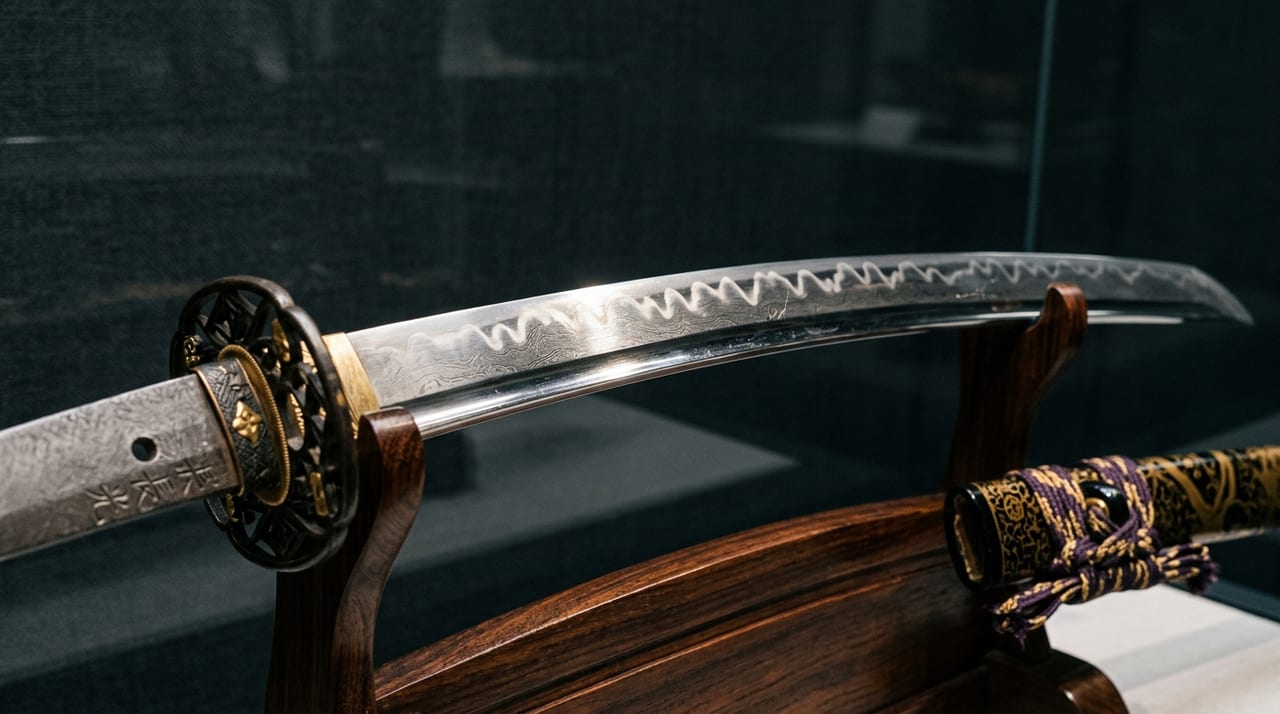
 * Image is for illustrative purposes only.
Daihannya Nagamitsu
大般若長光
Also known as: Daihannya · The 600-Kan Tachi · Treasure of Bizen Osafune
Description
Overview of the Sword
A National Treasure tachi from the mid-Kamakura period, renowned as the masterpiece of Osafune Nagamitsu, a leading master of the Bizen Osafune school. Its blade length is 2 shaku 4 sun 3 bu (about 73.6 cm) with a curvature of about 2.9 cm. Its imposing tachi form, with a broad body width and sturdy kasane, shows the ideal proportions of the mid-Kamakura period.
Forging and Characteristics
The jigane shows fine, tight ko-itame-hada and strongly marked midare-utsuri, displaying the beauty characteristic of the Bizen tradition. The hamon is the greatest highlight of Daihannya Nagamitsu. The splendid ō-chōji-midare blooms across the full width of the cutting edge, a view universally acknowledged as a masterpiece representing the pinnacle of chōji hamon in the Bizen tradition. Ashi and yō appear abundantly, and the nioi-guchi is deep and bright. This splendid finish shows Nagamitsu's skill and aesthetic sense at their highest level. The bōshi is disordered (midare) and returns in a small round tip, and the nakago bears the two-character signature 'Nagamitsu' with its original ubu surface. The maker, Osafune Nagamitsu (birth and death dates unknown; active in the latter half of the 13th century), was a smith from Osafune in Bizen Province (present-day Setouchi, Okayama Prefecture). Together with his father, Osafune Mitsutada, he laid the foundations of the Osafune school. Mitsutada was known for a bold style, while Nagamitsu excelled at more splendid and delicate chōji-midare hamon, raising the artistry of the Bizen tradition to a higher level. The name 'Daihannya' derives from the extraordinary appraised value (daizuke) of 600 kan in coin assigned to this tachi in the Muromachi period. Since the Great Prajñāpāramitā Sutra (Daihannya-kyō) consists of 600 scrolls, the name came to be used in reference to the 600 kan. This extraordinary appraised value shows how highly this tachi was esteemed at the time.
Provenance
The provenance traces back to the Ashikaga shogunate, and throughout the Muromachi period it was kept as a treasured sword of the shogun's family. It was subsequently passed among the rulers of the realm: Miyoshi Nagayoshi, Oda Nobunaga, and Tokugawa Ieyasu.
Current Holding
It was designated a National Treasure in 1951 and is now held by the Tokyo National Museum.
Legends & Stories
Legends and Anecdotes
The provenance of Daihannya Nagamitsu runs in step with the shifts of power among the rulers of the realm.
Into the Hands of Warriors
During the Muromachi period, this tachi was kept as a treasured sword of the Ashikaga shogunate. In the turmoil of the Sengoku period, it passed out of the shogun's family. In the time of the 13th shogun, Ashikaga Yoshiteru, it came into the hands of Miyoshi Nagayoshi, a powerful figure in the Kinai region. After Nagayoshi's death, it is said to have passed to Oda Nobunaga. In the first year of the Genki era (1570), at the Battle of Anegawa, Nobunaga highly valued the achievement of Tokugawa Ieyasu's forces in defeating the Asakura army, and as a reward he granted this Daihannya Nagamitsu to Ieyasu. The Battle of Anegawa was a clash between the allied Oda and Tokugawa forces and the allied Asai and Asakura forces. For Ieyasu, it was an important battle that solidified his alliance with Nobunaga. That a famous sword of the realm, Daihannya Nagamitsu, was chosen to reward this merit speaks eloquently to the high value of this tachi. Ieyasu kept the tachi securely for a long time. Later, as a reward for military merit at the Battle of Nagashino, he granted it to Okudaira Nobumasa, who had held out at Nagashino Castle. Afterward it passed to the line of Matsudaira Tadaaki, the youngest son of Okudaira Nobumasa who became an adopted son of Ieyasu (Musashi Province, Oshi domain). After the Meiji period it was designated a National Treasure, and it is now held by the Tokyo National Museum. As the appraised value of 600 kan shows, Daihannya Nagamitsu was not merely a famous sword but also held enormous value as an asset. For daimyo of the Sengoku period, famous swords were among the highest rewards, on a par with domains, and also served as tools of diplomacy. The reason Daihannya Nagamitsu passed among the rulers of the realm lies in the overwhelming economic and cultural value this tachi held. Several works by Osafune Nagamitsu have been designated National Treasures, and Daihannya Nagamitsu is widely regarded as the greatest masterpiece among them. The splendid scene created by the ō-chōji-midare hamon continues to captivate sword enthusiasts around the world as the pinnacle of the beauty of the Bizen tradition. In the game Touken Ranbu, it appears as a tachi and is depicted as a splendid character befitting the value of 600 kan.