New Arrivals — Browse our catalog for the latest authentic Japanese sword arrivals. Browse →
January 1392 (Meitoku 2, 12th month)
Yamashiro Province (Uchino, Kyoto)
Forces
Ashikaga Shogunate Forces
Yamana Clan Forces
About 12 min read
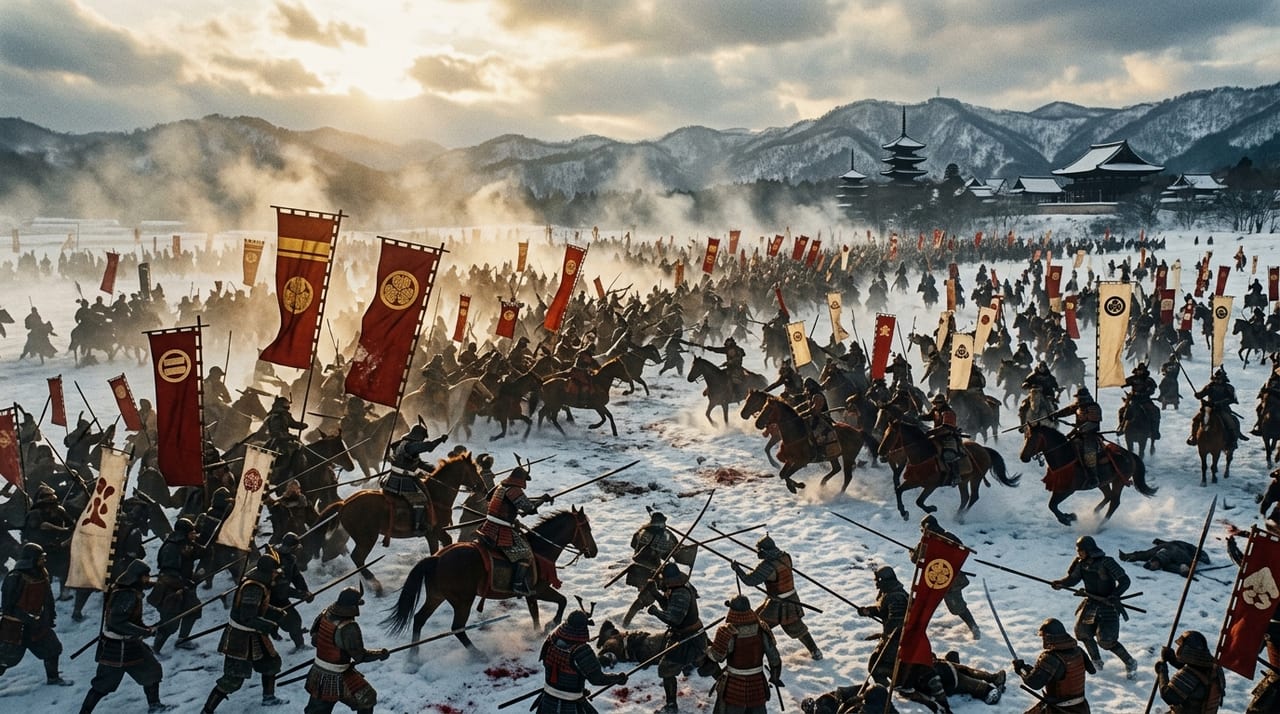
The Meitoku Rebellion, which erupted in the 12th month of Meitoku 2 (January 1392), was an armed conflict between Ashikaga Yoshimitsu, the third shogun of the Muromachi shogunate, and Yamana Ujikiyo, Yamana Mitsuyuki and their kin of the Yamana clan, which together held the shugo posts of eleven provinces nationwide. Despite lasting only a few days, the rebellion fundamentally transformed the power structure of the Muromachi shogunate. Through the devastating weakening of the Yamana clan, Ashikaga Yoshimitsu established the most powerful shogunal authority in Muromachi history and subsequently promoted trade with Ming China, constructed the Golden Pavilion, and achieved the reunification of the Northern and Southern Courts (Meitoku 3 / 1392). The age of Yoshimitsu was also a golden age in which Muromachi sword culture flowered most abundantly.
Amid the turmoil of the Northern and Southern Courts period (1336–1392), the Yamana clan steadily expanded its power. Having navigated the struggle between Ashikaga Takauji and Ashikaga Tadayoshi (the Kannō Disturbance) and skillfully exploited internal power struggles within the shogunate, the Yamana came to control approximately eleven of Japan's sixty-six provinces at the height of their strength. Since this represented roughly one-sixth of the country, the clan earned the sardonic epithet "the One-Sixth Lord" (rikubunoichi-dono), and their power was formidable enough to threaten the Ashikaga shogunal house itself.
Yamana Ujikiyo was a particularly forceful figure within the clan and consistently maintained an independent stance toward the shogunate. Though his conflict with Yoshimitsu remained largely concealed, Ujikiyo's ambitions directly threatened the shogunate's authority.
Ashikaga Yoshimitsu was a skilled political strategist. Recognizing the Yamana clan's power as a threat to the shogunate, Yoshimitsu gradually orchestrated internal divisions within the family. He exploited conflicts between Yamana relatives, worked to weaken the clan, and simultaneously strengthened his alliances with other powerful daimyo—the Hosokawa, Akamatsu, Ōuchi, and others.
One significant instrument of Yoshimitsu's authority as shogun was the collection and bestowal of famous blades. Yoshimitsu accumulated many celebrated swords for the shogun's collection. The bestowal of named blades to powerful daimyo served both as confirmation of political loyalty and as reinforcement of the master-vassal bond. This "sword diplomacy" was a crucial facet of Yoshimitsu's power politics.
Particularly notable is that Yoshimitsu laid the foundation for the Higashiyama Gomotsu—the Ashikaga shoguns' collection of Chinese paintings, tea utensils and other karamono. His cultural policies, which would later lead to the "Higashiyama culture" of subsequent eras, encompassed many domains—swords, tea utensils, calligraphy and painting, nō theater—and established the aesthetic standards for Muromachi sword art as the highest expression of warrior culture.
In Meitoku 2 (1391), the conflict between Yoshimitsu and Yamana Ujikiyo reached its critical point. According to some accounts, Yoshimitsu cleverly provoked and isolated Ujikiyo, engineering circumstances that forced the Yamana leader to raise arms of his own accord. In the 12th month of Meitoku 2 (January 1392), Yamana Ujikiyo and Yamana Mitsuyuki raised their army and clashed with shogunal forces near Kyoto.
But the outcome was decided swiftly. The shogunal army, reinforced by powerful daimyo such as the Hosokawa, Akamatsu, and Ōuchi, overwhelmed the Yamana forces. Yamana Ujikiyo was killed in battle; Yamana Mitsuyuki fled the field but was captured and executed in Ōei 2 (1395). The Yamana domains were drastically reduced from eleven provinces to three. This rapid victory was the fruit of Yoshimitsu's careful prior political maneuvering.
Following his victory in the Meitoku Rebellion, Ashikaga Yoshimitsu achieved complete mastery over the Muromachi shogunate. In the following year, Meitoku 3 (1392), he achieved the reunification of the Northern and Southern Courts, ending the imperial succession's division that had lasted approximately sixty years. This achievement marked the political zenith of his authority.
Yoshimitsu also vigorously promoted trade with Ming China—the tally trade (kangō). Through this commerce, numerous cultural treasures and works of art flowed into Japan, including karamono (Chinese art objects) such as Song and Yuan paintings.
Having constructed the Kitayama Villa (later the Golden Pavilion, now Rokuon-ji) in Ōei 4 (1397), Yoshimitsu became the embodiment of "kōbu-yūgō culture"—a fusion of warrior and aristocratic aesthetics—despite his position as the supreme military authority. In this Kitayama culture, swords were established both as symbols of the warrior class and as objects of artistic appreciation. The sword-aesthetic sensibility that would later bloom in the "Higashiyama culture" of his grandson Yoshimasa had its origins in Yoshimitsu's Kitayama culture.
Two points of particular significance for the history of the Japanese sword are connected to the Meitoku Rebellion.
First, the bestowal of a tachi during the rebellion itself. Ōuchi Yoshihiro, who fought the Yamana forces at Nijō-Ōmiya, was praised by Yoshimitsu for slaying an enemy commander in single combat and was rewarded with a tachi.
Second, the matter of Yoshimitsu's shogun's collection. As shogun of the Muromachi shogunate, Yoshimitsu collected and preserved many famous blades. The shogunal collection of karamono (Chinese paintings, tea utensils and the like) later known as the Higashiyama Gomotsu also had its foundations laid during his reign. However, with the decline of the Muromachi shogunate, these treasures dispersed, and not a few were lost after the Ōnin War (from 1467 onward). Many of the surviving Higashiyama Gomotsu are designated National Treasures or Important Cultural Properties.
Though the Meitoku Rebellion was a brief internal conflict, it marked the opening of Yoshimitsu's autocratic rule, which created the most florescent period of Muromachi sword culture. The pattern of Muromachi sword culture—wherein the shogunal house collected celebrated blades, bestowed them on daimyo as instruments of political authority, and became the cultural arbiter of sword connoisseurship—reached its fullest expression during Yoshimitsu's reign after the Meitoku Rebellion.
Ashikaga Takauji
Founder of the Muromachi shogunate; Yoshimitsu's grandfather whose era enabled Yamana's rise
Akamatsu Mitsusuke
Member of the Akamatsu clan that fought on the shogunate's side
Ashikaga Yoshinori
Yoshimitsu's son, the sixth shogun who was later killed in the Kakitsu Incident
Hosokawa Katsumoto
Hosokawa clan, the kanrei family that supported the shogunate after Meitoku
Daihannya Nagamitsu
Great Bizen blade held by the Ashikaga shoguns, emblem of the Muromachi sword collection
Kiku-Ichimonji Norimune
Celebrated blade from the imperial tradition, treasured in the Ashikaga shogunal collection
Nihongō
One of Japan's three great spears, emblematic of Muromachi warrior culture