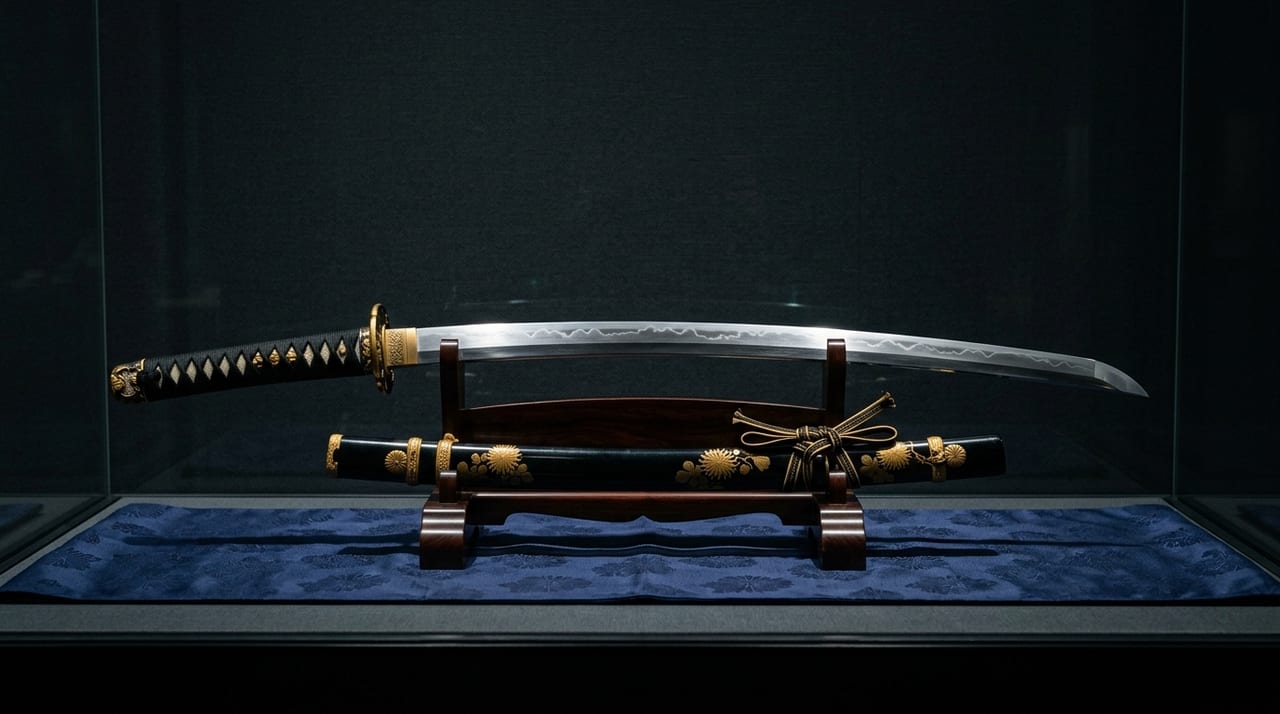
 * Image is for illustrative purposes only.
Kiku-Ichimonji Norimune
菊一文字則宗
Also known as: Kiku Gozaku
Description
What Is Kiku Ichimonji? A Legendary Sword That Does Not Exist
Kiku Ichimonji (kiku ichimonji) is the name of a legendary tachi said to be the work of Norimune, founder of the Bizen Ichimonji school. Norimune served as a gobankaji (rotating smith) for Retired Emperor Go-Toba (Go-Toba-in), and the blade is said to have cut the imperial chrysanthemum crest. To put it plainly, no surviving blade bearing both the chrysanthemum crest and Norimune's signature has been confirmed to this day. The scholarly consensus is that a specific sword called "Kiku Ichimonji Norimune" does not exist. The famous story that it was the favorite sword of Okita Sōji of the Shinsengumi is also a fiction from a Shōwa-era novel. Behind the legend, however, lies the real history of Kamakura-period swordmaking: the gobankaji system and the Ichimonji school.
Overview: Go-Toba and the Gobankaji
"Kiku Ichimonji" is a legendary famous tachi said to be the work of Norimune, a smith of the Bizen Ichimonji school who was active in the early Kamakura period. Norimune was chosen as one of the gobankaji (御番鍛冶), master smiths whom Retired Emperor Go-Toba (Go-Toba-in) summoned from across the country to forge blades on a monthly rotation. He is said to have served the first-month (January) rotation, the leading position, and he is regarded as the de facto founder of the Fukuoka Ichimonji school. Go-Toba loved swords so much that he took up forging himself. Because his own works and those of the gobankaji were said to bear the imperial chrysanthemum crest, the names "kiku-gosaku" (chrysanthemum imperial work) and "Kiku Ichimonji" are said to have arisen.
Style and Characteristics
Ichimonji school blades are defined above all by their brilliant choji-midare (clove-shaped irregular) hamon (temper line). The hamon rises and falls in a continuous series, and with kawazuko-choji (tadpole-head clove) and jūka-chōji (double-flower clove) mixed in, its gorgeous, lavish appearance is regarded as the pinnacle of Bizen blades of the Kamakura period. The jigane (base steel) is tightly packed ko-itame (small burl grain), with vivid midare utsuri (irregular shadow). Tachi attributed to Norimune are known for a slender, elegant form resembling Heian-period tachi, and for a classical, refined style with a small irregular hamon fired on a suguha (straight temper) base. With Norimune as its de facto founder, the Ichimonji school developed into the Fukuoka Ichimonji (early to mid Kamakura), Yoshioka Ichimonji (arising around the late Kamakura period), Iwato Ichimonji (also called Shōchū Ichimonji), and Katayama Ichimonji, forming a major current of Bizen swordmaking. The name "Kiku Ichimonji" is also used as a byword for this brilliant style.
Designation and Holdings
The key point is that no blade bearing Norimune's signature together with the chrysanthemum crest has been confirmed to survive. It is most reasonable to regard "Kiku Ichimonji Norimune" as a legendary famous sword, an anecdotal blade nurtured by later war chronicles and kōdan (storytelling). Among Norimune's representative works whose existence is secure, the most renowned is the National Treasure tachi, signed Norimune (designated 1951), held by Hie Shrine in Akasaka, Tōkyō. As Norimune's only National Treasure, it conveys his skill to this day. The "Kiku Ichimonji" of this entry should therefore be understood not as a specific surviving work, but as a symbolic name born of the fame of Norimune and the Ichimonji school.
Okita Sōji and Kiku Ichimonji: The Origin of the Popular Belief
Within the Shinsengumi in the late Edo period, the story that Okita Sōji's favorite sword was "Kiku Ichimonji Norimune" is widely known, but it has no historical support. The source of this popular belief is a passage in Shibasawa Kan's Shinsengumi Shimatsuki (1928), which describes Okita's sword as "a slender Kiku Ichimonji." The image was firmly fixed in the public mind when Shiba Ryōtarō later portrayed it as "Kiku Ichimonji Norimune" in Shinsengumi Keppūroku and other works. The swords Okita is actually said to have carried were works such as Kashū Kiyomitsu and Yamato-no-kami Yasusada. Moreover, an early Kamakura-period tachi by Norimune was already a treasure of the daimyō-house class, more than 600 years old by the late Bakumatsu period. It was not something a single retainer could wield in actual combat.
Does Kiku Ichimonji Actually Exist?
No tachi bearing both the chrysanthemum crest and the Norimune signature has been confirmed to exist. The scholarly consensus is that it is a legendary famous sword nurtured by later stories. The National Treasure tachi, signed Norimune, at Hie Shrine is the representative extant work by Norimune, and it serves as a clue to the reality behind the legendary "Kiku Ichimonji."
Where Does the Name "Ichimonji" Come From?
The name derives from the distinctive inscription style of the Ichimonji school, in which only the character 一 (ichi, "one") is cut on the tang (nakago). The simple inscription 一 is famous in sword history as a bold declaration of pride unmatched by any other school.
Does It Appear in Modern Works?
The story of Go-Toba-in and the gobankaji lives on in contemporary pop culture as well. For example, "Ichimonji Norimune" appears in the game Tōken Ranbu. Though a legendary sword, or precisely because it is one, Kiku Ichimonji continues to stand as a symbol of the named-sword culture surrounding Japanese swords.
Legends & Stories
Retired Emperor Go-Toba is said to have summoned master smiths from various provinces as gobankaji to forge blades in monthly rotation, and to have tempered blades himself. Such swords are said to have borne the sixteen-petal chrysanthemum crest of the imperial throne and were called "Kiku Gosaku" (chrysanthemum imperial work). Through its association with the fame of Norimune, regarded as the foremost of the gobankaji, the name "Kiku Ichimonji" spread, but no sword bears the inscription "Kiku Ichimonji," and no Kamakura-period blade carved with both a chrysanthemum and the character ichi ("one") survives.