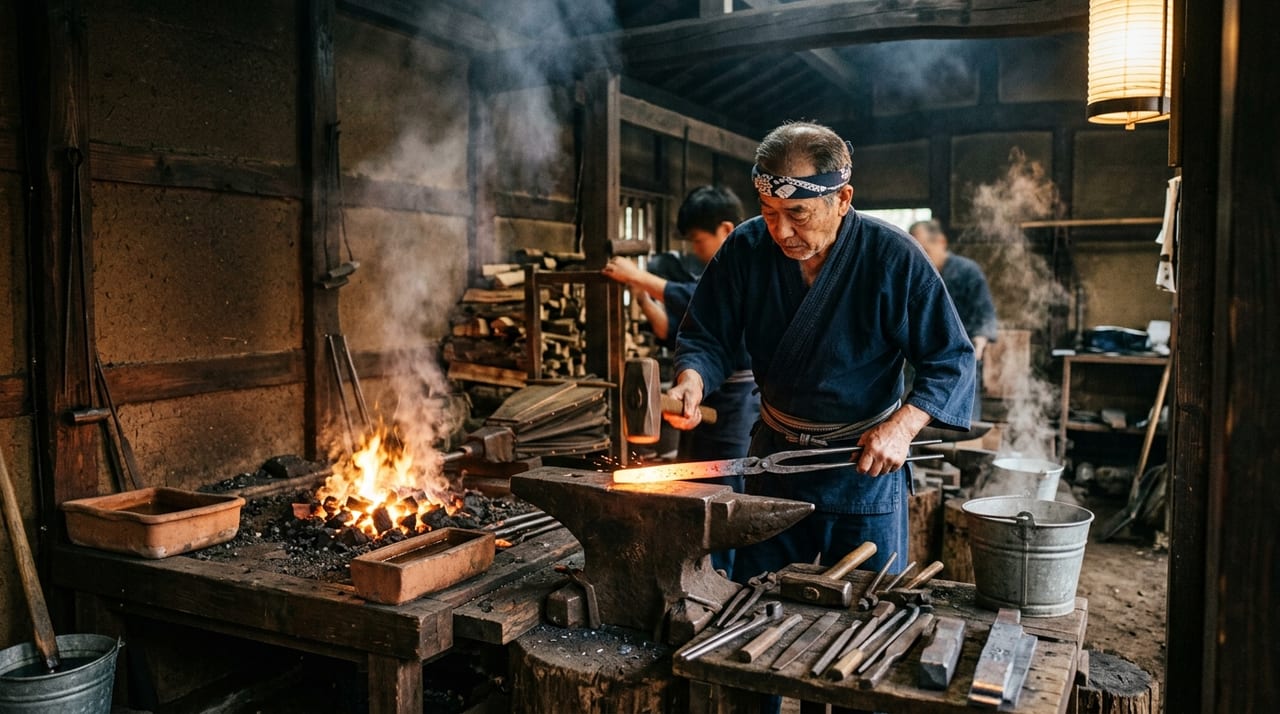
 * Image is for illustrative purposes only.
Ichimonji Norimune
一文字則宗
Description
Dawn of Bizen — Ichimonji Norimune, Founder of the Fukuoka Ichimonji School
Ichimonji Norimune was a swordsmith active in Bizen Province (present-day eastern Okayama Prefecture) in the early Kamakura period, and is a master who shines brilliantly in the history of the Japanese sword as the founder of the Fukuoka Ichimonji school. The name 'Ichimonji' derives from the fact that swordsmiths of the school cut the character 一 on the nakago, and Norimune is considered its founder. Norimune is also said to have held first place among the goban-kaji of Retired Emperor Go-Toba.
Norimune's period of activity is held to be the early Kamakura period, overlapping with the establishment of the Kamakura shogunate. In this period, when demand for swords surged with the rise of the warrior class, Norimune became the founder of the Fukuoka Ichimonji school and laid the foundation of the Ichimonji school, which includes the later Yoshioka Ichimonji and Katayama Ichimonji and others.
Norimune's Hamon and the Ichimonji Chōji-midare
Hamon types in Japanese swords are broadly divided into suguha and midare-ba, and among midare-ba the most magnificent and technically difficult is chōji-midare. Chōji refers to the shape of the hamon's outline resembling the flower of the chōji (clove), and the way round, plump, mica-like outlines line up in continuous succession gives it a fantastic beauty, as if lotus flowers were continuously floating on the surface of the water.
However, Norimune's own hamon is centered on works that fire small midare in the suguha style with the antique flavor of Ko-Bizen, and within these some works fire old-style gunome chōji. The gorgeous chōji-midare called 'kawazuko-chōji' and 'jūka-chōji' in the ōbusa style appears at the height of Fukuoka Ichimonji in the mid-Kamakura period.
The Shine of the Jigane — Bizen's Yamato-kurabe
Norimune's jigane is based on itame-hada, with nagare-hada mixed in places. A bright, clear jigane in which ji-nie adheres evenly and chikei faintly appears embodies the healthy beauty of iron characteristic of Bizen-den. Bizen blades of the early Kamakura period are said to tend to have somewhat coarser jigane forging compared with the later Osafune-mono, but Norimune's works are markedly finer even among them, and became the goal for later Ichimonji school smiths.
The sword's form is not much different from swords of the Heian period. It is basically a slender, elegant tachi form, and the sori is based on koshi-zori. Many have kijimomo-gata nakago.
The Legacy of Norimune — Founder of the Ichimonji School
Norimune's greatest achievement is laying the foundation of the Ichimonji school, which was passed on to many later smiths. Schools calling themselves Ichimonji include, in addition to Fukuoka Ichimonji, Yoshioka Ichimonji, Katayama Ichimonji, and Iwato (Shōchū) Ichimonji.
The Fukuoka Ichimonji school carries on Norimune's lineage. In the early period, Sukemune, said to be Norimune's son, appeared, and in the mid-Kamakura period, master smiths such as Yoshifusa, Norifusa and Sukezane emerged. Norifusa is said to have lived in Katayama, and is also called 'Katayama Ichimonji'. The Yoshioka Ichimonji school arose in the late Kamakura period in the Yoshioka area north of Fukuoka. These Ichimonji schools carried the peak of Bizen blades in the Kamakura period.
The splendid chōji-midare of the Ichimonji school was also passed on to the Osafune school, where master smiths such as Osafune Mitsutada, Osafune Nagamitsu and Osafune Kagemitsu each added their own individuality, building the golden age of Bizen blades in the Kamakura and Nanboku-chō periods.
Extant Works by Norimune — The Testimony of National Treasures
Authentic signed works by Norimune are extremely few, but some have been designated National Treasure (Hie Shrine) and Important Cultural Property (such as 'Sasamaru' of Atago Shrine), showing their high evaluation. The National Treasure tachi held by Hie Shrine (Tokyo) is widely known as the representative masterpiece that best conveys Norimune's style. The shrine has also long transmitted this one blade, showing that Norimune's swords were deeply connected not only with warriors but also with Shinto ritual. The beauty of the hamon and the bright jigane eloquently speaks to the height of technical skill that the swordsmith Norimune reached.
Most of Norimune's signed works bear only the two-character signature 'Norimune,' and the common name 'Ichimonji Norimune' is a later designation. The confidence and pride contained in the simple two-character signature embody a stately stylistic beauty permitted only to the highest-tier swordsmiths.
Norimune's Spirit and TOUKENZA
The aesthetics of chōji-midare nurtured by the Ichimonji school, of which Ichimonji Norimune is the founder, was a revolutionary contribution that greatly expanded the possibilities of the beauty of the Japanese sword. Norimune's spirit, which affirmatively upheld 'being beautiful' and 'being lustrous' as the value of a sword, may be said to have been the first major step in elevating the Japanese sword from a mere weapon to a work of art.
Date Masamune of Sendai, where TOUKENZA is based, is also known for his fondness for Bizen Osafune swords, and 'Shokudaikiri Mitsutada' is a representative example. The beauty of Mitsutada's chōji-midare inherits the tradition of Ichimonji and Osafune beginning with Norimune, and the lineage of Bizen blade beauty continues from Norimune to Mitsutada, and on to Shokudaikiri Mitsutada, which came into Masamune's hands. The splendid aesthetics of the Bizen blades produced by the Ichimonji school's chōji-midare still form the foundation of how TOUKENZA conveys the beauty of the Japanese sword to the world.
Famous Works
- tachi signed Norimune (National Treasure, Hie Shrine)
- tachi signed Norimune (Important Cultural Property, several)