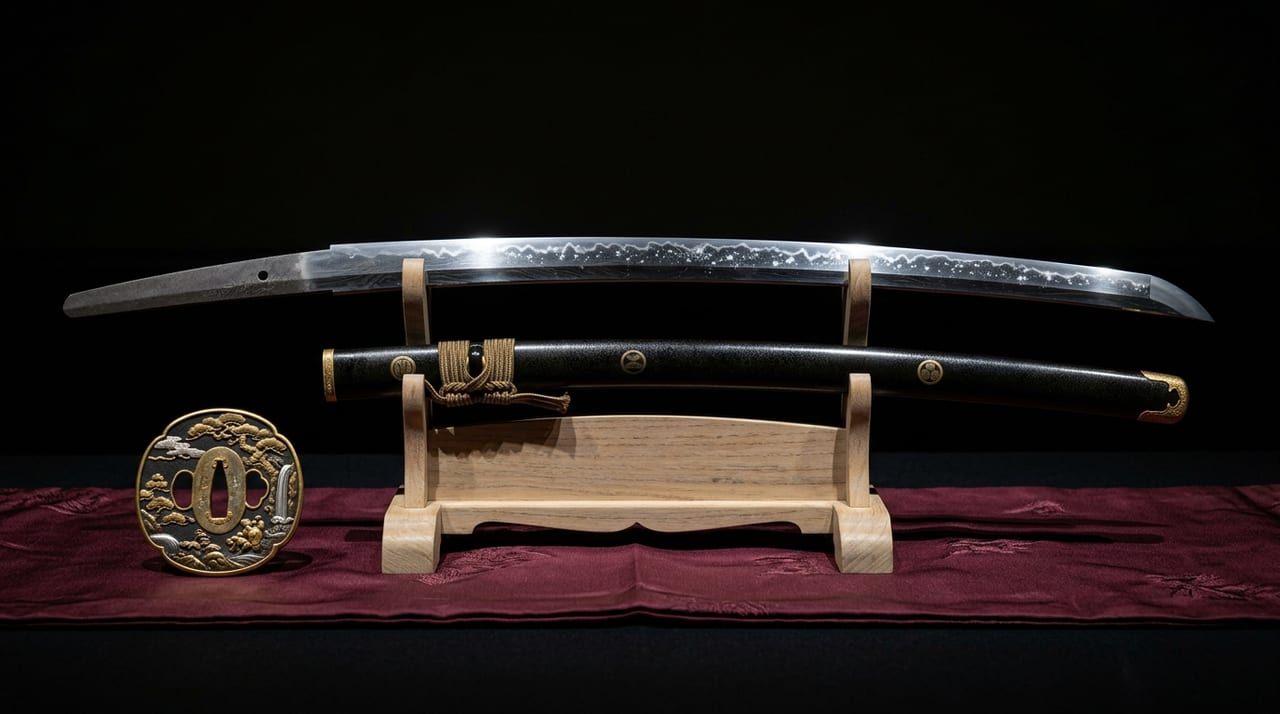
 * Image is for illustrative purposes only.
Masamune
正宗
Also known as: Sōshū Masamune — Master of Masters
Description
Overview of the Sword
Universally acknowledged as the greatest swordsmith in Japanese history, this is Sōshū Masamune, formally Gorō Nyūdō Masamune. Active in Kamakura, Sagami Province (present-day Kamakura City, Kanagawa Prefecture) from the late Kamakura period into the early Nanboku-chō period, he was a genius smith who perfected the forging technique known as the Sōshū tradition (Sōshū-den). Before Masamune, the main swordsmithing traditions in Japan were the Yamato-den, Yamashiro-den, and Bizen-den. Masamune integrated and developed these to establish the Sōshū-den.
Forging Method and Characteristics
The greatest feature of the Sōshū-den is its brilliant hamon (temper line) of nie-deki. Nie (沸) are coarse-grained crystals that form along the cutting edge during quenching. In Masamune's hamon, these nie are large and shine brightly, creating a fantastical scene like stars scattered across the night sky. The jigane (base steel) shows the forging patterns known as chikei and kinsuji, which appear vividly and have the faint, mysterious beauty of mist over a pine forest. The overall beauty created by the jigane and hamon together is a level no other swordsmith is said to have reached, and those who see a Masamune blade are said to be left speechless by its overwhelming artistry. Masamune ranks first among the "Three Greatest Smiths" (Tenka Sansaku: Masamune, Gō Yoshihiro, and Awataguchi Yoshimitsu). His style influenced swordsmiths across the country, and ten of them later came to be called the "Ten Disciples of Masamune" (Masamune Jittetsu), though not all were his direct pupils. The Ten include Saemonji (Chikuzen), Nagayoshi (Bizen), Norishige (Etchū), and Sadamune (Sagami), among others. Each developed in their own way in their home regions and enriched Japanese swordmaking culture in the centuries that followed. Many of Masamune's works are unsigned, which is a major characteristic and also a mystery. One theory holds that his work was so individual and overwhelming that it was recognizable at a glance, so there was no need to sign it. The Kyōhō Meibutsuchō, compiled in the Edo period, records many Masamune works as the "Meibutsu Masamune," each given a name such as "Hyūga Masamune," "Ishida Masamune," or "Kanze Masamune." Among daimyo households, these Meibutsu Masamune were used as the highest gifts and rewards, and owning a single Masamune blade was regarded as the highest honor for a warrior family. Today nine Masamune works are designated National Treasures, held by institutions including the Tokyo National Museum, the Mitsui Memorial Museum, and the Tokugawa Art Museum. In Japanese, the name "Masamune" has become established as a byword for "the very best," and even people who know nothing about Japanese swords know the name. It is truly a treasure of Japanese culture.
Legends & Stories
The famous legend of Masamune versus Muramasa tells of a cutting test in a stream. Muramasa's blade cut everything that touched it — leaves, fish, even the air itself. But leaves drifted around Masamune's blade, and fish swam away unharmed. Though Muramasa's blade seemed superior, a watching monk declared: 'Masamune's blade is a sword of benevolence — it does not cut that which is innocent.' The tale is apocryphal, as the two smiths lived in different eras, but it perfectly captures how Masamune's art transcends mere weaponry to embody spiritual refinement. In Japanese, 'Masamune' has become a byword for supreme excellence in any field.