New Arrivals — Browse our catalog for the latest authentic Japanese sword arrivals. Browse →
1493–1498 (Meiō 2 to Meiō 7)
Izu Province (present-day Izu region of Shizuoka Prefecture)
Forces
Hōjō Sōun's forces
Ashikaga Chachamaru's forces
About 13 min read
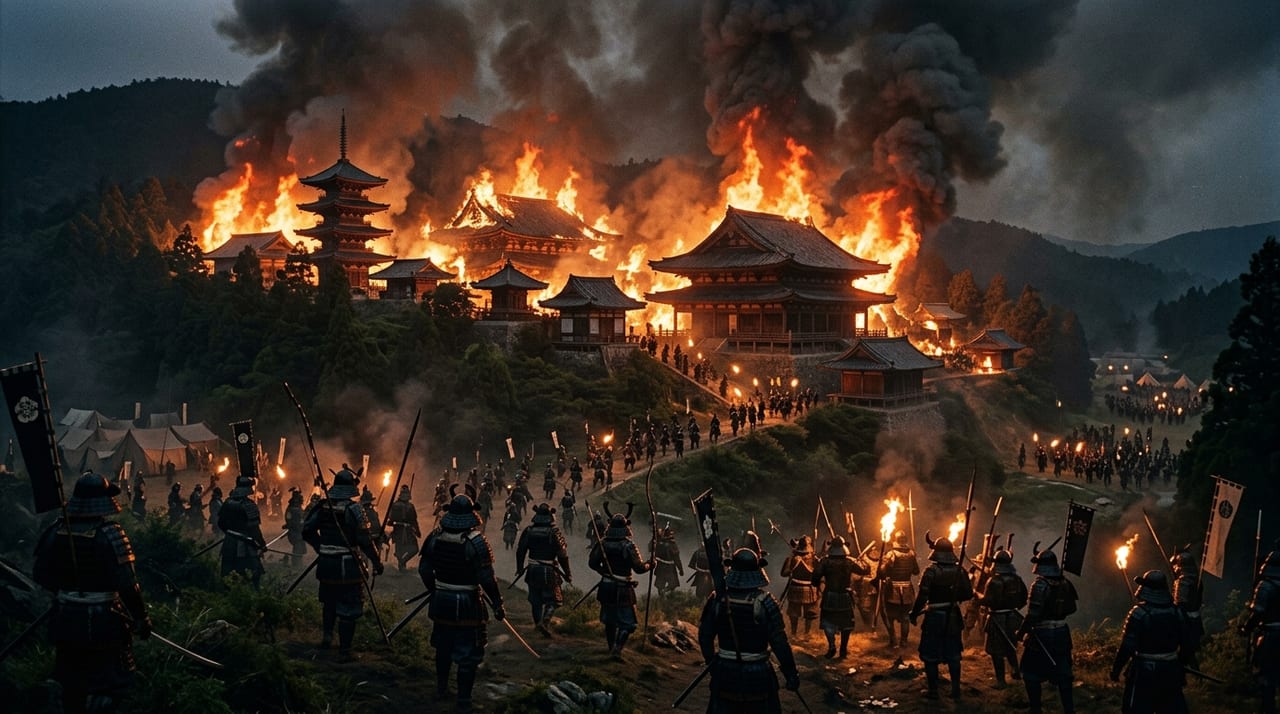
The pacification of Izu by Hōjō Sōun (hōjō sōun no izu heitei) is traditionally dated from Meiō 2 (1493) to Meiō 7 (1498), but there is also a view that the Horikoshi Gosho was actually captured in Meiō 4 (1495). It is the process by which Hōjō Sōun (Ise Sōzui), founder of the Later Hōjō clan, unified Izu Province. This unification was traditionally regarded as a forerunner of gekokujō, but recent research has made clear that it was a movement linked to the Meiō Coup. By holding all of Izu Province, Sōun became a forerunner of the Sengoku daimyō. Sōun's pacification of Izu opened the way for the Later Hōjō clan to come to control all of Kantō in time, and it became an event that symbolizes the start of the Sengoku period.
Izu Province was not a domain directly under the Muromachi bakufu but was under the control of the Horikoshi kubō, a branch of the Ashikaga family. The Horikoshi kubō was established when Ashikaga Masatomo came down from Kyoto and set up his base in Izu. After Masatomo's death, Chachamaru, his eldest son who had been disinherited, killed Jundōji, the younger half-brother who had been named as successor, along with Jundōji's mother Enman-in, seized real power, and governed Izu Province. However, Chachamaru's rule was not necessarily stable, and latent conflicts existed within Izu Province.
Hōjō Sōun (Ise Sōzui) was a member of the Ise clan, a prestigious family that served as mandokoro shitsuji of the Muromachi bakufu (the Bitchū Ise clan, based at Ebara estate in Bitchū Province). The once widely circulated theory that he was a 'masterless samurai of low-ranking kokujin origin' has been rejected by recent research. Sōun served Imagawa Ujichika of Suruga and was granted Kōkokuji Castle as a reward for settling the succession dispute within the Imagawa family. He was never a retainer of Horikoshi kubō Ashikaga Chachamaru; rather, as a commander under Imagawa Ujichika, he stood in opposition to Chachamaru's side.
In the 4th month of Meiō 2 (1493), Hosokawa Masamoto carried out the Meiō Coup and installed Seikō (later Ashikaga Yoshizumi), a younger half-brother of Chachamaru, as shogun. Chachamaru came to be regarded as the man who had killed the shogun's mother and younger brother. It is said that Yoshizumi (or people associated with the bakufu) ordered Sōun, a bakufu retainer who held a castle near Chachamaru, to avenge these killings. There is also a view that Sōun himself harbored ambitions toward Izu, and in the unstable situation within Izu Province, Sōun went ahead with the invasion of Izu.
In Meiō 2 (1493), Sōun invaded Izu from Kōkokuji Castle in Suruga and attacked Horikoshi Gosho (Ashikaga Chachamaru's residence). Chachamaru resisted with the support of the Yamanouchi Uesugi clan and Izu's kokujin, but in the 10th month he is said to have abandoned Horikoshi Gosho and fled to southern Izu. There is also a view that Horikoshi Gosho was actually captured in the 2nd month of Meiō 4 (1495).
As a result of this attack, it is thought that Sōun quickly brought Horikoshi and the northern part of Izu north of Nirayama under his control. However, the unification of all of Izu Province required prolonged fighting for several more years. The kokujin forces of southern Izu, who supported Chachamaru, were still continuing their resistance.
After being driven from Horikoshi Gosho, Chachamaru moved south across the Izu Peninsula and, with support from the Yamanouchi Uesugi clan, the Kanō clan of central Izu, and the Sekido clan of Oku-Izu, continued to resist within Izu Province until Meiō 4 (1495). Afterward he is said to have left Izu and sought the help of the Takeda clan of Kai and the Yamanouchi Uesugi clan in an attempt to retake Izu. For this reason, it took five years from the invasion until the pacification of Izu was complete.
On the 25th day of the 8th month of Meiō 7 (1498), the Meiō earthquake struck, causing damage across the Pacific coast. After the earthquake, the internal strife within the Takeda clan of Kai briefly led to reconciliation, and in the same 8th month Chachamaru was handed over from the Takeda side to the Ise side and is said to have committed seppuku (according to the Ōdaiki chronicle). However, whether he took his own life in Izu or in Kai is uncertain, and there is also a theory that Fukune Castle, in the southernmost part of Izu, was his final place. According to this theory, after the earthquake and tsunami caused heavy damage to the area around Fukune Castle, Sōun attacked with a small force and killed Chachamaru and the castle lord Sekido Yoshinobu. Thus the last Ashikaga family power in Izu Province was extinguished, and all of Izu Province came fully under the control of Hōjō Sōun.
Hōjō Sōun's pacification of Izu had a meaning beyond mere military unification. After unifying Izu, Sōun carried out a form of governance that is praised as 'good governance'. That is, he refrained from excessive collection of nengu, reduced the burden on farmers, established certain hatto, and strove for fair governance.
Because of this 'good governance', the people of Izu came to accept the rule of the Hōjō clan. For this reason, after the pacification of Izu, no large-scale ikki or rebellion occurred, and the stability of the Hōjō clan's ruling system was in fact supported by the people's approval. This stable system of governance became the foundation on which Sōun used Izu as a rear base when he aimed to advance into all of Kantō.
Hōjō Sōun's pacification of Izu holds historical significance for several reasons. First, this unification was traditionally regarded as a forerunner of gekokujō, in which territory was acquired through the clan's own military strength without relying on the authority of the bakufu. However, recent research suggests that the invasion of Izu was carried out with the great justification of avenging a wrong on the orders of Shogun Ashikaga Yoshizumi, and that Sōun was recognized by Yoshizumi as holder of all of Izu Province as a reward for his service.
Second, Sōun's pacification of Izu symbolizes the emergence of the Sengoku daimyō system. After unifying the territory, Sōun established hatto to stably govern that territory and developed the governing system. In this way, by advancing territorial rule and the development of the governing system at the same time, Sōun became a forerunner of the Sengoku daimyō.
Third, the success of the pacification of Izu opened the way for the Hōjō clan to rule all of Kantō. Using Izu as its base, the Hōjō clan expanded its territory into Sagami and Musashi Provinces and other parts of Kantō, and eventually grew into a great power that held most of Kantō under its control. Throughout the Sengoku period, the Hōjō clan reigned as the overlord of Kantō and remained the greatest power in Kantō until it was attacked by Oda Nobunaga and Toyotomi Hideyoshi.
Thus, Hōjō Sōun's pacification of Izu was not merely a territorial unification within a single region but became the starting point of the Later Hōjō clan, which would later rule most of Kantō.