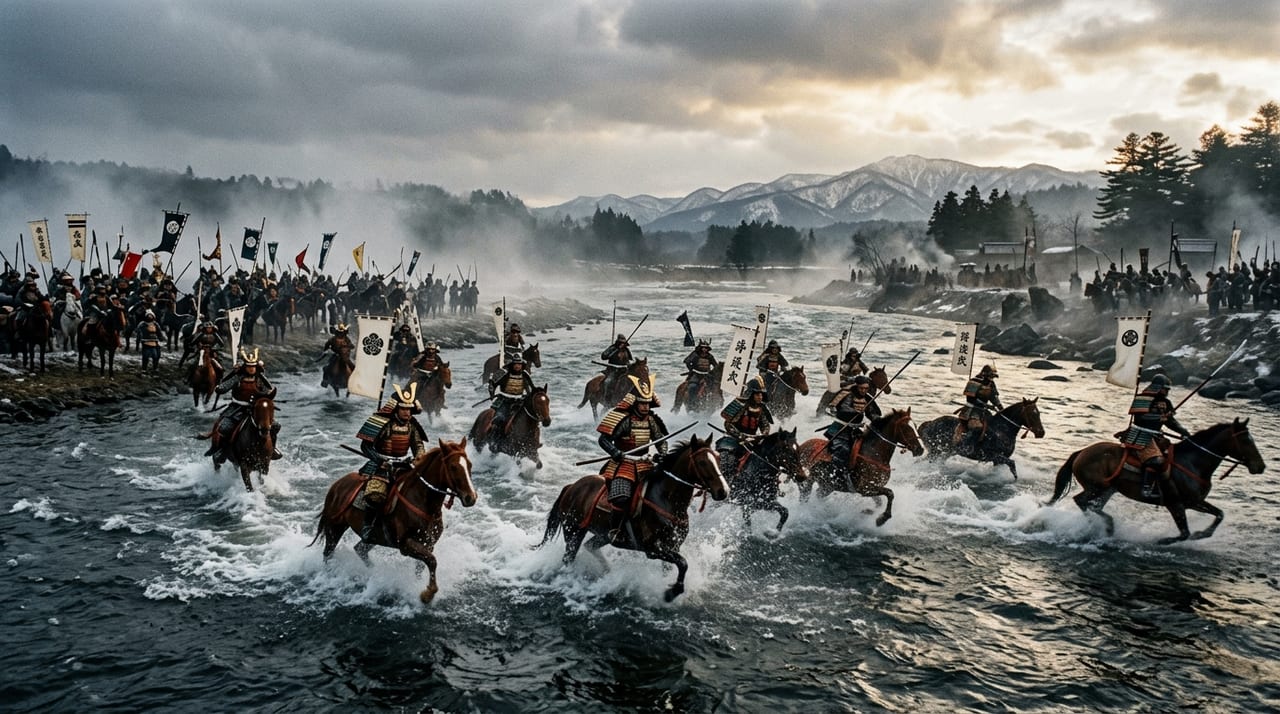
Battle of Arita-Nakaide
Tenth month (22nd), Eishō 14 (1517)
Arita-Nakaide, Aki Province (present-day Kitahiroshima, Hiroshima)
- Date
- Tenth month (22nd), Eishō 14 (1517)
- Location
- Arita-Nakaide, Aki Province (present-day Kitahiroshima, Hiroshima)
- Result
- A great victory for the Mōri-Kikkawa allies. Both Kumagai Motonao and Takeda Motoshige were killed, and Motonari won his first battle.
Forces
Mōri–Kikkawa allied forces
Takeda forces
About 7 min read
In the tenth month of Eishō 14 (1517), the Battle of Arita-Nakaide was fought in Aki Province (present-day Hiroshima Prefecture). Also called the Battle of Arita, it is widely known as the first battle of Mōri Motonari, who would later become the ruler of the Chūgoku region.
Young Motonari Supporting the Young Lord
In the eighth month of Eishō 13 (1516), Mōri Okimoto, head of the Mōri, a powerful local lord family of Aki, died suddenly, and Kōmatsumaru, only two years old, succeeded to the household headship. Serving as his guardian was Okimoto's younger brother, Mōri Motonari, then 20 years old. However, Motonari himself had almost no battle experience, and the unrest among the Mōri retainers, who were serving a young lord, could not be concealed. At that time Aki lay between two great powers, the Ōuchi of Suō and the Amago of Izumo, and the local lords were placed in an unstable situation in which they had to decide where to stand between them.
The Struggle over Arita Castle
Taking advantage of this crisis for the Mōri, Takeda Motoshige, who aimed to restore the power of the Takeda, a former shugo house of Aki Province, with support from the Amago, attacked Arita Castle of the Kikkawa, who sided with the Mōri. This was the origin of the battle. As head of the Aki Takeda, Motoshige was a presence opposing the Ōuchi, and his movements shook the balance of power among the local lords of Aki. The allied forces of the Mōri and the Kikkawa set out to relieve Arita Castle.
Defeating Two Commanders
On the 22nd day of the tenth month, the vanguard of the allied Mōri and Kikkawa forces, about 1,000 strong, which had advanced toward Arita, faced off at Nakaide against about 1,500 men led by Kumagai Motonao, a valiant general of the Takeda side. At first the allied forces responded with long-range archery, but soon they seized an opening and launched close-quarters combat. Kumagai Motonao, underestimating the allied forces as a small force, attacked, but he was struck in the forehead by an arrow, fell from his horse, and had his head taken by Miyanoshō Tsunetomo.
The Takeda army was shaken by the loss of its fierce general, Kumagai Motonao, but Takeda Motoshige led the main force and went on the offensive. However, just as he tried to cross the Matauchi River, Motoshige too was struck by a stray arrow and killed in action. Having lost two commanders in succession, the Takeda army collapsed entirely and fled in defeat. This battle, in which the smaller allied force killed the enemy commander who had the advantage in numbers and turned the tide, was later called "Okehazama of the West."
Motonari's First Step to Greatness
The victory in this first battle spread Motonari's military renown throughout Aki and beyond, and made the Ōuchi take notice of him. Thereafter Motonari skillfully wielded schemes and diplomacy, rising from an ordinary local lord of Aki. He defeated Sue Harukata at the Battle of Itsukushima, and eventually grew into a great daimyo who repelled the two great powers of the Amago and the Ōuchi and ruled ten provinces of the Chūgoku region. The Battle of Arita-Nakaide is remembered as the starting point of the brilliant career of Mōri Motonari, that rare wise strategist.
In the Sengoku period, Aki and Bingo lay within the sword culture region of the Chūgoku, connected to Bizen and Mimasaka, and the repeated conflicts of the local lords sustained demand for practical swords. The character of battle, shifting from archery to close combat, conveys well the arms of this era and shows that bows and arrows and swords and spears were together the protagonists of the battlefield.