New Arrivals — Browse our catalog for the latest authentic Japanese sword arrivals. Browse →
September 22, 1547 (Tenbun 16; the year is disputed)
The castle town of Inabayama (Inokuchi) and Kanoguchi, Mino Province (present-day Gifu City, Gifu Prefecture)
Forces
Saito Dosan's army (Mino)
Oda Nobuhide's army (Owari)
About 10 min read
In the early Sengoku period, Mino Province was a land whose nominal governors, the Toki family, had been weakened by internal strife, leaving real power to the Saito, a family descended from the deputy governors, and above all to Saito Dosan (Toshimasa). Dosan is popularly remembered as an oil merchant who rose to seize all of Mino, though many scholars now think this was the work of two generations, Dosan and his father Nagai Shinzaemon-no-jo. Either way, as Dosan expelled Toki Yorinori and consolidated his hold, he provoked resistance from Toki loyalists and neighbors, some of whom made common cause with forces in Owari and Echizen.
In neighboring Owari, the authority of the Shiba governors and the Oda deputy governors was fading, and Oda Nobuhide, from a branch of the deputy governor line, was rising. Nobuhide moved from Shobata Castle to Nagoya and then Furuwatari, controlled the commercial wealth of ports such as Tsushima and Atsuta, and fought the Matsudaira of Mikawa. With the Imagawa to the east, the Saito to the north and Ise powers to the west, intervention in Mino is said to have been difficult for Nobuhide to ignore.
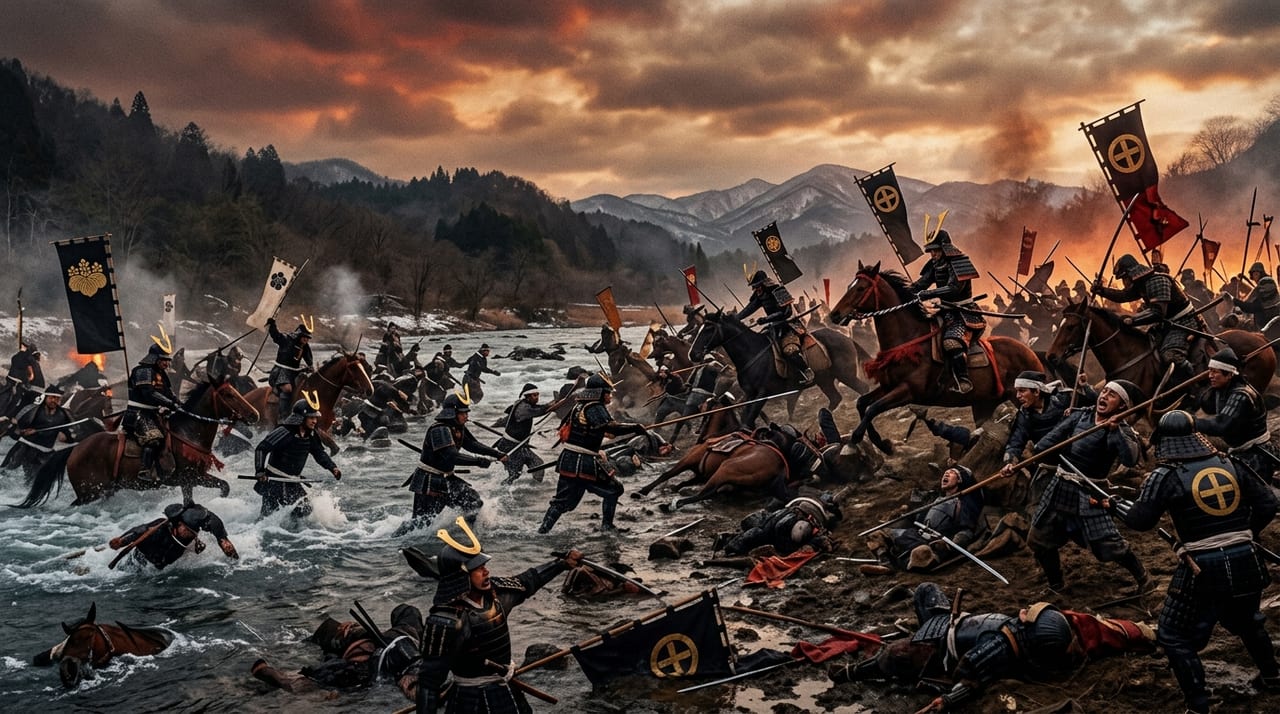
According to the common account, in the ninth month of Tenbun 16 (1547) Nobuhide led a large force into Mino and set fire to the area of Inokuchi, the castle town below Dosan's seat at Inabayama Castle (later Gifu Castle). The first book of the Shinchoko-ki likewise records that Nobuhide broke into Mino, burned around Inokuchi, and was engaged on the way back. Dosan is said to have withdrawn into his castle at first, then sortied as the Oda force began to retreat, pursuing it to Kanoguchi, in what is now southern Gifu City, and inflicting heavy losses.
The Oda side lost many men. The Shinchoko-ki names figures such as Oda Inaba-no-kami, Oda Yojiro, Oda Saburogoro, Aoyama Yozaemon, Chiaki Kii-no-kami and Mori Jurō among the dead and puts the total at about five thousand, a number that may be inflated. Some accounts say Oda Nobuyasu, a younger brother of Nobuhide said to have held Inuyama Castle, and Oda Nobuaoi were killed, but names and death years differ among sources and nothing can be stated with certainty.
The year of the battle is disputed. The 1547 date follows the Shinchoko-ki and later war chronicles and genealogies, but another theory places it in the ninth month of Tenbun 13 (1544). In that version Nobuhide attacked Mino in coordination with Asakura Takakage of Echizen, and Dosan won despite being pressed by both. Still other scholars propose two separate clashes, in 1544 and 1547, or suggest that a series of Mino–Owari conflicts was later condensed into a single battle in the chronicles.
Part of the confusion arises because the Shinchoko-ki was written decades after the events and reliable primary sources from the Mino side are scarce. This entry therefore follows the common account and gives September 22, 1547, but that date, like the details above, is not settled and is described as "said to be" throughout.
After the defeat Nobuhide found it hard to continue pushing into Mino. The two houses are said to have moved toward peace, sealed by the marriage of Nobuhide's heir Oda Nobunaga to Dosan's daughter Kicho (Nohime). The Shinchoko-ki records that Nobuhide and Dosan made peace and that Dosan's daughter was taken in by Nobunaga. The wedding is commonly dated to 1549 (Tenbun 18), and the Oda retainer Hirate Masahide is well known as the go-between, though these details rest largely on the Shinchoko-ki and later chronicles and are hard to confirm in contemporary documents.
The marriage made Dosan and Nobunaga father-in-law and son-in-law. A famous episode is their meeting at Shotoku-ji temple near the border in 1553 (Tenbun 22). The Shinchoko-ki says that Dosan, having heard Nobunaga called a fool, came to test him and was astonished when Nobunaga appeared in formal dress, remarking that his own sons would one day hold the horses at this man's gate. The story is widely told as a sign of Nobunaga's character, though embellishment is possible.
In 1556 (Koji 2) Dosan fell out with his eldest son Saito Yoshitatsu and was killed at the Battle of Nagaragawa. He is said to have left Nobunaga a letter bequeathing Mino, but the authenticity of this letter is debated. After Dosan's death, the long struggle with Yoshitatsu and then Tatsuoki continued until 1567 (Eiroku 10), when Nobunaga took Inabayama Castle and Mino. It was around then that Inokuchi is said to have been renamed Gifu.
The battle shows how, in the Sengoku period, warfare across a border and alliance by marriage were two sides of one diplomacy. A lord who could not overwhelm a rival by force could fix the relationship through kinship, secure his rear, and turn his troops elsewhere. For Nobuhide, peace with Dosan freed attention for the Imagawa and Mikawa fronts, and for Dosan it reduced the burden of a standing feud with the Oda.
This entry does not claim any particular sword or blade story for the battle. The weapons of the retainers on both sides are generally said to have been the uchigatana, tachi and spear of the age, and reliable sources on individual commanders' swords are limited, so later anecdotes should be treated with caution.
This entry draws on the first book of the Shinchoko-ki, the Kanoguchi entry on ja.wikid.org, and the Saito Dosan entry of the Japanese national multilingual database of the Ministry of Land, Infrastructure, Transport and Tourism. Because sources differ on the year, the people involved and the death toll, uncertain points are described as "said to be".