New Arrivals — Browse our catalog for the latest authentic Japanese sword arrivals. Browse →
2nd month, Tenbun 17 (1548)
Uedahara, Chiisagata District, Shinano Province (present-day Uedahara, Ueda City, Nagano Prefecture)
Forces
Takeda Forces
Murakami Forces
About 11 min read
Takeda Shingen's attempt to unify Shinano was not a simple case of a strong power subduing a weak one. Shinano's terrain was complex, and many kokujin (local landed lords) held their own territories. It was a land where many small powers contended, and among them Murakami Yoshikiyo stood out as an exceptionally formidable figure.
Murakami Yoshikiyo was a powerful local lord of northern Shinano, and he based himself at Katsurao Castle in Sakaki. He was regarded as the foremost warrior of his age. Later, Yoshikiyo, who fled to Uesugi Kenshin out of admiration for him, would make an appeal that led to the Battles of Kawanakajima between Shingen and Kenshin. But that lay in the future. At this stage, in Tenbun 17 (1548), Yoshikiyo still reigned as an independent power in northeastern Shinano.
Takeda Shingen (then known as Harunobu) had been pursuing his invasion of Shinano in earnest since Tenbun 10 (1541), the year he expelled his father Nobutora. Having destroyed the Suwa clan of Suwa District and expanded his domain into Ina and Saku, Shingen reached Saku District, which bordered the Murakami sphere of influence. A confrontation with the Murakami clan was becoming unavoidable. The first full-scale clash with Yoshikiyo would occur at Uedahara in the 2nd month of Tenbun 17 (1548).
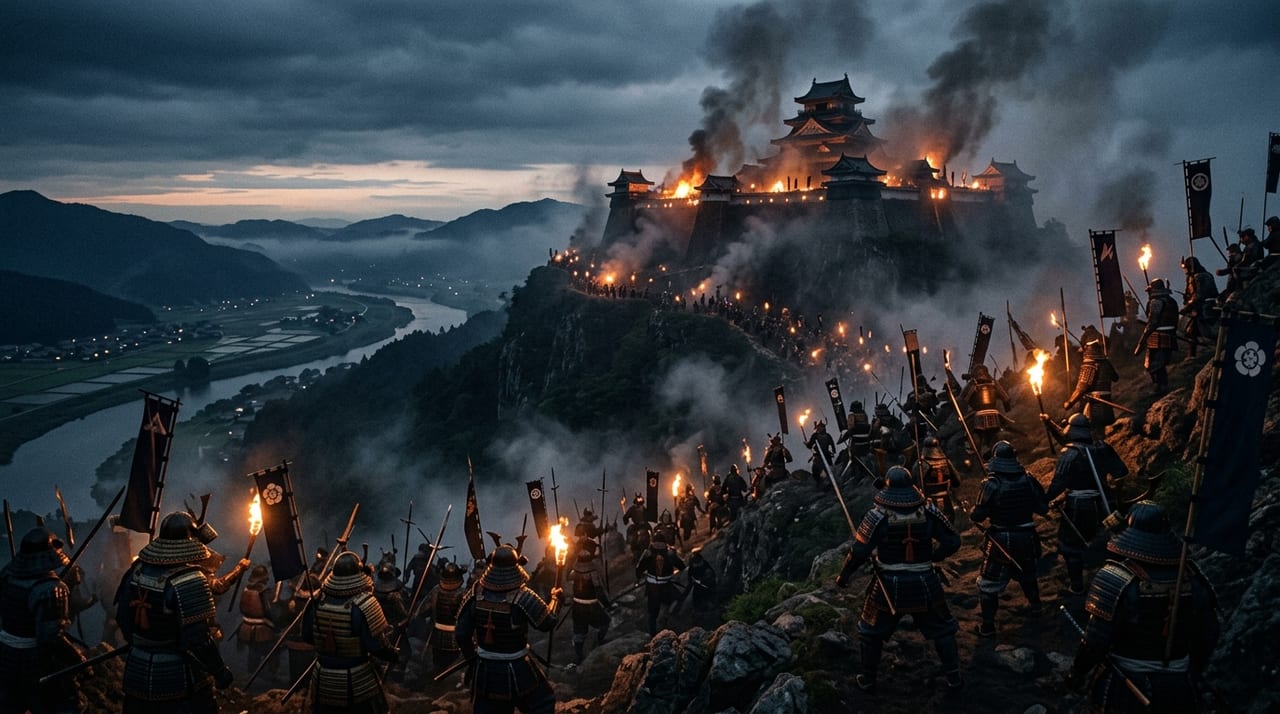
In the 2nd month of Tenbun 17 (1548), the Takeda army advanced to Uedahara in Chiisagata District, Shinano. Shingen's aim was to secure a route for attacking Katsurao Castle, Yoshikiyo's stronghold.
Sources on the details of the battle are scarce, and several accounts coexist. According to the Edo-period war chronicle Kōyō Gunkan and other sources, the vanguard under Itagaki Nobukata defeated the Murakami forces and charged deep into the enemy lines. However, while they paused to conduct the inspection of severed heads (kubi-jikken) in front of the enemy, they were caught off guard and counterattacked. The collapse of the Itagaki forces is said to have led to the rout of the entire Takeda army.
What can be stated with certainty is that the Takeda army suffered a major defeat in this battle, losing senior retainers. Some view it as a draw, since the Murakami side also took losses, but for Harunobu it was the first defeat since he had inherited the family headship.
Among the losses Takeda Shingen suffered at the Battle of Uedahara, the most serious was the loss of personnel.
Itagaki Nobukata: a veteran commander who had served the Takeda house since the time of Shingen's father, Nobutora, and a senior retainer who sustained Shingen's invasion of Shinano. He is said to have played an important role even in Shingen's expulsion of his father, and he was an indispensable figure as the Takeda house's counselor.
Amari Torayasu: likewise a veteran senior retainer of the Takeda house. Counted among the 'Twenty-Four Generals of Takeda' as one of the elite, he supported Shingen's pacification of Shinano.
The fact that these two men died in the same battle was a strategic blow to the Takeda army.
An even more striking fact follows. Takeda Shingen himself was wounded in two places.
It is not unheard of for a Sengoku daimyo to be wounded in battle, but the fact that a strategist of Shingen's caliber was injured on the field shows how sudden and chaotic this battle was. Shingen was usually a commander in the gunbaisha (tactician-commander) mold, who grasped the course of battle from the position from which he directed his forces. That he was wounded suggests that the situation unexpectedly collapsed close to his headquarters.
This wound was handed down to later generations as an anecdote offering a glimpse of Shingen's human side. Shingen, who had shown his martial power to the realm under the 'Fūrinkazan' banner, was on this day nothing more than a wounded commander.
How Murakami Yoshikiyo managed to defeat the Takeda army, which was considered superior in numbers, is a question that offers important insight into Sengoku battle tactics.
The tactic Yoshikiyo is said to have used was attacks that made full use of mobility, moving freely in all directions. Familiar with the mountainous terrain of northern Shinano, Yoshikiyo's army is presumed to have attacked at places and times where the Takeda's heavy cavalry, deployed on the plains, could not bring its full force to bear. A psychological surprise, a sudden assault before the enemy could organize its formation, may also have temporarily nullified the Takeda army's organizational strength.
Yoshikiyo's victory is a typical example of the 'formula by which the weak defeat the strong in the Sengoku period.' It is considered that he fought by making the fullest use of the advantages of terrain, psychological warfare, and timing.
After the defeat at Uedahara, Takeda Shingen immediately turned to counterattack. In the 7th month of that same year, at the Battle of Shiojiri Pass, he defeated the forces of Ogasawara Nagatoki, shugo (military governor) of Shinano, who had invaded Suwa. It was a battle that showed Shingen's determination to recover lost ground strategically.
However, his feud with Murakami Yoshikiyo continued further. In the attack on Toishi Castle in Tenbun 19 (1550), the Takeda army was again defeated by Yoshikiyo's forces. This defeat, known as the Toishi Rout (Toishi-kuzure), was the second major defeat following Uedahara and proved how difficult Shingen's path to conquering Shinano was.
Murakami Yoshikiyo was the greatest trial of Takeda Shingen's career. Yoshikiyo ultimately fled into exile, seeking refuge with Uesugi Kenshin in Echigo (1553), and Shingen succeeded in subduing most of northern Shinano. But that path had been traveled only after two humiliating defeats, at Uedahara and in the Toishi Rout.
Regarding the swords used by Takeda Shingen, several blades that have survived are transmitted as having been 'used by Takeda Shingen,' as swords connected with the Takeda clan of Kai Province.