New Arrivals — Browse our catalog for the latest authentic Japanese sword arrivals. Browse →
19th day of the 3rd month, Tenbun 17 (1548)
Azukizaka, Nukata District, Mikawa Province (present-day area around Hane-chō and Miai-chō, Okazaki City, Aichi Prefecture)
Forces
Imagawa–Matsudaira allied army
Oda army
About 16 min read
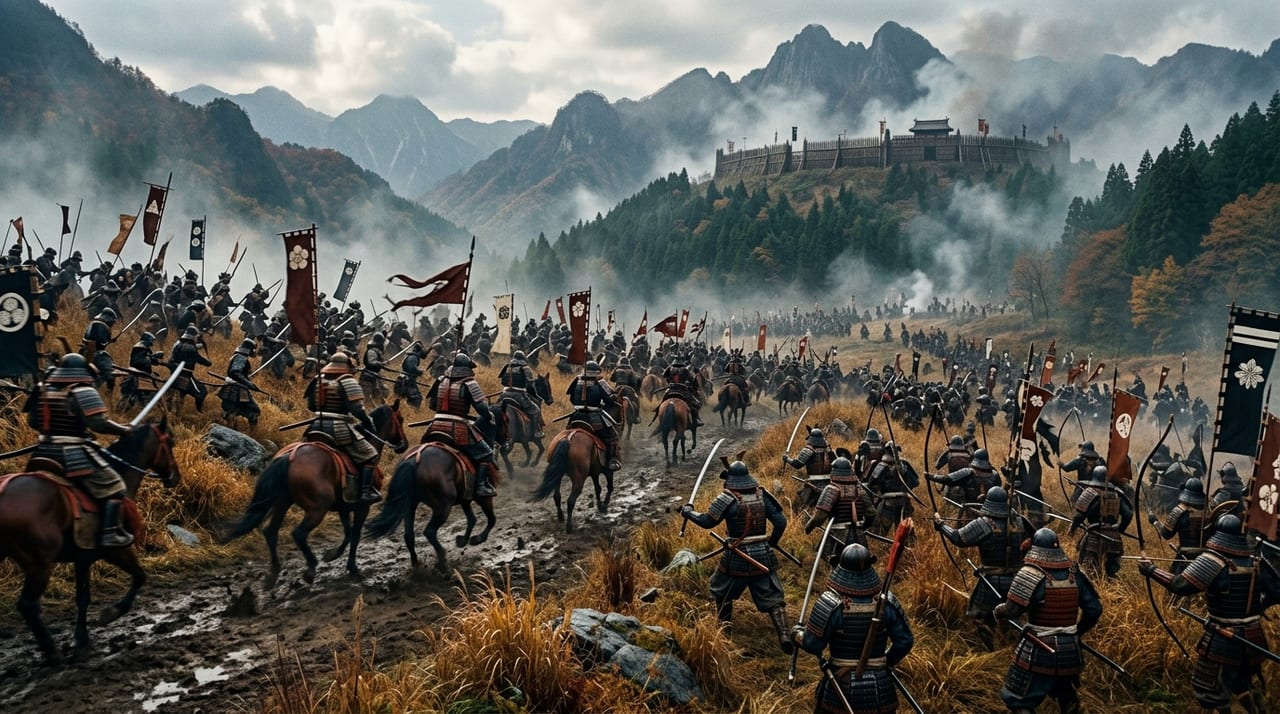
The Battle of Azukizaka (Azukizaka no Tatakai) was fought on the 19th day of the 3rd month of Tenbun 17 (1548) at Azukizaka in Nukata District, Mikawa Province (present-day area around Hane-chō and Miai-chō, Okazaki City, Aichi Prefecture). In this engagement, the forces of Oda Nobuhide of Owari and Imagawa Yoshimoto, who aimed to become lord of Suruga, Tōtōmi, and Mikawa, clashed. It is also recorded that the two sides fought in the same area in Tenbun 11 (1542). Because the historical sources transmit two “Battles of Azukizaka,” the 1548 battle is also called the “Second Battle of Azukizaka.”
Matsudaira Hirotada, lord of Okazaki Castle in Mikawa Province, was under pressure from the advance of Oda Nobuhide of neighboring Owari, and was in a position of seeking aid from Imagawa Yoshimoto of Suruga. His father, Matsudaira Kiyoyasu, had expanded his power until he occupied Okazaki Castle in Taiei 4 (1524) and gained control of nearly all of eastern and western Mikawa. However, in Tenbun 4 (1535), while marching to Moriyama in Owari to attack Oda Nobuhide, he was assassinated by his own retainers in what is known as the Moriyama Kuzure, and the power of the Matsudaira clan declined rapidly. Hirotada, who succeeded him, strengthened his subordination to the Imagawa on an unstable political base. In Tenbun 16 (1547), while Takechiyo (later Tokugawa Ieyasu), his eldest son, was being sent as a hostage to the Imagawa, an incident occurred in which Toda Yasumitsu, who was responsible for the escort, betrayed them, and Takechiyo was seized by the Oda side (abduction during the transport of a hostage to the Imagawa).
Under these circumstances, Oda Nobuhide sought to expand his power into Mikawa and planned to capture Okazaki Castle. Imagawa Yoshimoto, aiming to relieve the Matsudaira and to establish his possession of Mikawa, dispatched a large army to the region with the strategist Taigen Sessai as commander.
Fighting at this location is also recorded as having taken place in Tenbun 11 (1542), six years before 1548. At that time, Matsudaira Kiyoyasu, then head of the Matsudaira clan, had died in the Moriyama Kuzure in Tenbun 4 (1535), and since then the power of the Matsudaira had declined rapidly. Oda Nobuhide took advantage of this vacuum to advance into western Mikawa. In response, Imagawa Yoshimoto, who supported the Matsudaira, dispatched a large army to drive the Oda forces out of western Mikawa. In the 8th month of Tenbun 11 (1542), the two sides clashed at Azukizaka, southeast of Okazaki Castle. In this first battle, seven warriors who fought on the Oda side, namely Oda Nobumitsu, Oda Nobufusa, Okada Shigeyoshi, Sassa Masatsugu, Sassa Magosuke, Nakano Kazuyasu, and Shimokata Sadakiyo, fought bravely, and they were later praised as the Seven Spears of Azukizaka. It is said that the Oda side won, owing to the recognition of these feats of valor. Some scholarly observations hold that the Imagawa advance into eastern Mikawa actually took place from Tenbun 12 (1543) onward, and there are also views that question the historicity of the first battle. In any case, the battle of Tenbun 17 is positioned as a rematch in which the Imagawa side challenged the Oda six years later to avenge the earlier defeat.
In the 3rd month of Tenbun 17 (1548), Oda Nobuhide, with his eldest illegitimate son, Oda Nobuhiro, as vanguard, led more than 4,000 troops from his home territory of Owari, passed through Anjō Castle, crossed the Yahagi River, and encamped at Kamiwada. In response, Imagawa Yoshimoto mobilized about 10,000 troops, dispatching them with Taigen Sessai as commander-in-chief and Asahina Yasuyoshi as deputy commander.
On the 19th day of the same month, the Imagawa vanguard made contact with the Oda vanguard under Nobuhiro at Azukizaka, and battle was joined. The Imagawa forces had deployed near the summit of the slope and held the advantage of terrain. They broke the Oda vanguard by attacking downhill from above (gyakuotoshi). Nobuhiro's force retreated to the vicinity of Nusumigi, where Nobuhide's main body was, and joined it. Regaining momentum, it broke the Matsudaira contingent. However, an Imagawa unit that had been lying in ambush struck the main Oda army in the flank, and the Oda forces collapsed completely and fled across the Yahagi River toward Anjō Castle. In this battle, Okabe Motonobu (also known as Naganori) of the Imagawa side fought valiantly and contributed to the Imagawa victory. Motonobu later earned lasting renown in the Battle of Okehazama in Eiroku 3 (1560), when he held Narumi Castle, the front-line castle. Even after Yoshimoto was killed, he agreed to surrender the castle in exchange for the return of his lord's head.
The battle ended in an overwhelming victory for the Imagawa side. The strategy of Taigen Sessai—a flanking attack using ambushing troops and a formation that made use of the terrain—was the decisive factor in defeating the Oda forces, and it definitively established Sessai's military reliability within the Imagawa.
After the battle, the Imagawa greatly expanded their influence in Mikawa and established a sphere of control spanning Suruga, Tōtōmi, and Mikawa. Matsudaira Hirotada's subordination to the Imagawa grew even stronger, and Takechiyo (later Tokugawa Ieyasu) ultimately spent a long period in Sunpu as a hostage of the Imagawa. It is also said that this period as a hostage under the Imagawa cultivated Ieyasu's later perseverance and diplomatic sense.
The incident of Toda Yasumitsu's betrayal, which resulted in Takechiyo being handed over to the Oda side, took place the previous year, but its aftermath was settled in Tenbun 18 (1549), the year after the Battle of Azukizaka. In the 3rd month of that year, Hirotada died (some accounts say of illness, others say he was murdered by his retainers), and Imagawa Yoshimoto immediately took over Okazaki Castle. In the 11th month of the same year, the Imagawa captured Anjō Castle, the Oda base, and took Oda Nobuhiro, the illegitimate son of Nobuhide who had led the Oda vanguard at Azukizaka, as a prisoner. The Imagawa side then arranged a hostage exchange of Nobuhiro for Takechiyo, and Takechiyo was finally handed over to the Imagawa household. Nobuhiro, who had been routed at Azukizaka, thus became a party to the hostage exchange the following year, and was drawn into the resolution of the struggle over Mikawa.
The Battle of Azukizaka is a microcosm of the Sengoku-period turmoil in Mikawa and Owari, the home region of Tokugawa Ieyasu in later years. It is cited in Sengoku history as one example of the battlefield use of tachi and uchigatana by the local warrior bands of the time. The Imagawa's establishment of supremacy in Mikawa was an important phase of the power struggle over Mikawa, which continued to the Battle of Okehazama in Eiroku 3 (1560), when the Matsudaira clan, having regained independence as lords of Okazaki Castle, broke away from the Imagawa.
Taigen Sessai himself is also noted as a rare figure, being a Rinzai Zen monk who oversaw the military affairs and diplomacy of the Imagawa house. Yoshimoto was placed in a Buddhist temple in childhood and trained in Kyoto together with Sessai, whose monastic name at the time was Kyūei Shōgiku. When Imagawa Ujiteru and Hikogorō died in quick succession in Tenbun 5 (1536), a succession dispute known as the Hanakura Rebellion arose. On Sessai's advice, Yoshimoto's faction attacked Hanakura Castle, where his elder half-brother Genkō Etan was holed up, and drove Etan to suicide, thereby realizing Yoshimoto's succession after he returned to lay life. For this achievement, Yoshimoto came to place deep trust in Sessai as his highest adviser in politics and military affairs. In Tenbun 23 (1554), Sessai also worked to conclude the Kō-Sō-Sun Tripartite Alliance with Takeda Harunobu (Shingen) and Hōjō Ujiyasu. This removed worries at the Imagawa's back and enabled the concentration of forces to the west, in the Mikawa and Owari region. The victory at Azukizaka is positioned as one of the turning points in the process by which Imagawa Yoshimoto built the power that led to his being called “the finest archer of the Kaidō,” and as one of the occasions on which Sessai's military talent was strongly impressed upon Mikawa and beyond.
The Azukizaka old battlefield is identified as lying around present-day Hane-chō and Miai-chō, Okazaki City, Aichi Prefecture, and monuments and historical site guides recounting the battle have been installed in the vicinity. The place name “Azukizaka” remains today and serves as a valuable site of memory that conveys the struggles over Mikawa in the Sengoku period. Said to have been fought twice on the same slope, this old battlefield is noted by both local historians and Tokugawa Ieyasu researchers as a historic site that conveys the tension of the early Sengoku period, when the Oda and Imagawa clashed at a strategic point on the Owari–Mikawa border.