New Arrivals — Browse our catalog for the latest authentic Japanese sword arrivals. Browse →
Tenbun 18 (1549)
Settsu, Kawachi, and Yamashiro provinces (present-day Osaka and Kyoto prefectures)
Forces
Miyoshi Side
Hosokawa Harumoto's side
About 11 min read
Miyoshi Nagayoshi (1522–1564) was born as the eldest son of Miyoshi Motonaga, a kokujin daimyō of Awa Province (present-day Tokushima Prefecture). His father Motonaga was a Sengoku warrior who had distinguished himself in the overthrow of Hosokawa Takakuni, but in Kyōroku 5 (1532) he was destroyed by an Ikkō-ikki uprising that rose up through the schemes of Hosokawa Harumoto and others. Nagayoshi lost his father at only 10 years of age and was placed under the patronage of Hosokawa Harumoto.
However, Nagayoshi steadily built up his strength amid adversity. Rallying his father's former retainers and restoring the power of the Miyoshi clan, he sought to advance into the Kinai on the basis of Awa, Sanuki, and Awaji. His military talent stood out from an early stage, and by around the time he reached the age of 30, he had come to be deeply involved in Kinai politics as the most powerful retainer of Hosokawa Harumoto.
Nagayoshi's character cannot be confined to the simple frame of a warrior. He was a multifaceted cultural figure who excelled in waka and renga. The breadth of his learning attracted cultural figures, court nobles, and monks of the Kinai even after he became tenkabito (ruler of the realm), and it also helped him build his political foundation.
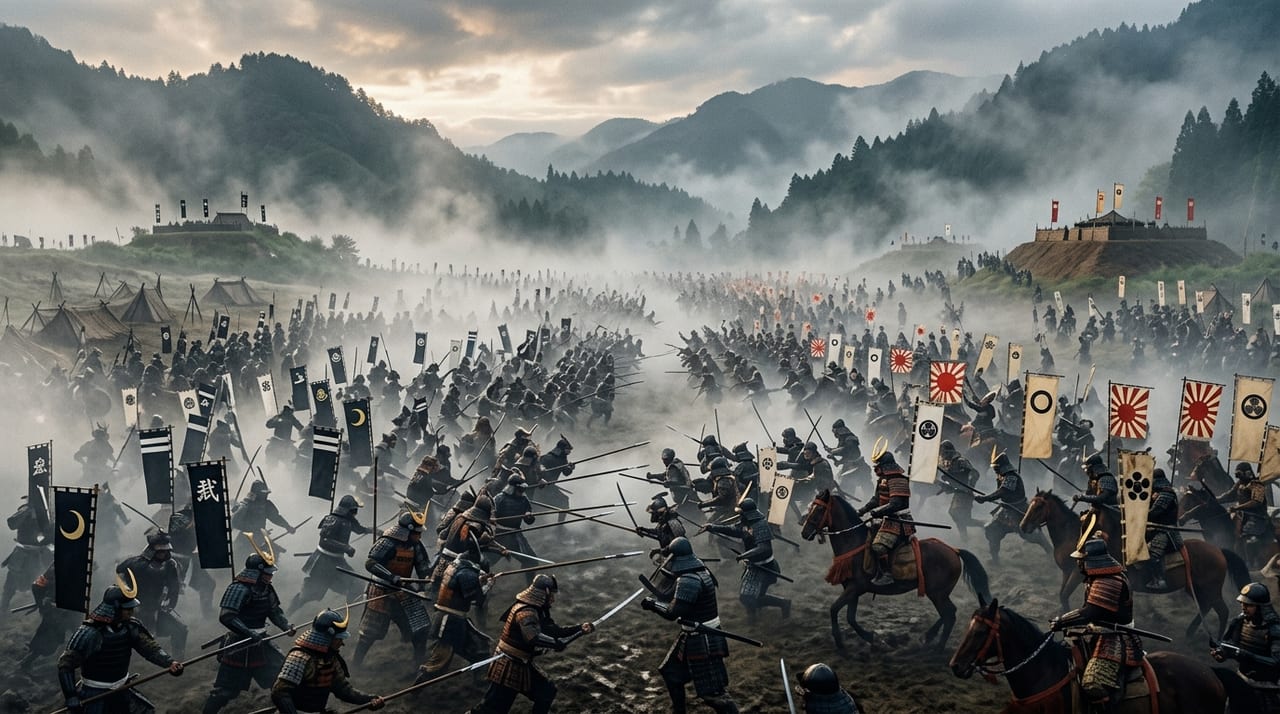
On the 24th day of the 6th month of Tenbun 18 (1549), Miyoshi Nagayoshi fought a decisive battle at Eguchi (in the vicinity of present-day Higashiyodogawa Ward, Osaka City) against the combined forces of his former lord Hosokawa Harumoto and Harumoto's ally Miyoshi Masanaga (Nagayoshi's sworn enemy). In this battle, known as the "Battle of Eguchi," Nagayoshi deployed skillful tactics to win a crushing victory. Miyoshi Masanaga was slain, and Hosokawa Harumoto fled in defeat.
This victory gave Nagayoshi control of real power in the Kinai. The Ashikaga shogun (Yoshiteru) also temporarily fled Kyoto, and Nagayoshi's power came to surpass the office of kanrei of the Muromachi shogunate. It was an event about 20 years before Oda Nobunaga raised the banner of tenka fubu.
The concept of the "tenkabito" is generally held to begin with Oda Nobunaga, but in recent research Miyoshi Nagayoshi has been reassessed as its forerunner. Nagayoshi did not merely dominate the Kinai through military power; he realized governance across the fields of politics, economy, and culture.
Political aspect: He temporarily expelled the shogun Yoshiteru, and later reconciled with him and reduced him to a puppet, adopting a method of seizing real power while hollowing out the authority of the shogunate. This style of governance later became the prototype for the method by which Nobunaga dealt with the shogun Ashikaga Yoshiaki.
Economic aspect: He turned his attention to the economic power of Sakai (present-day Sakai City), located on the border between Settsu and Izumi, and used the wealth from its trade to procure military funds and military supplies.
Cultural aspect: Nagayoshi was also a cultural figure who was deeply versed in waka and renga. While using Akutagawayama Castle (present-day Takatsuki City) and Iimoriyama Castle as his bases, he actively pursued exchanges with the cultural figures, court nobles, and monks of Kyoto, and he himself composed excellent waka. His existence as a cultural patron contributed greatly to the revival of Kinai culture, which had been devastated since the Ōnin War.
The era of Miyoshi Nagayoshi also marks an important turning point in the culture of Japanese swords. As warfare that had continued since the Ōnin War (1467–1477) persisted, demand for swords grew explosively, and sword-smith groups in various regions carried on active production.
The Kinai that Nagayoshi ruled, especially Yamato (present-day Nara Prefecture) and Yamashiro (present-day southern Kyoto Prefecture), had been a region that produced outstanding sword smiths since ancient times. The tradition of the Five Yamato Schools (Senjuin, Tegai, Shikkake, Taima, Hōshō) was passed down throughout the medieval period, and even in Nagayoshi's era, the sword smiths of Yamato continued their activities.
Although Nagayoshi wielded great power as tenkabito, in his later years he suffered from the successive deaths of his close kin. In Eiroku 4 (1561), his younger brother Sogō Kazumasa died suddenly, and in Eiroku 5 (1562), another younger brother, Miyoshi Jikkyū (Yoshikata), was killed in action at the Battle of Kumeda. Then in Eiroku 6 (1563), his eldest son, Yoshioki, died young at the age of 22 (there is a theory that he was poisoned). The spiritual blow that these deaths dealt to Nagayoshi was immense. In the 5th month of Eiroku 7 (1564), he summoned his younger brother Ataka Fuyuyasu to his residence, Iimoriyama Castle, and had him put to death. Then, in Eiroku 7 (1564), he died at the young age of 43.
After Nagayoshi's death, the Miyoshi regime rapidly collapsed. His successor Miyoshi Yoshitsugu was supported as guardian by Matsunaga Hisahide and the Miyoshi Triumvirate (Miyoshi Sanninshū), but in Eiroku 8 (1565) the Eiroku Incident occurred, in which the shogun Yoshiteru was killed, and the Miyoshi house fell into a state of internal strife. Then Nobunaga entered Kyoto in Eiroku 11 (1568), and the era of a new tenkabito began.
For a long time, Miyoshi Nagayoshi was underestimated in Japanese history as an "intermediate figure." However, research since the late 20th century has revealed that he was a Sengoku hegemon who possessed his own governing philosophy and cultural policies.
In recent years, commemorative activities honoring Miyoshi Nagayoshi have become active in the region centered on Osaka and Hyōgo. Excavation research at the ruins of Kawachi Iimoriyama Castle has advanced, and it is becoming clear how advanced the construction techniques of Nagayoshi's residence were. The era of Nagayoshi, which had fallen away from the center of the historical stage, is now about to receive renewed illumination.