New Arrivals — Browse our catalog for the latest authentic Japanese sword arrivals. Browse →
From the 9th day of the 9th month through the 1st day of the 10th month of Tenbun 19 (1550)
Toishi Castle, Chiisagata District, Shinano Province (present-day Ueda City, Nagano Prefecture)
Forces
Takeda forces
Murakami forces
About 10 min read
Takeda Harunobu (later Shingen), the Sengoku daimyo of Kai Province, steadily pressed his invasion of Shinano Province throughout the Tenbun era. In 1548 (Tenbun 17), Harunobu clashed with Murakami Yoshikiyo, the dominant power of northern Shinano, at Uedahara, suffering a severe defeat that cost him senior retainers Itagaki Nobukata and Amari Torayasu. Later that year, Harunobu avenged himself by defeating Ogasawara Nagatoki at the Battle of Shiojiritōge, but his loss to Murakami Yoshikiyo is said to have remained a deep humiliation.
In the 7th month of 1550 (Tenbun 19), after further defeating Ogasawara Nagatoki and advancing his hold on central Shinano, Harunobu turned to undermining Murakami Yoshikiyo's power in northern Shinano by moving against Toishi Castle (also written Togoishi), an important forward stronghold of Yoshikiyo's, in present-day Ueda City, Nagano Prefecture. Toishi Castle guarded the approach to Yoshikiyo's home base of Kazurao Castle, and capturing it would let Harunobu both avenge Uedahara and secure decisive control over northern Shinano.
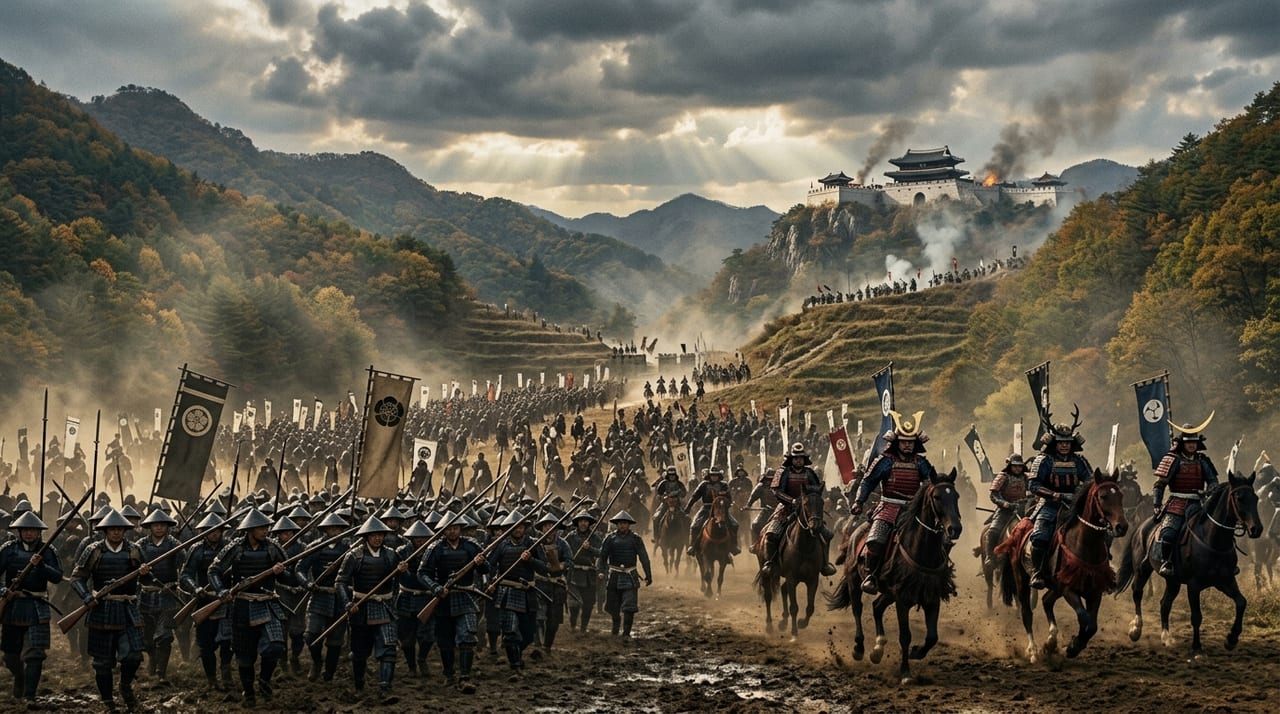
Toishi Castle stood on terrain as forbidding as its name — "grindstone" — suggested, flanked on the east and west by sheer cliffs, with the only approach possible from a single direction to the southwest. Though its garrison numbered only about 500, this natural fortress had a reputation for being difficult to take. On the 9th day of the 9th month of Tenbun 19, Harunobu's Takeda force of roughly 7,000, spearheaded by the senior retainer Yokota Takamatsu, launched an all-out assault on the castle.
Relying on their overwhelming numerical advantage, the Takeda forces pressed the siege, but the castle's defenses held firm and the assault dragged on without success. As the siege lengthened, Murakami Yoshikiyo marched from his home base at Kazurao Castle with a relief force of roughly 2,000 men, threatening to catch the Takeda army in a pincer. At the end of the 9th month, the Takeda finally abandoned the assault and decided to withdraw.
It was this retreat that proved the true catastrophe for the Takeda. The castle garrison and Yoshikiyo's relief force joined forces to launch a relentless pursuit of the withdrawing Takeda army, and on the 1st day of the 10th month, the disorganized Takeda troops were scattered and cut down at multiple points, suffering enormous losses. Yokota Takamatsu, who had led the vanguard, was among the many officers and men killed in this retreat, and the Takeda army as a whole suffered roughly 1,000 casualties — an extraordinary toll for the period. This chain of defeats has been remembered ever since as the "Toishi Debacle," and is widely regarded as the worst defeat of Takeda Shingen's entire career, despite the many battles he fought.
Even after the debacle, Murakami Yoshikiyo continued to hold Toishi Castle, but the Takeda side turned to means other than direct assault. Sanada Yukitaka (also known as Yukitsuna), who served the Takeda as one of their Shinano vanguard lords, was originally a local lord based in Sanada, within the same Chiisagata district, and possessed deep knowledge of the region's networks and circumstances. Rather than relying on force, Yukitaka worked through stratagem within the castle to bring it over to the Takeda side, and on the 26th day of the 5th month of 1551 (Tenbun 20), Toishi Castle finally fell into Takeda hands without a single battle being fought.
That a castle which had inflicted a crushing defeat on a direct assault could be brought over bloodlessly through stratagem in less than a year became a celebrated episode symbolizing Sanada Yukitaka's cunning, and marked a turning point that helped establish the Sanada clan's standing within the Takeda house.
The loss of Toishi Castle meant Murakami Yoshikiyo had lost a crucial forward defense guarding his home base at Kazurao Castle, forcing his defensive line to retreat significantly thereafter. Unable to withstand continued Takeda pressure, Yoshikiyo finally abandoned Kazurao Castle in the 4th month of 1553 (Tenbun 22) and fled to Echigo Province to seek the protection of Nagao Kagetora (later Uesugi Kenshin). Kagetora's subsequent decision to campaign in Shinano in response to Yoshikiyo's flight became the direct trigger for the Battles of Kawanakajima, which would be fought intermittently over the following decade and more.
The Toishi Debacle has often been cited in later military studies and castle research as a case demonstrating how a small garrison holding formidable terrain could repel a besieging force many times its size. At the same time, the battle stands as a striking contrast illustrating both the limits of direct frontal assault and the Sengoku-period tactical philosophy of taking castles through stratagem and intrigue rather than force. Shingen himself is said to have drawn a lasting lesson from this defeat, favoring flexible strategies blending stratagem and diplomacy with military force in his subsequent campaigns to subdue Shinano, rather than relying solely on direct assault.
Today, the ruins of Toishi Castle are preserved as a historic site in Ueda City, Nagano Prefecture, commanding a sweeping view over the Ueda Basin. The steep terrain still conveys a vivid sense of the fortress it once was, and the site continues to draw history enthusiasts as the stage of the worst defeat Takeda Shingen ever suffered.
Takeda Shingen
Takeda commander who led the assault on Toishi Castle and suffered the worst defeat of his career
Murakami Yoshikiyo
The northern Shinano lord who held Toishi Castle and repelled the Takeda assault
Sanada Yukitaka
Head of the Sanada clan who took Toishi Castle without battle through stratagem the following year