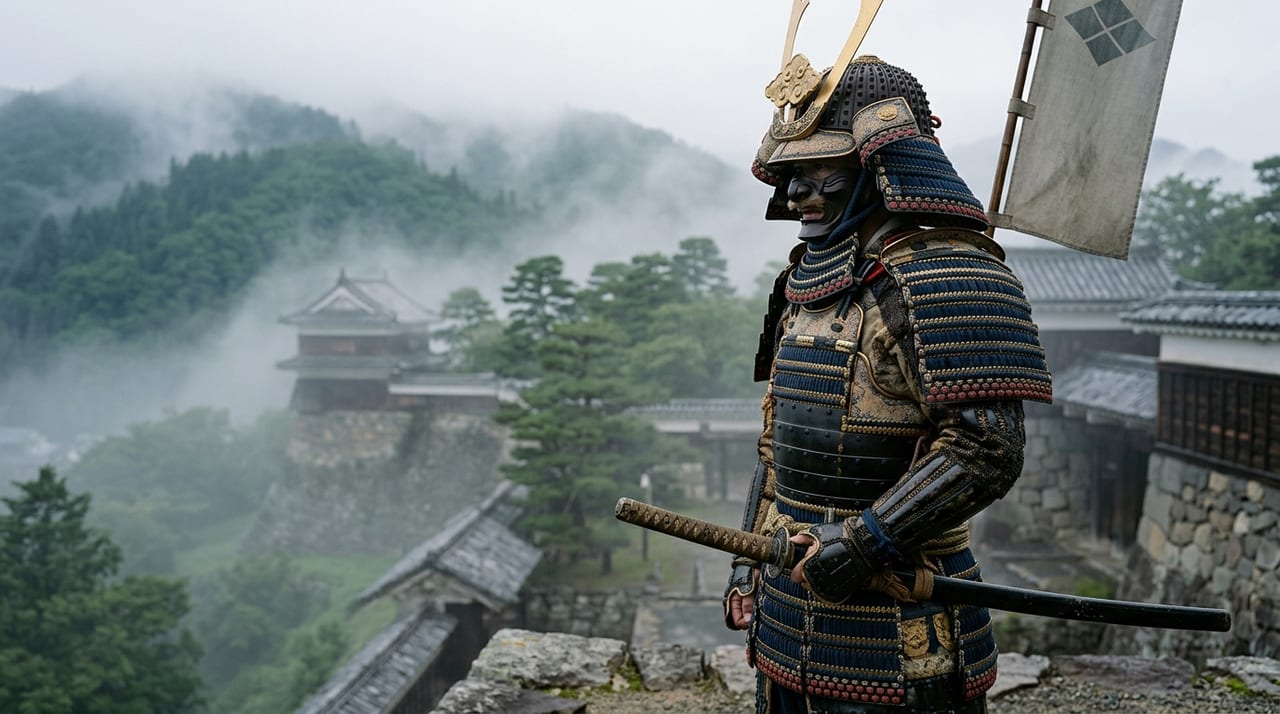
 * Image is for illustrative purposes only.
Imagawa Yoshimoto
今川義元
The Cultured Lord of Suruga
Description
Overlord of Tōkai
Born in Eishō 16 (1519) in Suruga Province (present-day Shizuoka Prefecture), Imagawa Yoshimoto was one of the foremost daimyō of the Sengoku period, praised as 'Kaidō-ichi no yumitori' (the finest bowman of the Tōkaidō). The Imagawa family was a prestigious house ranking just below the Ashikaga shogunal family. Yoshimoto trained as a Zen monk in Kyoto before becoming head of the Imagawa house. As a result, he deeply absorbed the court culture of Kyoto and built a flourishing cultural sphere in Suruga. Under his rule, his domain grew into a formidable power controlling three provinces: Suruga, Tōtōmi, and Mikawa.
Cultural Salon of Suruga
Suruga Province, under Yoshimoto's rule, was one of the centers of regional culture of its time. Yoshimoto promoted renga, waka, calligraphy, and courtly etiquette, and compiled the Imagawa Kana Mokuroku (Imagawa house laws) to establish order in governing his domain. Shinchō Kōki records that as he approached Okehazama, Yoshimoto wore the Matsukura-gō tachi, a heirloom of the Imagawa house, and the Ō-Samonji wakizashi. Yoshimoto's image, riding in a palanquin in court-style dress with ohaguro (blackened teeth) and shaved eyebrows as he went to the battlefield, was in later times sometimes caricatured as a 'warlord with court pretensions' (kuge-kabure no bushō). In reality, however, Yoshimoto had not lacked martial skill.
Deep Connoisseurship of Swords
The most famous of the swords Yoshimoto owned is the Sōza Samonji (Yoshimoto Samonji). This tachi, made by a Samonji smith of Chikuzen Province, is said to have been presented to Imagawa Yoshimoto by Takeda Nobutora, shugo of Kai, or to have passed to Yoshimoto from Miyoshi Masanaga via Takeda Nobutora. Yoshimoto is said to have treasured the sword as a favorite blade. When Yoshimoto was killed in the battle of Okehazama, the sword passed as a spoil of war into the hands of Oda Nobunaga. It was later handed down to Toyotomi Hideyoshi and Tokugawa Ieyasu, becoming a rare famous blade held by three holders of the realm.
The Tragedy of Okehazama
In the fifth month of Eiroku 3 (1560), Yoshimoto led a great army said to number 25,000 or even 40,000 into Owari Province. However, at Okehazama in Owari Province (present-day Aichi Prefecture), he was struck by a surprise attack from barely two thousand-odd troops led by Oda Nobunaga. Amid heavy rain and confusion, Yoshimoto's main camp was quickly overrun. Although Yoshimoto wounded Hattori Kazutada, he was beheaded by Mōri Shinsuke. He died at the age of forty-two. Yoshimoto's end, after being praised as 'Kaidō-ichi no yumitori', was handed down to later generations as a symbol of the merciless reversal of fortune of the Sengoku period.
Reassessment as a Military Leader
Recent research has substantially revised the image of Yoshimoto as a 'warlord with court pretensions'. Yoshimoto was a capable commander who faithfully inherited the military strength built by his father, Ujichika, and by generations of the Imagawa house. His defeat and death at Okehazama resulted from exceptional circumstances, a surprise attack and bad weather, and does not negate his military ability. Having combined the pen and the sword at a high level, and held refined culture and formidable military power at once, Yoshimoto is being reassessed as one of the ideal forms of the Sengoku daimyō.
Notable Swords
- Sōza Samonji (Yoshimoto Samonji) (a masterpiece tachi of the Chikuzen Samonji school. Seized by Nobunaga at Okehazama, later passed to Hideyoshi and Ieyasu, a sword of three holders of the realm. Yoshimoto's favorite blade)
- the Matsukura-gō tachi (a 2 shaku 8 sun tachi, a heirloom of the Imagawa house, which Shinchō Kōki records Yoshimoto wore at Okehazama)