New Arrivals — Browse our catalog for the latest authentic Japanese sword arrivals. Browse →
Imagawa Ujiteru and Hikogorō died suddenly on the 17th day of the 3rd month of Tenbun 5 (April 7, 1536); the conflict ended with Etan's suicide on the 10th day of the 6th month (June 28, 1536)
Suruga Province — Hanakura Castle, Yui Castle, and Katanoue Castle (in and around present-day Fujieda, Shizuoka Prefecture), and Sunpu
Forces
The faction backing Senkaku Shōhō (Imagawa Yoshimoto)
The faction backing Genkō Etan
About 12 min read
On the 17th day of the 3rd month of Tenbun 5 (April 7, 1536), Imagawa Ujiteru, head of the Imagawa clan and shugo daimyō of Suruga Province, and his younger brother Hikogorō, who was regarded as his successor, both died suddenly on the same day. No source records the direct cause of death with certainty, but records such as the Katsuyama-ki, which describe an epidemic in Kai Province at the time, have led to the widely held view that both men contracted disease while traveling together on a visit to Hōjō Ujitsuna. Theories of assassination are sometimes raised, but the unprecedented loss of both a head of the clan and his designated heir on the same day is today generally understood as a natural consequence of the two having traveled and acted together.
The deaths of Ujiteru and Hikogorō left the Imagawa clan without a clear successor. Among the sons born to concubines of the previous head, Imagawa Ujichika, the question of who would become the next head of the clan soon split the clan's retainers into two rival camps.
When Imagawa Ujichika died in the 6th month of Daiei 6 (1526), his son and successor Ujiteru was only fourteen years old. For this reason, Ujichika's principal wife, Lady Jukei, issued official documents under her own seal reading "Ki" and effectively managed the affairs of state for the Imagawa clan for roughly two years, until Ujiteru turned sixteen. Of the twenty-five surviving documents known to have been issued by Lady Jukei, thirteen date from Ujiteru's reign, testifying to the extent of her political influence within the clan. She is likewise believed to have played a significant part in the succession crisis that followed the sudden deaths of Ujiteru and Hikogorō.
The two candidates for headship were Senkaku Shōhō (the future Imagawa Yoshimoto), Ujichika's fifth son who had entered the temple of Zentoku-ji in Suruga, and Genkō Etan, another son by a concubine who had entered Henjōkō-ji in Hanakura. Even during Ujichika's lifetime, Shōhō had reportedly held a higher position in the line of succession than Etan, and on this basis Lady Jukei, Ujichika's principal wife, moved to back Shōhō's candidacy. She was supported by the Rinzai monk Taigen Sessai, who had served as Shōhō's tutor, and by the Imagawa retainer Okabe Chikatsuna, with Hōjō Ujitsuna of Sagami Province also lending his backing.
Opposing them, Etan was championed by the Fukushima family, a collateral branch of the Imagawa related to Etan's mother's family. Led by Fukushima Echizen-no-kami and Fukushima Yashirō, the family brought Etan to Hanakura Castle to make their stand. The Fukushima held a certain degree of influence within the Imagawa clan, and by placing Etan on the succession, they appear to have sought to preserve their own political standing as maternal relatives.
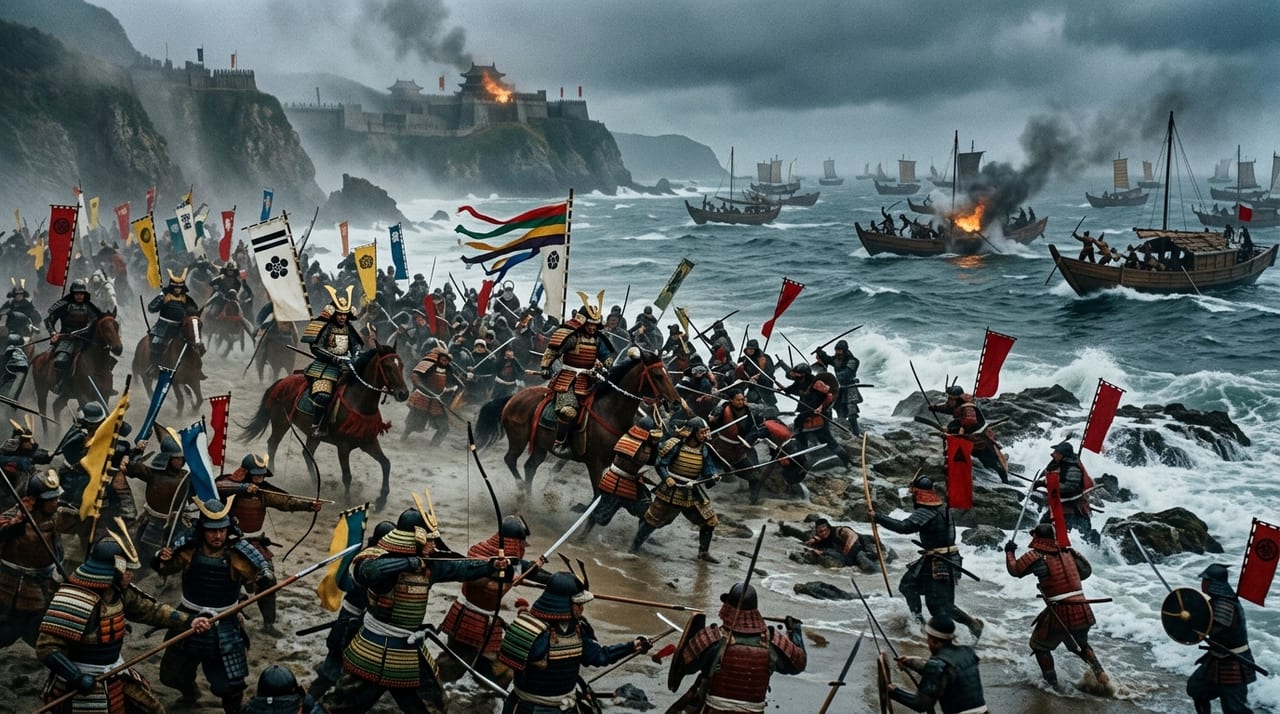
On the 24th day of the 5th month of Tenbun 5 (June 12, 1536), Lady Jukei, seeking to defuse the crisis, attempted to persuade Fukushima Echizen-no-kami, but the effort failed. The following day, the 25th (June 13), the two camps clashed in open battle at Sunpu, and Fukushima Echizen-no-kami withdrew to Kunō Castle. The fighting then spread to Yui Castle, Katanoue Castle, and Hanakura Castle, developing into a wider conflict that engulfed central Suruga Province and the border with Tōtōmi.
Alarmed by the escalating conflict, Lady Jukei requested reinforcements from her ally Hōjō Ujitsuna in Sagami, and a large force was duly dispatched to Suruga in response. These reinforcements gave Shōhō's faction a decisive military advantage and allowed it to press its offensive against Etan's side.
On the 10th day of the 6th month of Tenbun 5 (June 28, 1536), Okabe Chikatsuna, fighting for Shōhō, attacked and took Katanoue Castle, and pressed his advantage with a full assault on Hanakura Castle, the last remaining stronghold of Etan's faction. Hanakura Castle soon fell. Etan fled to Fumon-ji temple in Setoya, Tōtōmi Province (present-day Fujieda, Shizuoka Prefecture), where, cornered and with no further recourse, he took his own life. The principal members of the Fukushima family who had supported him lost nearly all their remaining power in the course of the fighting.
Etan's suicide brought roughly three months of succession conflict to a close. The victorious Shōhō returned to lay life and, on the 5th day of the 8th month of Tenbun 5, formally succeeded to headship of the Imagawa clan under the name Imagawa Yoshimoto. The episode later came to be known as the "Hanakura Disturbance," after the place where the two rival camps had fought.
Lady Jukei's true allegiance in the disturbance remains a matter of scholarly disagreement. While it is widely held that she was the one who returned Yoshimoto to lay life and backed his succession, an alternative theory — drawn from a passage in the contemporaneous record Kōhakusai-ki and from differing interpretations of the true circumstances of Hikogorō's death — holds that Lady Jukei may in fact have sided with Genkō Etan's faction rather than that of her own son Yoshimoto. No definitive conclusion has been reached on this point.
Having secured his position through the Hanakura Disturbance, Yoshimoto relied heavily on Taigen Sessai in governing his domain and worked to build an alliance with the Takeda clan of Kai Province. The historian Marushima Kazuhiro has suggested that this choice of alignment with the Takeda may have been intended as a check against Hōjō Ujitsuna, who had backed Yoshimoto's succession. This overture toward the Takeda, however, contributed to a deterioration in relations with Ujitsuna, becoming one of the underlying causes of the later Katō Ichiran conflict entangling Suruga, Sagami, and Kai.
Having consolidated his authority within the clan through the Hanakura Disturbance, Yoshimoto went on to expand his influence toward Mikawa and Owari, building the peak of Imagawa power that would eventually lead to the Battle of Okehazama. Taigen Sessai, who continued to support Yoshimoto throughout his reign, also proved himself an able diplomat, and is known to have played a deep role in later negotiating the tripartite alliance among the Imagawa, Takeda, and Hōjō clans. Sessai's presence at Shōhō's side during the Hanakura Disturbance thus remained a defining factor shaping the whole of the Imagawa clan's later diplomacy. As the largest internal conflict over succession in the history of the Imagawa clan, the Hanakura Disturbance continues to draw the interest of historians today as a case study in how the sudden death of a daimyō could destabilize a Sengoku-period house, and how the allegiances of regents and maternal relatives could decisively shape the political outcome.