New Arrivals — Browse our catalog for the latest authentic Japanese sword arrivals. Browse →
7th month, Tenbun 5 (1536)
Kyoto, Yamashiro Province (primarily Shimogyō and Kamigyō districts)
Forces
Enryaku-ji / Rokkaku Allied Forces
Hokke Ikki (Nichiren Buddhist Adherents)
About 14 min read
The Tenbun Hokke Disturbance was a religious war in which, in the 7th month of Tenbun 5 (1536), the warrior monks of Enryaku-ji on Mount Hiei, with military support from Rokkaku Sadayori, burned all 21 head temples of the Hokke (Nichiren) sect in Kyoto. The conflict reduced Shimogyō in Kyoto to ashes, to the point that it is said to have exceeded the damage of the Ōnin War (1467–1477), and it drove Nichiren sect adherents out of Kyoto for six years. It was a microcosm of the complex power struggle in Sengoku-period Kyoto, where religion, politics, and armed force intersected, and it holds significant importance as a point of intersection between religious violence and sword culture in Japanese medieval history.
In late Muromachi and Sengoku-period Kyoto, the Hokke (Nichiren) sect spread rapidly among the machishū (townspeople), urban residents centered on merchants and artisans. The sect's practical teachings and communal organizational strength had strong appeal to urban residents seeking stability of life in a turbulent age. At the beginning of the Tenbun era, there were as many as 21 Hokke head temples within Kyoto, and its followers extended across a broad range of people, including court nobles and warriors. This expansion was also linked to an armed organization of believers called the Hokke Ikki. In Tenbun 1 (1532), the Hokke Ikki forces took part in an armed clash with the Ikkō Ikki (armed Jōdo Shinshū followers), the burning of Yamashina Hongan-ji, and emerged victorious, demonstrating their military strength. As an ally of Hosokawa Harumoto, the Hokke Ikki also became involved in politics in the Kinai region, growing into a force with its own political influence in Sengoku-period Kyoto.
In Tenbun 5 (1536), the incident in which Matsumoto Hisayoshi, a Hokke believer, challenged the sermon of Kaōbō, a monk of Enryaku-ji, to a debate and defeated him (the Matsumoto Debate), became the direct trigger of the disturbance. The monks of Enryaku-ji regarded this as an insult to the authority of their sect, and when their appeal to the shogunate also failed, they resolved to annihilate the Hokke followers. Rokkaku Sadayori, shugo (military governor) of Ōmi, initially moved to mediate between the two sides, but mediation failed and he sided with Mount Hiei. In the 7th month of Tenbun 5, Enryaku-ji, centered on its warrior monks, mobilized an estimated 60,000 troops, descended on Kyoto, and burned the 21 head temples of the Hokke sect one after another.
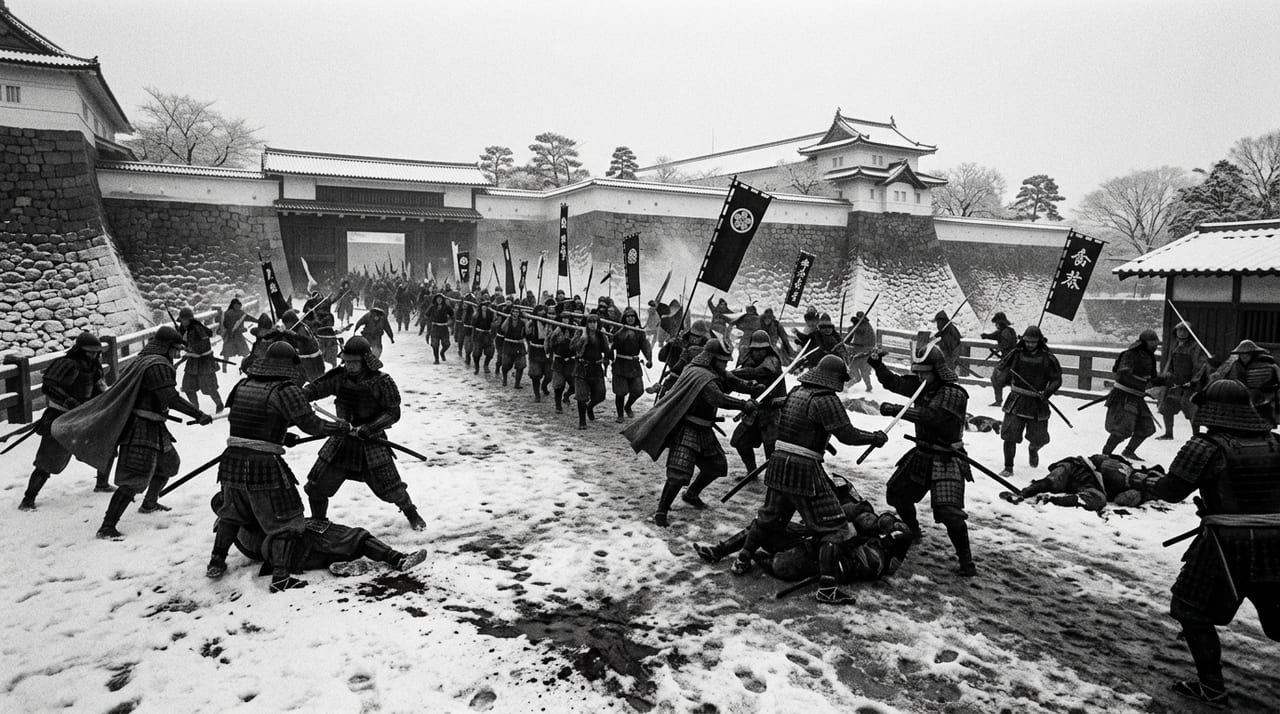
The attacks by the combined forces of Enryaku-ji and the Rokkaku clan were extremely fierce. Hokke head temples and subtemples went up in flames one after another, and even the private residences of believers were burned. The flames engulfed all of Shimogyō and a third of Kamigyō, and the scale of the devastation is recorded by later generations as exceeding the damage of the Ōnin War. Hokke believers attempted to resist in armed form, but were defeated by the organized military strength of the warrior monks and the Rokkaku clan, and fled from Kyoto to Sakai. The swords carried by the warriors and warrior monks who fought in this disturbance were typical equipment of the mid-Sengoku period. Uchigatana were easier to carry than tachi and faster to draw, making them suited to close combat in urban areas.
Rokkaku Sadayori (1495–1552), as head of the Rokkaku clan and shugo of Ōmi, had long been involved in Kinai politics. Sadayori initially attempted to mediate between Enryaku-ji and the Hokke followers, but when this ended without agreement he joined Enryaku-ji's side and led Ōmi troops to attack Kyoto. The Rokkaku forces' support for Mount Hiei clearly demonstrated a political pattern unique to the Sengoku period, in which warlords actively intervened in religious disputes and sought to reorganize religious order through military force. This "religious policy by force" is also an important precedent in the historical context leading to Oda Nobunaga's later burning of Mount Hiei (Genki 2, 1571) and the Ishiyama War (1570–1580).
Hokke believers were expelled from Kyoto, and proselytizing activities in Kyoto were banned for the following six years. In Tenbun 11 (1542), the Hokke sect's return to Kyoto was permitted through the mediation of Rokkaku Sadayori, and its activities in Kyoto gradually resumed. One of the greatest legacies of this disturbance was the reorganization of Kyoto's urban space. The area of Shimogyō that had become burned fields was laid out with a new street pattern in the subsequent reconstruction process, and it is said to have influenced part of the present-day urban area of Kyoto. As an event that vividly brings out three themes (the entanglement of religion and armed force in the Sengoku period, the organized resistance of urban residents, and the control of religious order by daimyō power), the Tenbun Hokke Disturbance occupies a position at the intersection of Japanese medieval history, religious history, and the history of sword culture.
The first half of the 16th century, when the Tenbun Hokke Disturbance occurred, was a period in which the form of Japanese swords decisively shifted from tachi to uchigatana. Whereas the "tachi," which warriors hung from the waist, had been mainstream in the Nanboku-chō and early Muromachi periods, after the Ōnin War (1467–1477) the "uchigatana," worn thrust through the belt, became the main weapon in actual combat during the Sengoku period. Uchigatana were worn thrust through the sash, and their drawing motion was quicker than that of tachi. They could be handled easily by both foot soldiers and mounted warriors, making them suited to the battlefields of the Sengoku period, when group battles increased. Because the fighting of the Tenbun Hokke Disturbance took place in the confined urban space of central Kyoto, the mobility of uchigatana was especially important. The combination of naginata used by the warrior monks of Enryaku-ji and the uchigatana and wakizashi carried by the Rokkaku clan's warriors embodied the standard combat equipment of this era. As an urban religious war fought when uchigatana culture had fully taken root, the Tenbun Hokke Disturbance is a symbolic event in which the functional evolution of Japanese swords and the demands of the age overlapped. Moreover, the fact that the townspeople of Kyoto armed themselves and formed the Hokke Ikki can be read as the historical prehistory of the "civilian armament" problem that the later Toyotomi regime sought to resolve through the Sword Hunt Edict (1588).
Many of the Hokke believers expelled from Kyoto moved to Sakai (present-day Sakai, Ōsaka Prefecture), which contributed greatly to the cultural and economic development of Sakai during the Sengoku period. Sakai was a self-governing city that prospered through international trade, and later also became a center of firearms production. The Hokke machishū maintained their influence in Sakai as well, making use of commercial networks and religious solidarity. Even after the Hokke sect returned to Kyoto in Tenbun 11 (1542), the sect's base in Sakai was maintained. Kyoto, rebuilt from the ashes of the Tenbun Hokke Disturbance, continued to rise like a phoenix amid the turbulent waves of the Sengoku period, and kept its position as a center of warrior culture alongside sword appreciation, the tea ceremony, and Noh theater. The "intersection of religion and armed force" that this disturbance symbolizes vividly illuminates the chaos on the eve of the early modern order completed by Nobunaga, Hideyoshi, and Ieyasu. When the Japanese sword is spoken of as "the embodiment of the spirit of the age" beyond a mere weapon, the swords wielded amid the flames of the Tenbun Hokke Disturbance, too, are passed down to later generations bearing the weight of that history.