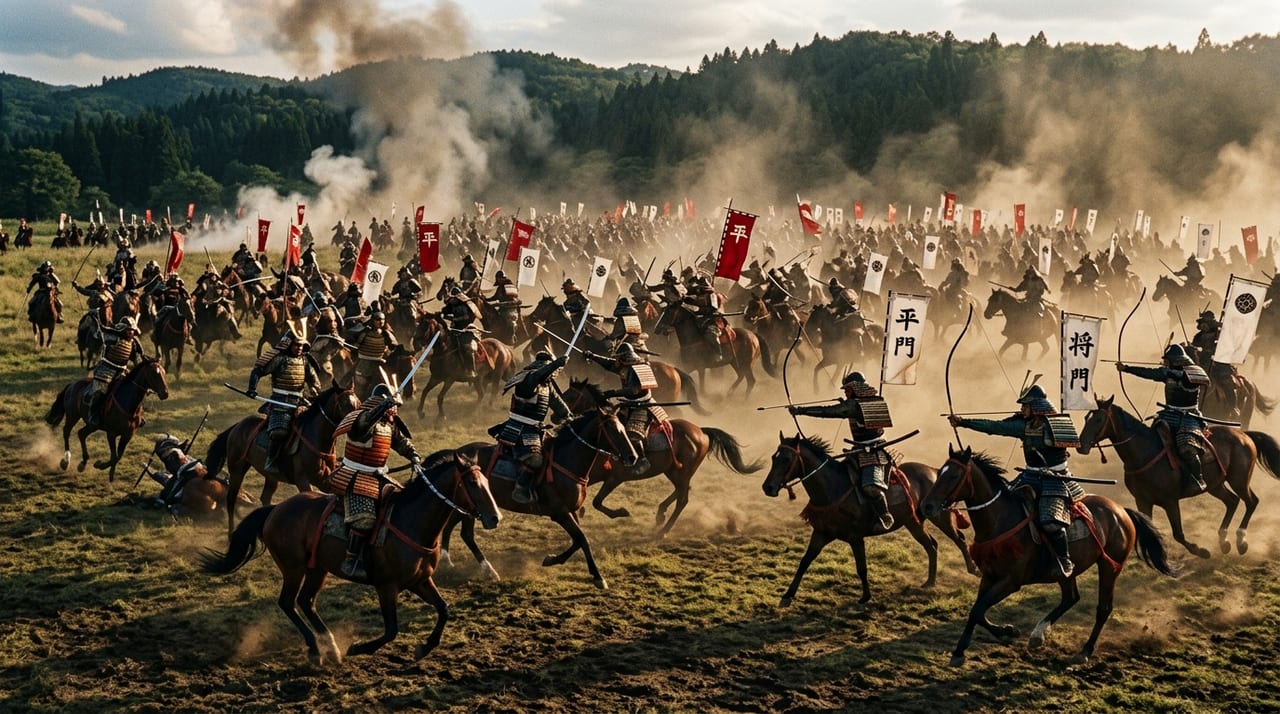
First Battle of Kōnodai
October 23, 1538 (Tenbun 7, 10th month, 7th day)
Kōnodai, Shimōsa Province (present-day Kōnodai, Ichikawa City, Chiba Prefecture)
- Date
- October 23, 1538 (Tenbun 7, 10th month, 7th day)
- Location
- Kōnodai, Shimōsa Province (present-day Kōnodai, Ichikawa City, Chiba Prefecture)
- Result
- Victory for the Hōjō forces. Ashikaga Yoshiaki and his son Yoshizumi were killed in battle, ending the Koyumi Kubō line, and the Hōjō clan expanded its power into Shimōsa Province.
Forces
Koyumi forces
Hōjō forces
About 7 min read
The Rivalry Between the Koyumi Kubō and the Later Hōjō over the Bōsō Region
In the early Sengoku period, the Kantō region was a complex patchwork of contending powers — the Koga Kubō, the Kantō Kanrei Uesugi, and the Later Hōjō. Amid this, Ashikaga Yoshiaki, based at Koyumi in Shimōsa Province (present-day Chūō Ward, Chiba City), was a cadet-line descendant of the Koga Kubō house who independently styled himself the "Koyumi Kubō." Commanding the allegiance of the Satomi clan and the Mariyatsu Takeda of the Bōsō Peninsula, he built up a formidable regional power base. Asserting his own legitimacy as a Kubō-level authority in the Kantō, Yoshiaki came into sharp conflict with Hōjō Ujitsuna, who was expanding his influence from Sagami across the wider Kantō region.
In 1538 (Tenbun 7), Yoshiaki raised an army under the pretext of punishing Mariyatsu Nobumasa, who had defected to the Hōjō side, and advanced to Kōnodai in Shimōsa with the naval support of Satomi Yoshitaka. Kōnodai was a strategic point facing Musashi Province across the Edo River, and by encamping there Yoshiaki intensified pressure on Hōjō territory toward Edo. In response, Hōjō Ujitsuna personally led a large army into the field together with his eldest son Ujiyasu, and the two forces came to face each other across the Edo River.
The Clash at Sagamidai
Before dawn on the 7th day of the 10th month of Tenbun 7, the Hōjō army crossed the Edo River in three columns and advanced via Matsudo toward the lightly defended Sagamidai area (present-day Matsudo City), closing in on the Koyumi army's headquarters at Kōnodai. In the opening phase, the Koyumi forces are said to have fought effectively, using the terrain to their advantage, but the numerically superior Hōjō army gradually pushed back, and the fighting turned from a stalemate into a chaotic melee.
As the battle hung in the balance, Ashikaga Yoshiaki received word that his younger brother Motoyori and his son Yoshizumi had fallen in the fighting. Consumed with fury, he is said to have personally led a small group of close attendants in a charge directly at the Hōjō headquarters. This reckless assault ended with Yoshiaki's own death amid the melee, and the loss of the Koyumi Kubō's central pillar caused the army to lose its command structure entirely. When news of Yoshiaki's death spread, Satomi Yoshitaka's forces, which had been fighting hard until then, chose to withdraw from the field, and the Koyumi army collapsed into full retreat.
The End of the Koyumi Kubō and Its Aftermath in Bōsō
In this single battle, Ashikaga Yoshiaki, his son Yoshizumi, and many senior retainers were killed, effectively bringing the Koyumi Kubō house to an end. Victory gave Hōjō Ujitsuna a foothold toward Shimōsa, and thereafter the Later Hōjō steadily extended their influence into the Shimōsa territories east of the Edo River. Satomi Yoshitaka, meanwhile, having withdrawn from the field early without suffering major losses, returned to southern Kazusa Province and, if anything, expanded his effective control over the Bōsō Peninsula. Ironically, the death of his ally Yoshiaki became an opportunity for the Satomi clan to establish an independent power base of its own.
The First Battle of Kōnodai stands as a symbolic episode in the process by which the Hōjō clan rapidly rose outside the framework of the Koga Kubō and Kantō Kanrei system to establish new hegemony over the Bōsō and Shimōsa region. The same site at Kōnodai would later become the stage of the Second Battle of Kōnodai in 1564, fought between Hōjō Ujiyasu and Satomi Yoshihiro, making it a place where the struggle between Bōsō powers and the Later Hōjō was twice etched into Kantō's Sengoku-era history. Present-day Kōnodai in Ichikawa City, Chiba Prefecture, still preserves historical traces of the battle, including a memorial mound within Satomi Park said to honor those who fell. In terms of arms history, differences have also been noted between the tachi and uchigatana styles favored respectively by Bōsō and Sagami warrior bands of the time, making this battle a notable case study in regional variation of Kantō sword culture.