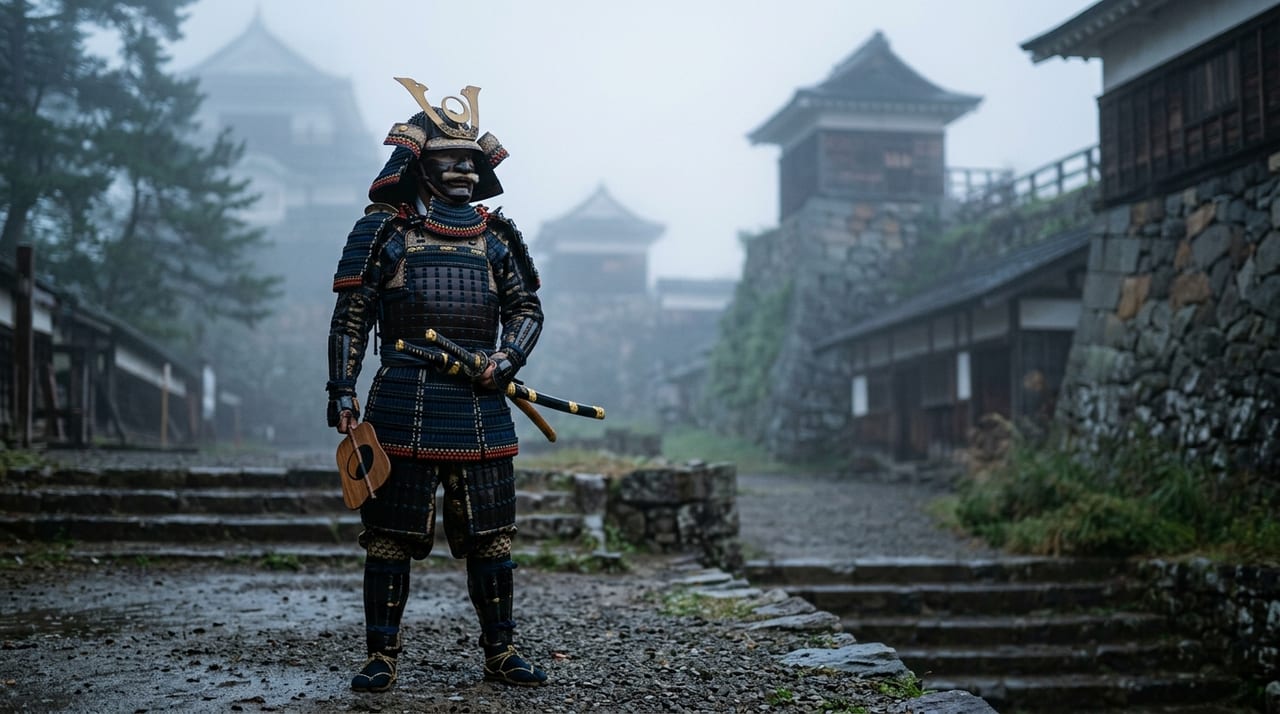
 * Image is for illustrative purposes only.
Uesugi Kagekatsu
上杉景勝
Heir of Righteousness — The Silent Iron Lord Who Kept Kenshin's Spirit Alive
Description
Kenshin's Successor
Born in Echigo Province in Kōji 1 (1556), Uesugi Kagekatsu was the warlord who, after the death of his adoptive father Uesugi Kenshin, subdued the fierce succession dispute known as the Otate no Ran to become the head of the Uesugi clan. Kagekatsu inherited Kenshin's spirit of "giri" (righteousness) with stubborn fidelity, and though he suffered a drastic reduction in domain from 1.2 million to 300,000 koku for siding with the western coalition (Ishida Mitsunari's faction) in the Battle of Sekigahara, he remained unyielding in his samurai honor. Known as "the silent iron general," Kagekatsu was a taciturn yet resolute man, the antithesis of the verbose, scheming warlords of his age.
The Otate no Ran and the Struggle for Succession
In Tenshō 6 (1578), following Kenshin's sudden death, the Uesugi clan fell into a major succession dispute known as the Otate no Ran. Kenshin's two adopted sons—Kagekatsu and Kagetora (the son of Hōjō Ujiyasu)—contested for headship, and after roughly two years of civil war, Kagekatsu emerged victorious. In this conflict, Kagekatsu demonstrated not only military prowess but diplomatic skill, navigating the complex negotiations with Oda Nobunaga and Takeda Katsuyori to secure his position as head of the Uesugi. This experience tempered Kagekatsu into a greater warlord.
Kenshin's Swords and Their Inheritance by Kagekatsu
Kagekatsu inherited the Uesugi clan's prized blades from his adoptive father Kenshin. The Sanchōmō, famed as Kenshin's treasured sword, is a masterwork of the Kamakura period forged by a renowned smith of the Fukuoka Ichimonji school, and its name is said to derive from its splendid hamon, which is as beautiful as the plumage of the yamatori. Kagekatsu cherished this celebrated blade and guarded it as a symbol of the Uesugi house. In 2020, Setouchi City in Okayama Prefecture purchased the Sanchōmō with approximately 500 million yen in donations collected from across Japan, and it is now owned by the city and displayed at the Osafune Sword Museum in Bizen.
The Bond with Naoe Kanetsugu
The most crucial figure in Kagekatsu's reign was the senior retainer Naoe Kanetsugu. Kanetsugu, renowned for his helmet crest bearing the character for "love" (ai), was that rare retainer who supported Kagekatsu in all matters—political, military, and diplomatic—such that their bond was celebrated as "two bodies, one Uesugi." Even in the hardship of drastic reduction following Sekigahara, Kagekatsu and Kanetsugu laid the foundation of Yonezawa Domain and ensured the Uesugi clan's survival. Kanetsugu's spirited resolve, epitomized by his "Naoe letter" (Naoejō), demonstrated that the Uesugi spirit of "giri" (righteousness) flowing from Kenshin onward remained unbroken.
The Blade Aesthetics of the Silent Iron General
Like Kenshin, Kagekatsu held a deep appreciation for the aesthetics of the sword. He had an outstanding connoisseur's eye, and from among Kenshin's belongings he selected the blades he particularly favored and compiled them into a register known as “Thirty-Five Blades Selected by Uesugi Kagekatsu.” Among them are blades such as the Himetsuru Ichimonji, an Important Cultural Property. In his taciturn way, Kagekatsu spoke of the samurai spirit through the blade itself, embodying his role as heir to the Uesugi tradition of "giri" (righteousness).
The Foundation of Yonezawa Domain
After Sekigahara, though reduced from 1.2 million koku in Aizu to 300,000 koku in Yonezawa, Kagekatsu continued to support the majority of his retainers. Though this placed extraordinary financial strain on him, Kagekatsu adhered to the conviction that, as the head of a house that valued "giri" (righteousness), he could not abandon his retainers. While Yonezawa Domain's economic hardship persisted for generations to come, so too did the Uesugi spirit of bushidō take root there. The spiritual foundation of the later domain reforms undertaken by Uesugi Yōzan rested upon the legacy of "giri" (righteousness) that Kagekatsu had guarded.
Notable Swords
- Sanchōmō — the Kamakura-period masterwork by the Fukuoka Ichimonji school that Kagekatsu inherited from Kenshin; its splendid hamon is likened to the feathers of the mountain bird (yamatori), a National Treasure masterpiece showing the pinnacle of Japanese sword art and a single blade embodying the Uesugi spirit of giri (righteousness)
- Himetsuru Ichimonji — a Kamakura-period tachi attributed to the Fukuoka Ichimonji school, one of the blades Kagekatsu selected for the “Thirty-Five Blades Selected by Uesugi Kagekatsu”; an Important Cultural Property held by the Uesugi Museum, Yonezawa City