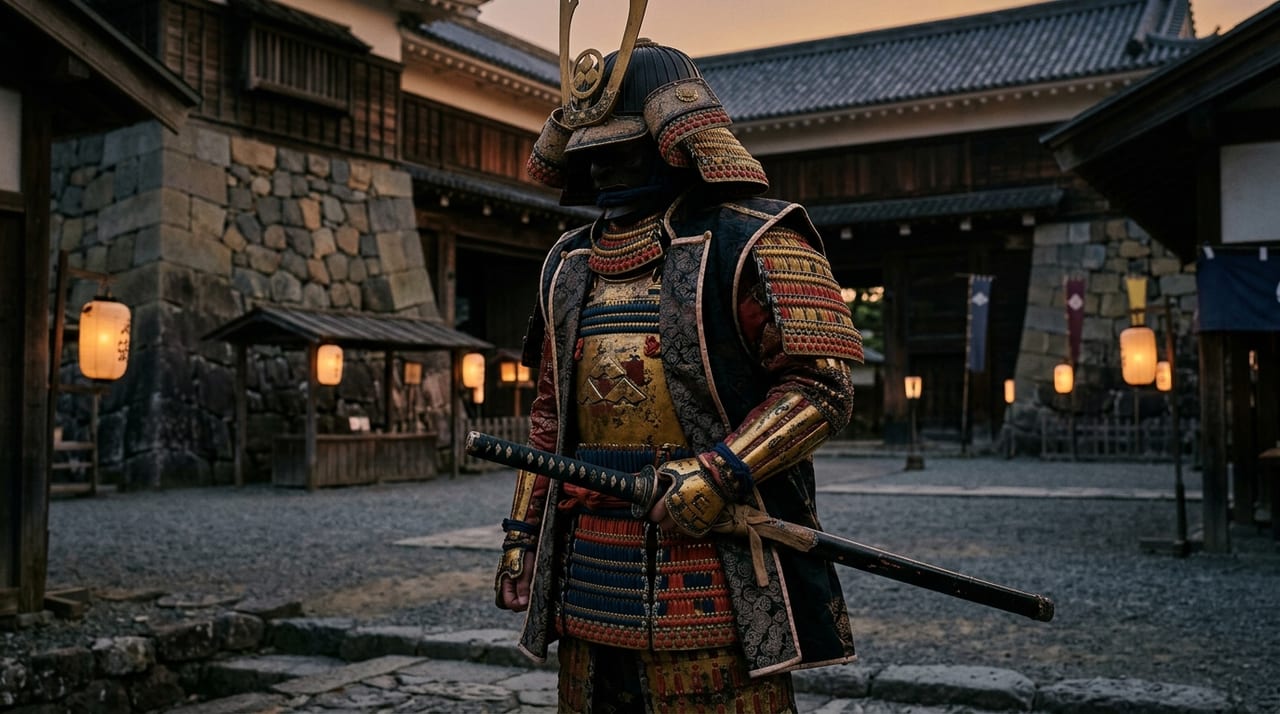
 * Image is for illustrative purposes only.
Hōjō Ujiyasu
北条氏康
The Lion of Sagami—The Brilliant Lord Who Repelled Uesugi and Takeda and Revitalized the Later Hōjō
Description
Birth of the Lion of Sagami
Hōjō Ujiyasu, born in Eishō 12 (1515) as the eldest son of Hōjō Ujitsuna, the second-generation lord of the Later Hōjō clan, is a preeminent Sengoku military commander and statesman known by the epithet "Lion of Sagami." Following his grandfather Ise Sōun (Hōjō Sōun), who pioneered Later Hōjō dominion over the Kantō, and his father Ujitsuna, who developed it further, Ujiyasu inherited and brought their enterprise to near completion. Renowned not merely for military prowess but for exceptional skill in civil administration, diplomacy, and agrarian policy, he is regarded as a great ruler who established the Later Hōjō clan at the height of its power.
The Kawagoe Night Raid—A Miraculous Reversal
The Kawagoe Night Raid (Kawagoe Yasen) of Tenbun 15 (1546) represents the apex of Ujiyasu's military genius. When an army said to number eighty thousand—a coalition of Kantō Kanrei Uesugi Norimasa and Koga Kubo Ashikaga Harauji—besieged Kawagoe Castle, the castle garrison numbered but three thousand. Ujiyasu led a force of eight thousand men in a night attack, throwing the complacent besieging army into chaos and annihilating the vastly larger coalition. This victory caused the power of the Uesugi clan in the Kantō to retreat decisively, and the Later Hōjō became the de facto hegemon of the Kantō. This reversal is remembered alongside the Battle of Miyajima and the Battle of Okehazama as one of the Sengoku era's three great surprise attacks.
Tripartite Struggle with Takeda and Uesugi
Ujiyasu's life was marked by conflict with two of the Sengoku era's most celebrated commanders: Takeda Shingen and Uesugi Kenshin. Later he established a stable alliance with the Takeda and Imagawa clans through the Kai-Sagami-Suruga Alliance (1554). However, when Takeda Shingen invaded Imagawa territory in Eiroku 11 (1568), the tripartite alliance collapsed and the Takeda became Ujiyasu's enemy; the following year, in Eiroku 12 (1569), Ujiyasu concluded the Echigo-Sagami Alliance with Uesugi Kenshin. Earlier, in Eiroku 4 (1561), Uesugi Kenshin had besieged Odawara Castle, and in Eiroku 12 Takeda Shingen did the same, but each time Ujiyasu held out by defending the castle.
Excellence in Civil Administration
Ujiyasu's true distinction lay not in military affairs alone but equally in civil governance. In tax reform, he simplified the complex existing tax system and implemented policies that clarified and eased the tax burden on farmers. He also created the "Register of Lands and Military Obligations" (Shoryōyakuchō), establishing clear definitions of his retainers' landholdings and military duties and pioneering a modern form of feudal administration. The Kantō under the "Lion of Sagami" enjoyed relative stability and prosperity despite the chaos of the Sengoku age.
Development of Odawara Castle and Kantō Culture
Ujiyasu undertook large-scale renovation and expansion of Odawara Castle, developing it into the largest castle city in the Kantō. Under Later Hōjō rule, Odawara's commercial and industrial sectors flourished, and the castle town prospered as the premier city in the eastern provinces. Furthermore, Ujiyasu was a man of considerable cultural refinement, versed in Japanese poetry and linked verse (renga), and deeply devoted to Zen Buddhism. This cultural sophistication was reflected in his connoisseurship of swords; the blades associated with the Later Hōjō clan included many masterworks of the Sōshū-den smithing tradition. Sagami Province, the site of Ujiyasu's seat of power, was the very homeland that had produced legendary swordsmiths such as Masamune and Sadamune since the Kamakura period, and the overlap between Ujiyasu's domain and this center of sword-making imparted a distinctive character to the Later Hōjō clan's sword culture.
Deathbed Testament and Prospects for the Later Hōjō
In Genki 2 (1571), at the age of fifty-seven, Ujiyasu's life came to an end. On his deathbed, Ujiyasu is said to have instructed his heir Ujimasa and others to "ally with Takeda Shingen," and shortly after his death the Later Hōjō renewed their alliance with the Takeda. After Ujiyasu's death, the Later Hōjō continued under Ujimasa and Ujinao to rule the Kantō, but they fell in Tenshō 18 (1590) when Toyotomi Hideyoshi launched his assault on Odawara. Without the foundation that Ujiyasu had built, it would have been impossible for the Later Hōjō under Ujimasa and Ujinao to maintain their dominion over the Kantō.