New Arrivals — Browse our catalog for the latest authentic Japanese sword arrivals. Browse →
March 13, 1561 (Eiroku 4; the start of the siege, dates approximate)
Odawara Castle, Sagami Province (present-day Odawara, Kanagawa) and Tsurugaoka Hachimangu in Kamakura (present-day Kamakura, Kanagawa)
Forces
Uesugi and Kanto allied forces
Hojo forces (holding Odawara Castle)
About 10 min read
In the Muromachi period the Uesugi family hereditarily held the post of Kanto Kanrei, the deputy to the Kamakura Kubo. In the Sengoku era the Hojo of Sagami, from the time of Ise Soun (Hojo Soun), expanded rapidly and pressed both the Yamanouchi Uesugi, holders of the post, and the related Ogigayatsu Uesugi. After Hojo Ujiyasu's victory at the Night Battle of Kawagoe in 1546 (Tenbun 15), Hojo superiority in the Kanto grew firmer still.
Uesugi Norimasa, head of the Yamanouchi Uesugi, was pressed by the Hojo and the Takeda of Kai, and by around 1552 he is said to have lost his base at Hirai Castle in Kozuke and fled to Nagao Kagetora in Echigo. Kagetora gave him protection and gained a cause for restoring order in the Kanto. Kagetora's Nagao family had risen from the deputy governor line of Echigo, and succeeding to the name of the Uesugi, once their lords, would give him standing before Kanto warlords.
In 1560 (Eiroku 3), responding to the plight of Kanto lords under Hojo pressure, Kagetora left Echigo for the Kanto, a move known as the "etsuzan", the crossing of the mountains. Requests for help from lords such as Satomi Yoshitaka, Ota Sukemasa and Satake Yoshiaki, all squeezed by the Hojo, are said to lie behind it. Using Umayabashi Castle as a base, Kagetora attacked Hojo-held castles one after another, and into 1561 Kanto lords joined his camp. War chronicles put the assembled host at about 100,000, but this is considered exaggerated and reliable figures are lacking.
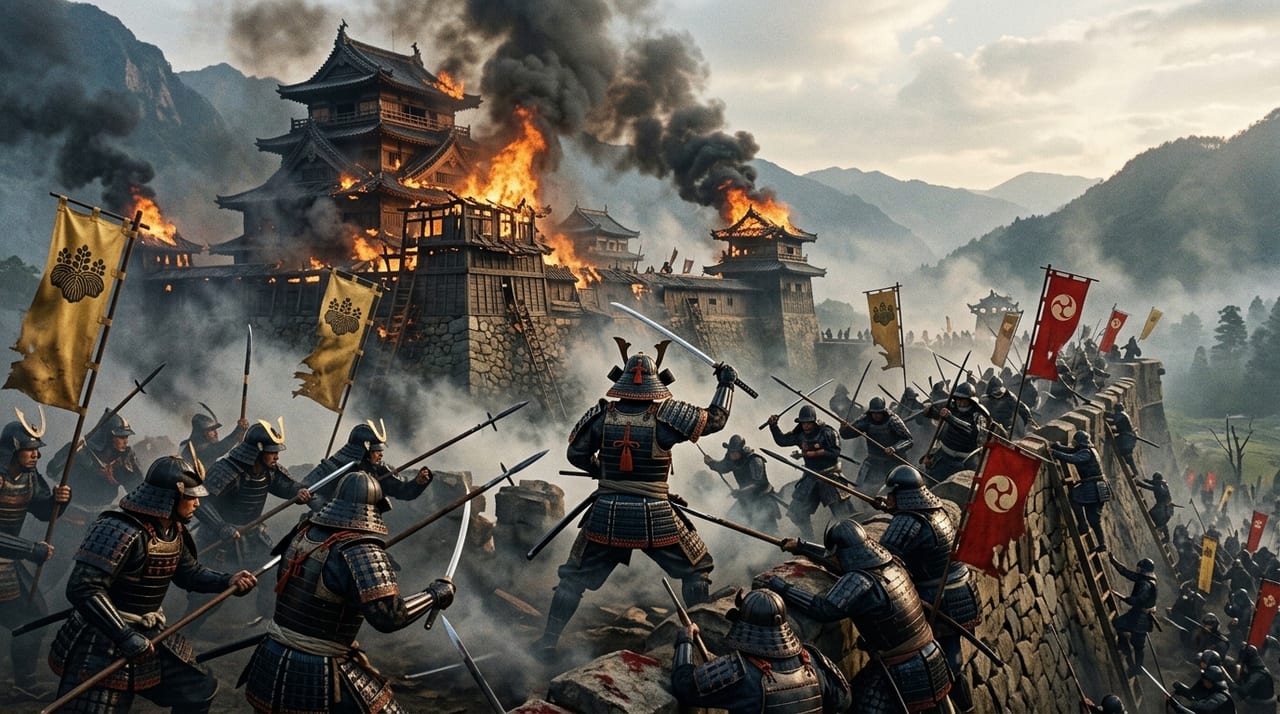
In March 1561 (Eiroku 4) Kagetora's army advanced into Sagami and besieged Ujiyasu's seat, Odawara Castle. Ujiyasu avoided a field battle and chose to defend from within. Odawara had extensive outer works and strong defenses, and Ujiyasu is said to have waited for the movements of his ally Takeda Shingen and for friction among the Kanto lords in the besieging army. The siege lasted about a month without taking the castle. An anecdote says that Ujiyasu showed his composure by serving soba to the besiegers, but this is regarded as a later embellishment with little documentary support.
Several factors are generally cited for the stalemate. First, the strength of Odawara itself. Second, the Uesugi side was a loose alliance of Kanto lords, and supplies, fatigue from a long campaign and differing aims were hard to avoid. Third, the Takeda, allied with the Hojo, were active toward Shinano, so Kagetora could not ignore the defense of Echigo and northern Shinano. For these reasons he lifted the siege without taking the castle.
Tactically, the siege was not a success for Kagetora. Yet the shock to the Kanto lords of seeing an army reach Ujiyasu's own seat was considerable, and some local lords who had followed the Hojo are said to have changed sides.
On the return march Kagetora entered Kamakura and is said to have held a ceremony at Tsurugaoka Hachimangu. The shrine had been a sacred place for warriors since Minamoto no Yoritomo and a support of the Kamakura Kubo. Before it Uesugi Norimasa is said to have handed Kagetora the post of Kanto Kanrei and the Uesugi name, and Kagetora became Uesugi Masatora. The "Masa" character is said to come from Norimasa, and he would later take a character from the shogun Ashikaga Yoshiteru to become Terutora, and finally take the Buddhist name Kenshin.
Legally, the handover of the Kanrei post was largely ceremonial, since it ordinarily required confirmation by the shogun, and whether Yoshiteru's approval was in place is debated. Still, a rite at Tsurugaoka Hachimangu served to show Kanto warriors visually that the Uesugi legitimacy had passed to Kagetora. Through it he is said to have gained the standing to command Kanto lords, and it also contributed to the later image of Kenshin as a commander who valued righteousness.
In the ninth month of the same year, Masatora met Takeda Shingen at the fourth battle of Kawanakajima, which is treated in a separate entry. What matters here is that the Kanto campaigns and the Shinano front were linked, and that Uesugi was drained on both. Ujiyasu then worked to recover lost ground and regained the upper hand in the Kanto by defeating Satomi and Ota forces at the Second Battle of Kokufudai in 1564 (Eiroku 7). Kenshin kept campaigning in the Kanto but never held it as a whole over the long term.
The siege of Odawara and the succession ritual at Tsurugaoka were events of both force and authority. A Sengoku lord's war was not only about whether a castle fell but also a political act showing inside and outside his domain who the legitimate ruler was. Holding the ritual at Tsurugaoka Hachimangu can be understood as borrowing authority linked to Minamoto no Yoritomo, the founder of warrior government.
This entry does not take up any particular sword anecdote. Many stories of famous blades are told about Uesugi Kenshin in later periods, but reliable sources tying them directly to this event are limited, so they are left out.
This entry draws on related articles at serai.jp and on materials about Odawara Castle and the Hojo published by Odawara City. Because sources differ on the length of the siege, the size of the armies, and the date and course of the ceremony at Tsurugaoka Hachimangu, uncertain points are described as "said to be".
Uesugi Kenshin
Echigo commander who besieged Odawara and inherited the Kanto Kanrei post
Hōjō Ujiyasu
Hojo head who held Odawara Castle by siege defense
Uesugi Norimasa
Yamanouchi Uesugi head who passed the Kanto Kanrei post and name to Kagetora
Takeda Shingen
Kai lord allied with the Hojo against Uesugi's Kanto campaigns