New Arrivals — Browse our catalog for the latest authentic Japanese sword arrivals. Browse →
Eiroku 3 to Genki 1 (1560–1570), a series of repeated confrontations
Karasawayama Castle, Aso District, Shimotsuke Province (present-day Fuji-chō and Tochimoto-chō, Sano City, Tochigi Prefecture)
Forces
Uesugi Forces
Sano Forces (Karasawayama garrison) and allied Hōjō forces
About 14 min read
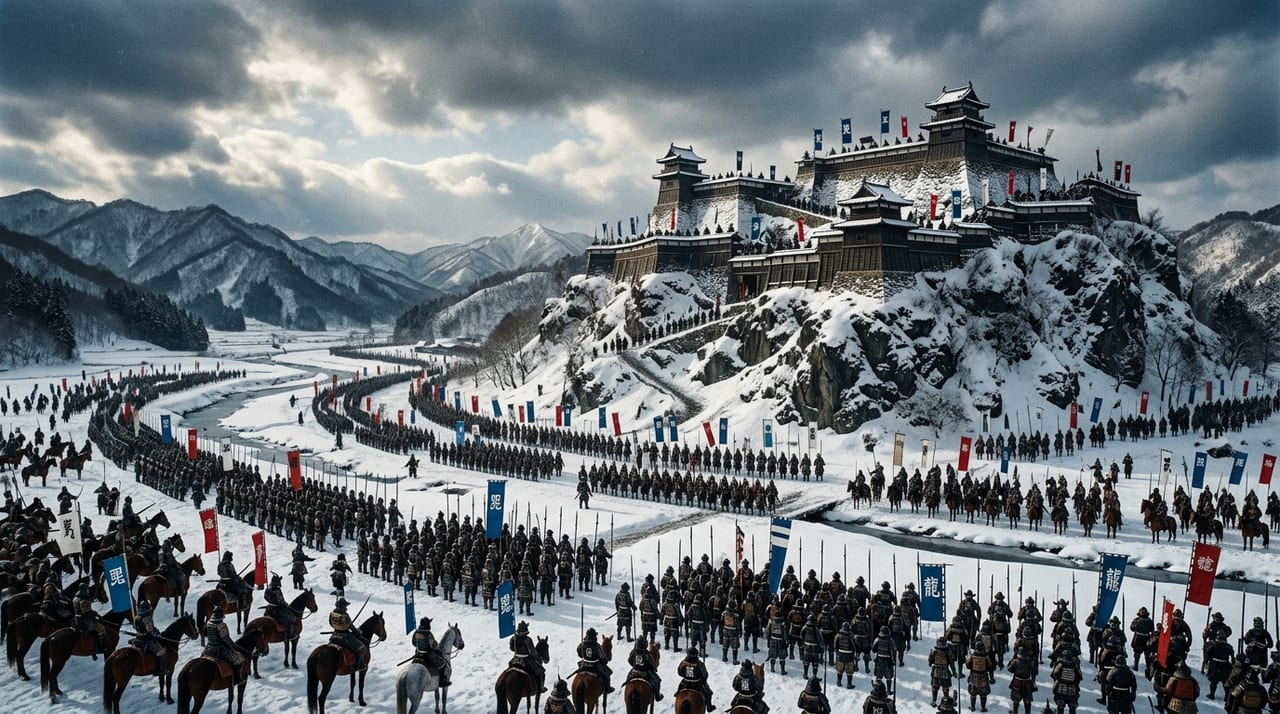
Rising above what is now Sano City, Tochigi Prefecture, Karasawayama Castle in Shimotsuke Province is counted among the "Seven Great Castles of Kanto." From the Eiroku era into the Genki era, Uesugi Kenshin of Echigo attacked this castle roughly ten times by some accounts, and by others more than a dozen, yet its lord, Sano Masatsuna, was never fully conquered. This is the decade-long story of the resilience born from Karasawayama's formidable defenses and Masatsuna's adroit diplomacy amid the struggle for Kanto supremacy between the Uesugi and the Hōjō.
Uesugi Kenshin came from the Nagao house, hereditary shugodai of Echigo Province, but when Kanto Kanrei Uesugi Norimasa was defeated by the Hōjō and fled into exile in Echigo, Kenshin took over both his name and his office of Kanto Kanrei. The Kanto Kanrei had traditionally been the authoritative office governing Kanto on behalf of the Muromachi shogunate, and by inheriting it Kenshin gained a legitimate claim to leadership over the region's warlords. Thereafter, proclaiming his mission as the restoration of order in Kanto, Kenshin launched a massive Kanto campaign from Eiroku 3 (1560) into the following year, rallying the region's local lords and ultimately laying siege to Odawara Castle, the Hōjō stronghold. Within this series of Kanto campaigns, Karasawayama Castle repeatedly became a target of Kenshin's attacks — both as a strategic waypoint on the invasion route from Echigo into the Kanto plain, and as a symbolic barometer of which local lords would side with the Uesugi. Bringing Karasawayama to heel carried political weight well beyond the capture of a single castle: it served to demonstrate Uesugi authority to the region's provincial warriors.
The Sano clan, said to descend from Fujiwara no Hidesato (Tawara no Tōta), was a distinguished house of Shimotsuke Province that had held Karasawayama Castle for generations. As the Sengoku age progressed, Sano territory found itself squeezed between two great powers: the Uesugi of Echigo (initially under Kanto Kanrei Uesugi Norimasa, whose title Kenshin later inherited) and the Hōjō, who were expanding from Sagami into Kanto. Sano Masatsuna, facing the peril that his clan's survival depended on submission to one power or the other, pursued a pragmatic diplomatic course — aligning with the Uesugi at times, with the Hōjō at others.
The bond between Uesugi Kenshin and Karasawayama Castle began in February of Eiroku 3 (1560). That year, when a force under Hōjō Ujimasa approached the castle, Kenshin is said to have rushed to its defense with a mere forty horsemen and driven the attackers off. From then on, Kenshin placed great importance on the fate of Karasawayama with every Kanto campaign, dispatching troops to retake it whenever the Sano turned to the Hōjō side. That same year marked the start of Kenshin's first full-scale Kanto campaign, which would culminate in the siege of Odawara Castle, and Karasawayama was positioned as one of its critical footholds.
Over roughly a decade, from Eiroku 3 (1560) to Genki 1 (1570), Kenshin marched on Karasawayama Castle time and again. But whenever Kenshin's large army drew near, Sano Masatsuna would promptly surrender and pledge fealty, only to defect back to the Hōjō once Kenshin withdrew to Echigo. This behavior is said to have greatly frustrated Kenshin, yet it was also an intensely pragmatic strategy by which a minor power like the Sano survived between two great daimyo. Masatsuna and Kenshin are said to have been the same age, both born in the Year of the Tiger in Kyōroku 3 (1530), and anecdotes suggest that while Kenshin regarded Masatsuna's resistance as exasperating, he also held a measure of respect for his tenacity. During this period, Karasawayama Castle repeatedly changed hands between the Uesugi and Hōjō camps, serving as a mirror reflecting the shifting balance of power in Kanto.
The single greatest reason Karasawayama withstood nearly a decade of Kenshin's attacks was the rugged terrain of the 242-meter mountain on which it stood. Surrounded by steep cliffs and defended by an intricate arrangement of baileys, it was hailed as "the finest mountain castle in Kanto." This formidable defense made it extremely difficult for Kenshin's forces, marching all the way from Echigo, to mount a sustained siege while stretching their supply lines. Winter snowfall and the sheer breadth of the Kanto plain further complicated any prolonged encampment by the Echigo army. The layout of Karasawayama Castle, with its many baileys nested within rugged mountain terrain, allowed even a small garrison to withstand a large army's assault over an extended period, and this was the single greatest weapon underpinning the Sano clan's survival. The Echigo army also faced a seasonal constraint of its own: it could only campaign after the spring thaw and was compelled to return home as winter approached. Sano Masatsuna understood this fatal weakness of Kenshin's forces intimately, and it is thought that, through repeated cycles of submission and defection, he refined the tactic of timing his switch back to the Hōjō to coincide with Kenshin's withdrawal to Echigo.
The struggle over Karasawayama Castle was also a battlefield where two distinct sword cultures — those of Echigo and Shimotsuke — came face to face. Uesugi Kenshin was renowned for his deep devotion to Bishamonten and treated swords not merely as weapons but as offerings to be revered. Among the blades attributed to Kenshin that survive today is the "Kenshin Kagemitsu," said to be the work of the Bizen Osafune smith Kagemitsu, remembered alongside other Echigo-forged swords as symbols of Kenshin's martial authority. Kenshin is said to have treated such storied blades not merely as tools of war but as spiritual anchors tied to his devotion to Bishamonten, and it is believed that on his Kanto campaigns these swords were carried as symbols underpinning battles he fought in the name of "gi" (righteousness). Meanwhile, the Sano region surrounding Karasawayama Castle carried an ancient tradition of venerating Amenomahitotsu-no-Kami, the god of smithing, and local blacksmiths — known as the Sano kaji lineage — continued to supply practical swords to the Sano's warrior band. Rooted in the region as a practical smithing tradition that also produced farm tools and everyday blades, the Sano kaji supported the down-to-earth armament of the local warrior band in a manner distinct from the elite forces Kenshin brought on his long campaigns from Echigo. The clash of these two sword cultures at Karasawayama thus offers a glimpse into one facet of the broader culture of arms in Sengoku-era Kanto.
Sano Masatsuna died in Tenshō 2 (1574). The Sano clan endured afterward through changes in leadership: Masatsuna's successor Sano Munetsuna likewise found himself caught between the Uesugi and the Hōjō, and after Munetsuna's death, Ujitada, a son of the Hōjō house, was adopted into the Sano family, allowing the clan to maintain a complex relationship with both powers while preserving its name. When the Hōjō fell in the Odawara Campaign of Tenshō 18 (1590), the Sano's fortunes — having leaned toward the Hōjō — were once again thrown into flux, but the clan had its holdings confirmed under Toyotomi Hideyoshi and went on to survive as a daimyo house into the Edo period. That this survival was possible owes no small debt to Masatsuna's tenacious resistance at Karasawayama against Kenshin's repeated onslaughts. Today, the ruins of Karasawayama Castle are designated among the "Continued 100 Fine Castles of Japan," drawing many history enthusiasts to what remains one of Kanto's premier mountain fortresses.