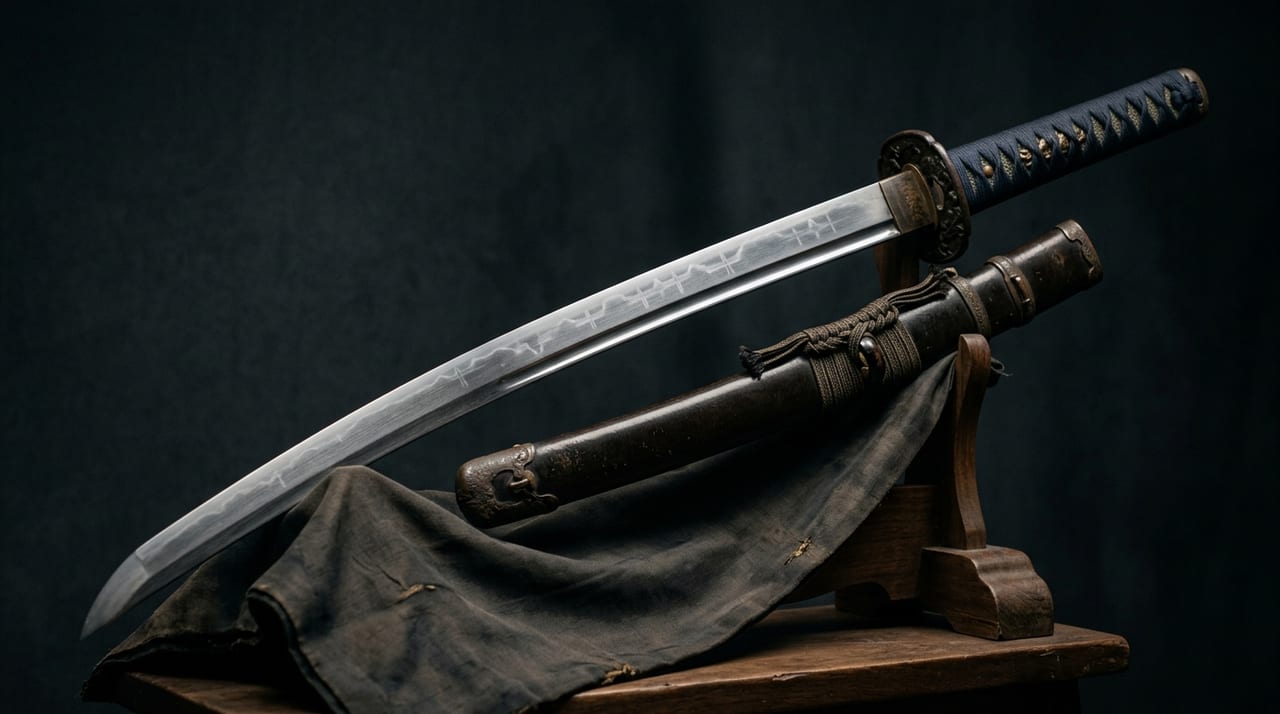
 * Image is for illustrative purposes only.
Kenshin Kagemitsu
謙信景光
Also known as: Kenshin Kagemitsu — beloved blade of Uesugi Kenshin, National Treasure with Genʻen 3 inscription
Description
Kenshin Kagemitsu is a National Treasure short sword (tantō) forged in Genkō 3 (1323) during the late Kamakura period by Kagemitsu (dates unknown), a master swordsmith of the Bizen Osafune school. It is celebrated as the sword beloved and used throughout his life by Uesugi Kenshin (1530–1578). Held at the Saitama Prefectural Museum of History and Folklore (Saitama City), it remains preserved today as a supreme treasure associated with the Uesugi clan.
Kagemitsu, regarded as the son of Nagamitsu, refined his father's formal beauty even further and became renowned for a distinctive style featuring small chōji (clove-blossom-shaped) hamon elements called ko-chōji. Kagemitsu's ko-chōji-midare came to be praised as "Kagemitsu's ko-chōji is the finest under heaven," representing such a high degree of perfection that it became particularly prized by the Ashikaga shogunate and the great daimyo. Kenshin Kagemitsu's hamon likewise centers on ko-chōji-midare with brilliant variations; the inscriptions on the tang—"Genkō 3" and "Bizen Osafune Kagemitsu"—make it one of the rare National Treasure swords with precisely datable manufacture.
The background of Uesugi Kenshin's use of this sword lies in his fervent Buddhist faith and devoted reverence for Bishamonten, the god of war. Kenshin believed himself to be an avatar of Bishamonten and is said to have clasped his hands to his sword before every battle, beseeching Bishamonten's protection. Kenshin Kagemitsu was thus more than a weapon—it was a sacred sword that served as the object of his prayers, endowed with religious significance beyond its martial function. After Kenshin's death (1578), it was transmitted to the Uesugi family and has been owned by Saitama Prefecture and kept in this museum since the modern era.
Legends & Stories
Kenshin Kagemitsu is surrounded by numerous legends bound to the spiritual power of Uesugi Kenshin, called an incarnation of Bishamonten. During the Kawanakajima campaigns (1553–1564, five clashes between Kenshin and Takeda Shingen), on the eve of the fourth campaign (1561), reputedly the fiercest, Kenshin is said to have isolated himself in a private chamber and spent the entire night in prayer, holding Kenshin Kagemitsu in his hands. The following dawn, Kenshin reportedly spoke from horseback after sheathing his blade, saying: 'Bishamonten appeared to me in the light of dawn and announced victory.' In this very campaign, Kenshin is also said to have personally charged Takeda Shingen's main encampment and crossed blades directly with Shingen, wielding Kenshin Kagemitsu in that fateful exchange. After Kenshin's death, records tell of samurai, court nobles, and Buddhist monks journeying from throughout the realm to glimpse this blade at the Uesugi seat, establishing its legendary status in Japanese sword history as a weapon in which the spiritual power of Kenshin and Kagemitsu became one.