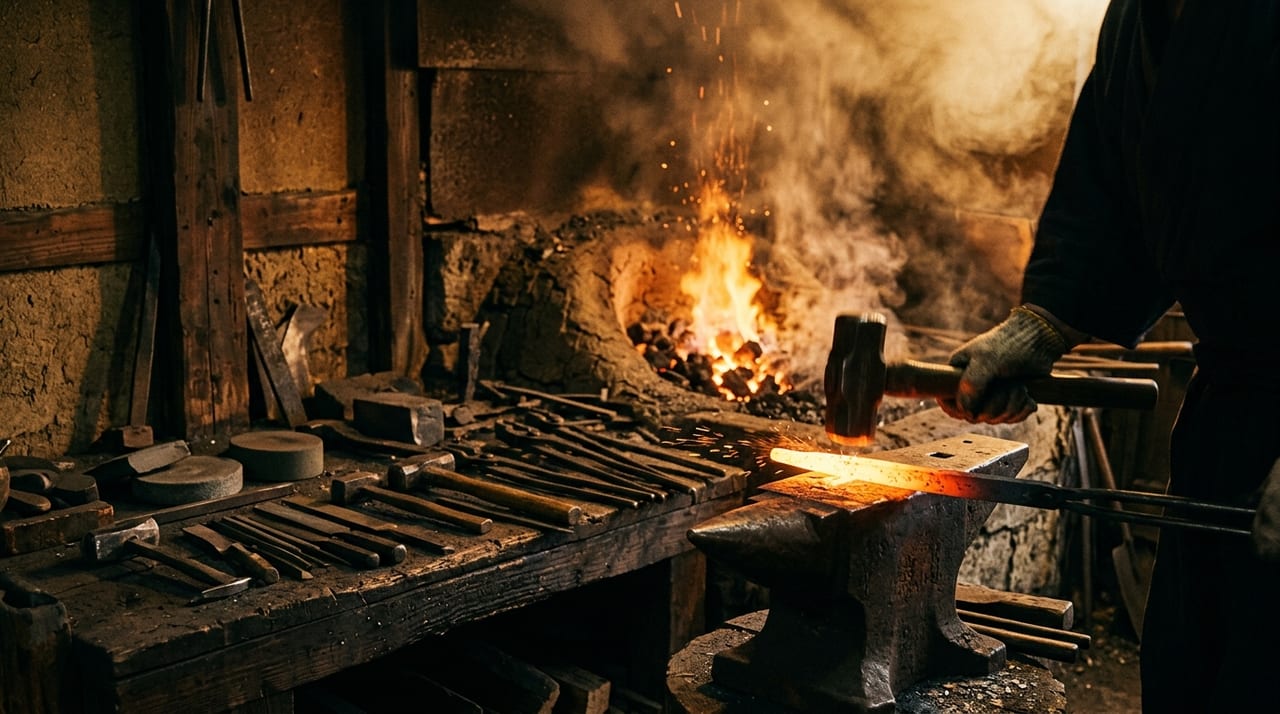
 * Image is for illustrative purposes only.
Osafune Kagemitsu
長船景光
Description
Osafune Kagemitsu was a swordsmith of the Osafune school who was active in Bizen Province (present-day Okayama Prefecture) from the late Kamakura period into the early Nanboku-chō period. He was a son of Nagamitsu, a renowned master of the Osafune school, and took his place as the third generation of the main Osafune line, which runs from the founder Mitsutada through Nagamitsu to Kagemitsu. He is said to have gone by the common name Sahyōe-no-jō, and many dated works from roughly thirty years, spanning the Kagen to Kenmu eras, survive. Because many of his signed works are inscribed with the year of their making, he is highly valued as a benchmark smith, indispensable for identifying Bizen works from the late Kamakura period.
The greatest feature of his style is that he perfected the “kataochi-gunome” hamon pattern. This refined the gunome his father Nagamitsu used into an orderly form. In this distinctive composition, one side of each gunome slopes down as if its shoulder had dropped, and its regular succession has become synonymous with Kagemitsu. The jigane is a densely forged ko-itame, which is praised as especially refined even within the Osafune school, and the striking utsuri that stands out vividly is another highlight. He is also known as a master of blade carving, and he skillfully carved kurikara dragons, Sanskrit characters (bonji), Jizō, and other motifs, especially on tantō. Another point of interest in Kagemitsu's work is that he also produced tantō in the katakiriha-zukuri style, which are not found in the works of his father Nagamitsu.
Several National Treasures survive among his masterworks. “Koryū Kagemitsu” is a tachi; it is signed “Bizen no Kuni Osafune jū Kagemitsu” and dated the 5th month of Genkō 2 (1322), and it is held by the Tokyo National Museum. The small carving of a kurikara dragon that remains just above the machi of the tang gives the work its name. It is said to have been worn by Kusunoki Masashige, and it is also renowned for its later history, having become part of the Imperial collection (gyobutsu) of Emperor Meiji. The tantō “Kenshin Kagemitsu” is also a National Treasure; it is signed “Bishū Osafune jū Kagemitsu” and dated the 3rd month of Genkō 3 (1323). It carves “Chichibu Daibosatsu” on the front and the Sanskrit seed syllable kiriku (hrīḥ) on the reverse. It is a masterpiece said to have been the personal blade of Uesugi Kenshin, and it is held by the Saitama Prefectural Museum of History and Folklore. In addition, tachi and tantō with clear dates survive across various regions as Important Cultural Properties.
In terms of lineage, he inherited the main line running through Mitsutada and Nagamitsu and passed down the lineage's techniques to his son Kanemitsu. The bōshi shape shared with his father Nagamitsu and with Sanenaga is called “sansaku-bōshi.” In later ages he was ranked among the premier smiths for his ingenuity with kataochi-gunome and his skill in blade carving. Because he left many reliably dated signed works, his works have been prized to this day as the standard for the study of the Bizen tradition.
Famous Works
- Tantō (National Treasure, with carved decoration)