New Arrivals — Browse our catalog for the latest authentic Japanese sword arrivals. Browse →
April 3, 1582 (Tenshō 10, 3rd month, 11th day)
Tenmokuzan (Tano), Kai Province (present-day Yamato-chō, Kōshū City, Yamanashi Prefecture)
Forces
Takeda Forces
Oda–Tokugawa Coalition
About 9 min read
On April 3, 1582 (Tenshō 10/3/11), at Tano at the foot of Tenmokuzan in Kai Province, Takeda Katsuyori took his own life together with his wife, Lady Hōjō, and his heir, Takeda Nobukatsu. This was the end of the Takeda house, once hailed as the "strongest in the Sengoku period." The battle at Tenmokuzan is still told as one of the most tragic downfalls in Sengoku history.
To tell the tragedy of Tenmokuzan, one must go back to the death of Takeda Shingen in Genki 4 (1573). Shingen inflicted a crushing defeat on Tokugawa Ieyasu at the Battle of Mikatagahara in Genki 3 (1572). While advancing west with the aim of marching on Kyoto, he died in the field before reaching his goal (aged 53).
Takeda Katsuyori, who succeeded him, inherited the vast Takeda army left by his father, Shingen, but also bore the pressure of being "Shingen's son." Katsuyori was by no means lacking as a military commander, and in the period before Nagashino he achieved military success in various regions. However, the Battle of Nagashino in Tenshō 3 (1575) decisively changed the fate of the Takeda house.
At the Battle of Nagashino, where the Takeda army clashed with the combined forces of Oda and Tokugawa, the house lost in one stroke veteran generals such as Baba Nobuharu, Yamagata Masakage, and Naitō Masatoyo. The loss of these stars, the core of the Takeda military power, was an irreparable blow.
Katsuyori afterward tried to rebuild the Takeda house and ordered the construction of a new castle, Shinpu Castle, in present-day Nirasaki, Yamanashi Prefecture. However, this large-scale project brought exhaustion to his retainers and farmers and rapidly weakened their loyalty to Katsuyori.
In Tenshō 10 (1582), Oda Nobunaga launched a major invasion of Kai. As Tokugawa Ieyasu and Hōjō Ujimasa also attacked Takeda territory in coordination, successive betrayals by senior retainers brought the Takeda house down from within. Kiso Yoshimasa defected, Anayama Baisetsu defected, and Katsuyori's close aides abandoned the Takeda one after another.
On the 3rd day of the 3rd month of Tenshō 10 (1582), Shinpu Castle was burned and abandoned before its completion. Katsuyori sought the protection of Oyamada Nobushige and aimed for Iwadono Castle, in present-day Ōtsuki, Yamanashi Prefecture. However, Oyamada also betrayed Katsuyori and refused to admit him to the castle. With nowhere left to go, Katsuyori chose Tenmokuzan as his final place.
On April 3, 1582 (Tenshō 10/3/11), just over 40 retainers went with Katsuyori toward Tenmokuzan. The Takeda house, which had once boasted a cavalry force of more than 20,000, had shrunk to such a small group at its end.
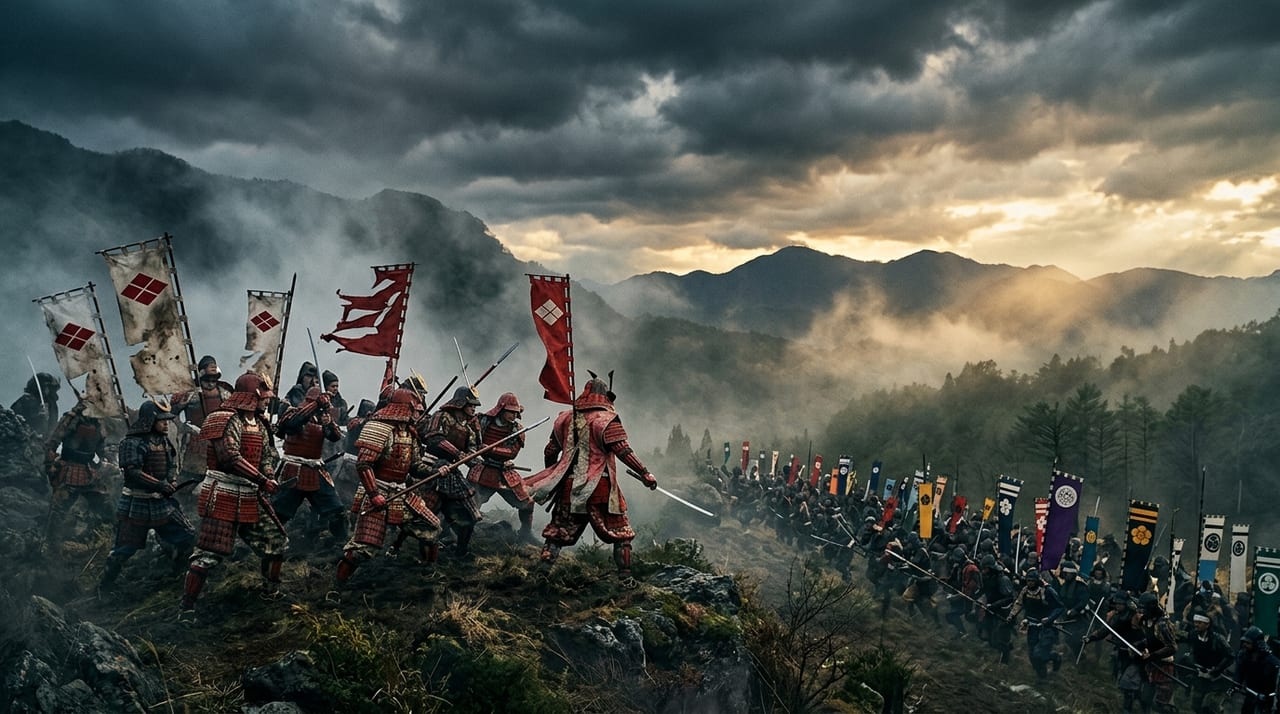
When they reached Tano, the vanguard of the Oda forces under Takigawa Kazumasu caught up with them. Katsuyori drew his sword and attempted a final resistance. In this last battle, his attendants were killed one after another while protecting their lord, showing the ultimate form of loyalty to a master.
Lady Hōjō (Katsuyori's wife, daughter of Hōjō Ujiyasu) is said to have composed a death poem at the time of her suicide: "Kurokami no / midaretaru yo zo / hateshi naki / omoi ni kiyuru / tsuyu no tama no o" — "Endless is this world, tangled like black hair; / in sorrow my life, a thread of dewdrops, fades away." This poem symbolizes the tragedy of a woman swept up in the turmoil of the Sengoku age.
Katsuyori's figure as he drew his sword in the last battle, never losing his dignity as a warrior and taking up the blade himself to face the enemy, was passed down to later generations as a symbol of "the way a samurai dies."
At its height, the Takeda house possessed many famous swords. However, many of the Takeda swords were scattered or seized when the house fell.
After the fall of the Takeda house, Tokugawa Ieyasu, who ruled Kai Province, inherited and made use of the Takeda legacy. The Takeda military system and military learning were absorbed into the development of the Tokugawa army, and some Takeda retainers came to serve as direct vassals of the Tokugawa. It is said that some Takeda swords were also stored in the Tokugawa family treasury.
The greatest influence the Battle of Tenmokuzan had on Japan's sword culture was the establishment of the samurai spirit of "fighting to the end with the sword in hand and falling with grace."
In the Sengoku period, refusing to surrender to the enemy and taking one's own life was regarded as the highest honor for a samurai. The act of seppuku, cutting the belly with a blade (mainly a wakizashi), formed the spiritual core of the samurai, and the group suicide at Tenmokuzan was a typical example of this practice.
The fall of Takeda Katsuyori meant not merely the disappearance of one great domain, but the end of an era created by Takeda Shingen, a towering figure. The Takeda army, hailed as the "strongest in the Sengoku period," perished at Tano together with its swords. It was a violent curtain fall that foreshadowed the end of the Sengoku age.
Takeda Shingen
Takeda clan patriarch and Katsuyori's father (deceased)
Oda Nobunaga
Leader of the campaign to destroy the Takeda clan
Tokugawa Ieyasu
Tokugawa Ieyasu; coordinated the invasion of Kai Province
Yamagata Masakage
Takeda general killed at Nagashino, whose loss weakened the clan
Yamamoto Kansuke
Takeda strategist killed at Kawanakajima
Baba Nobuharu
Takeda general killed at Nagashino, whose loss weakened the clan